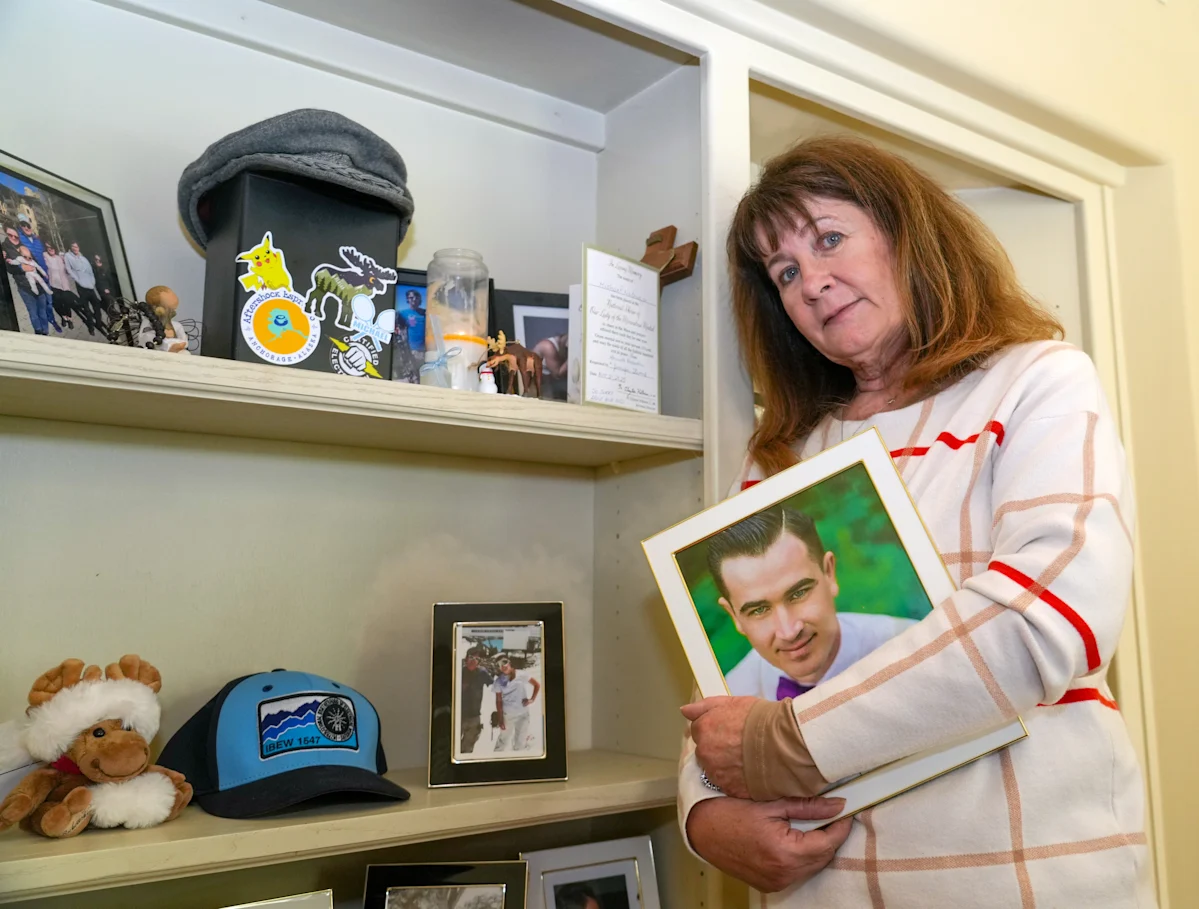
Nearly two decades after Michael Nalewaja, 36, was sent to rehab for drug addiction as a teenager, he was living a quiet life as an electrician in Alaska.
It all came crashing down days before Thanksgiving 2025, when he and a mutual friend unknowingly took a deadly cocktail of fentanyl and carfentanil, which they may have mistaken for cocaine.
“I heard the word ‘autopsy,’ and I literally dropped to the floor,” his mother, Kelley Nalewaja, said, recalling receiving the call from her wife. “Even if someone had naloxone ready, even if someone called 911 in time, he wouldn’t have survived.”
Carfentanil, a weapons-grade chemical that authorities say is 10,000 times more potent than morphine and 100 times more potent than fentanyl, has made a dramatic comeback across the United States, killing hundreds of unsuspecting drug users.
The increase coincides with the Chinese government’s recent crackdown on the sale of precursors used to make fentanyl. The regulations could prompt drug traffickers in Mexico to use carfentanil to enhance the potency of a weakened version of fentanyl, according to a U.S. Drug Enforcement Administration intelligence bulletin reviewed by The Associated Press.
A surge in the deadly drug, in which doses less than the size of a poppy seed can kill, comes as fentanyl seizures and overall overdose deaths continue to decline for years.
“You’re talking about something that wouldn’t even take a grain of salt to potentially be fatal,” said Frank Tarentino, chief of operations for the U.S. Drug Enforcement Administration’s Northeast Region, which stretches from Maine to Virginia. “That’s an extremely scary proposition for people with substance abuse dependence who are seeking opioids on the streets today.”
carfentanil surge
Carfentanil exploded into the North American drug supply a decade ago, causing hundreds of unsuspecting drug users to overdose, but its sales plummeted after China banned its use, closing a key regulatory loophole in the United States
But things have changed dramatically in recent years.
DEA laboratories found carfentanil 1,400 times in drug seizures in the United States in 2025, compared with 145 times in 2023 and just 54 times in 2022, according to DEA records reviewed by The Associated Press.
Authorities say drug traffickers in Mexico may be trying to produce carfentanil themselves, while other traffickers may be sourcing the drug from Chinese suppliers, bypassing that country’s regulations and advertising the drug in online forums in other countries.
Tarantino said the cartel’s situation was further complicated by the extreme dangers posed by carfentanil manufacturing.
“You can’t just dip your toe into this,” he said. “This isn’t some mad scientist on Reddit where you go to a shabby lab in Mexico and make carfentanil.”
Overdose deaths and fentanyl seizures drop
Drug overdose deaths in the United States have been declining for more than two consecutive years — the longest decline in decades. Experts point to several possible explanations, including wider use of the overdose reversal drug naloxone and the expansion of addiction treatment. Some have also linked it to regulatory reforms that the United States is urging China to undertake.
When it comes to carfentanil, even multiple high doses of naloxone may not be enough to reverse an overdose, experts say.
Seizures of fentanyl, along with several other illegal drugs, also declined. U.S. Customs and Border Protection reported that fentanyl seizures plummeted to about 12,000 pounds (5,443 kilograms) in 2025, less than half the amount seized in 2023.
But even as fentanyl levels decline, it remains a major concern for the U.S. Drug Enforcement Administration. Just recently, the agency’s proposed budget included a $362 million increase focused on cartel-driven fentanyl trafficking.
“Anyone who takes drugs that are not prescribed by their doctor is playing Russian roulette with their lives,” said Sara Carter, President Donald Trump’s drug czar. “But if those terrorists think they can continue this chemical warfare without consequences, they are wrong.”
Researched as a chemical weapon
Although carfentanil’s popularity still pales in comparison to fentanyl, experts are alarmed by the rise in a substance that has been studied for years as a chemical weapon and was used by Russian forces against Chechen separatists in 2002.
The DEA’s annual quota for legally produced carfentanil, which veterinarians use to tranquilize elephants and other large animals, is just 20 grams, an amount that could fit in the palm of the hand.
“It’s like a biological weapon,” said Michael King, founder of the Opioid Awareness Foundation. “If the world thinks we have a problem with fentanyl, that’s nothing compared to the problem we’re going to be dealing with with carfentanil.”
The number of carfentanil overdose deaths nearly tripled in 2024 from the previous year, with 413 deaths in 42 states and Washington, D.C., according to the latest data provided by the Centers for Disease Control and Prevention.
“Carfentanil definitely has the potential to spread in the United States unless law enforcement really pays attention to carfentanil and has intelligence on how these drug users obtain it,” said Mike Vigil, former chief of international operations for the U.S. Drug Enforcement Administration.
The U.S. Drug Enforcement Administration has documented several large seizures of carfentanil in recent months. In October, the DEA’s Los Angeles Field Division discovered 628,000 pills containing carfentanil, and in September, officials seized more than 50,000 counterfeit M30 pills from a person at a gas station in Washington state, who turned out to be a mixture of carfentanil and acetaminophen.
“It’s all about money”
In some cases, people who regularly use drugs have developed a tolerance to fentanyl and begin seeking carfentanil, despite the dangers, because of the sudden euphoria it can bring, explained Rob Tanguay, senior medical director of detoxification services at the Alberta Rehabilitation Institute in Canada. It is attractive to the pharmaceutical market because it is rarely available for supply, he said.
“The hardest part of all this,” he said, “is that it’s all about money.”
After Michael Nalewaja died, his mother decided not to have a large funeral.
Instead, she organized a town hall in her hometown of El Dorado Hills, California, bringing together local officials and mothers who had been through similar things.
She grieves the loss of her son, a charismatic and skilled salesman who recently won a national award from the Electrical Union, and she is pushing for major legislative and judicial reform so that others don’t have to go through what she did because of a drug she says was never fit for humans.
“It wasn’t an overdose, it wasn’t an overdose,” she said. “This is the murder weapon.”
___
Associated Press writer Joshua Goodman in Miami contributed.

