Author: Parisa Hafeez and Alexander Cornwell
DUBAI/TEL AVIV (Reuters) – Iran’s military command said on Wednesday that the world should prepare for oil prices to rise to $200 a barrel as three more ships were attacked in the blockaded Gulf.
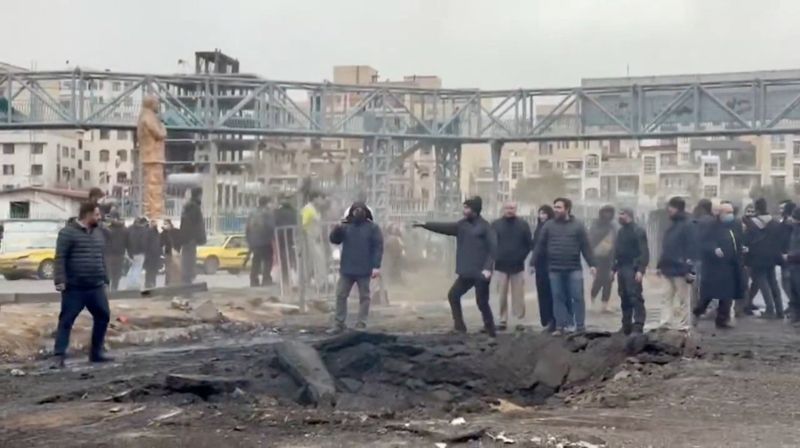
Iran opened fire on targets in Israel and across the Middle East on Wednesday, demonstrating that it can still strike back and disrupt energy supplies despite what the Pentagon said was the most violent U.S.-Israeli attack yet.
Oil prices, which surged earlier this week, have retreated and stocks have rebounded, with investors now betting that U.S. President Donald Trump will find a quick way to end the war he started with Israel nearly two weeks ago.
But so far, there has been no relief on the ground and no sign that ships can safely sail through the Strait of Hormuz. A fifth of the world’s oil is blocked behind a narrow channel off the coast of Iran, in the worst disruption to energy supplies since the oil crisis of the 1970s.
Ebrahim Zolfaqari, spokesman for Iran’s military command, said in comments to the United States, “Be prepared for oil prices to rise to $200 per barrel, because oil prices depend on how much regional security you undermine.”
After an overnight attack on a bank office in Tehran, Zolfakari also said Iran would respond by launching attacks against banks that do business with the United States or Israel. He added that people in the Middle East should stay 1,000 meters away from banks.
A senior Israeli official told Reuters that Israeli leaders now privately acknowledge that Iran’s ruling system can survive a war. Two other Israeli officials said there was no sign that Washington was close to ending the campaign.
Iranian official says Mojtaba Khamenei was ‘slightly injured’
In the latest public revolt, Iranians took to the streets in large numbers on Wednesday to hold funerals for senior commanders killed in air strikes. They carried the coffin and waved flags and portraits of slain supreme leader Ayatollah Ali Khamenei and his son and successor Mojtaba.
An Iranian official told Reuters that Mojtaba Khamenei was slightly injured early in the war when air strikes killed his father, mother, wife and a son. He has not made any public appearances or sent any direct messages since the war began.
One source also said Israel believed he suffered minor injuries.
Iran’s military said on Tuesday it had fired missiles at U.S. bases in northern Iraq, the U.S. Navy’s Middle East headquarters in Bahrain and targets in central Israel. An explosion occurred in Bahrain and four people were injured when two drones crashed near Dubai airport.
Bahrain’s Ministry of Civil Aviation said on Wednesday that several Gulf Air planes without passengers and some cargo planes had been diverted to other airports to “ensure the continuity and efficiency of air operations during the crisis”.
In Tehran, residents say they have grown accustomed to nighttime airstrikes that have sent hundreds of thousands fleeing to the countryside and polluted the city with black rain from oil smoke.
“There was a bombing last night, but I’m not as scared as before. Life goes on,” Farshed, 52, told Reuters by phone.
IEA proposes massive release of oil reserves
Three more merchant ships were hit by unknown shells in the Gulf, bringing the number of ships reported to have been hit since the war began to 14, according to the maritime security monitoring agency.
Crew members evacuated from a Thai-flagged bulk carrier after an explosion caused a fire. A Japanese-flagged container ship and a Marshall Islands-flagged bulk carrier were also damaged.
Oil prices briefly surged to nearly $120 a barrel on Monday and have since stabilized around $90, a sign of investors’ bets that Trump will be able to stop the war and reopen the strait soon.
But governments are still discussing taking drastic action. The International Energy Agency is expected to recommend releasing 400 million barrels of oil from global strategic reserves, a record high.
This will take several months, equivalent to just three weeks to transit the strait.
Israel says campaign has no time limit
U.S. and Israeli officials say their goal is to end Iran’s ability to project force beyond its borders and destroy its nuclear program, even as they also invite the Iranians to overthrow the country’s religious rulers.
Israeli Defense Minister Israel Katz said on Wednesday that the operation “will continue as long as necessary, without any time limit, until we achieve all our objectives and win the campaign.”
But the longer the war drags on, the greater the risks to the global economy, and if Iran’s clerical system survives the end of the war, Tehran will surely declare victory.
Iran’s police chief Ahmedreza bin Laden said on Wednesday that anyone taking to the streets would be considered “an enemy, not a protester. All our security forces have their hands on the trigger.”
Iran has said it will not let oil pass through the strait and will not enter into negotiations until U.S.-Israeli attacks cease. Trump has threatened to hit Iran “twenty times harder” if it blocks the strait, but U.S. officials have yet to reveal any military plans to lift the blockade.
In Israel, an explosion occurred when an air defense system intercepted a missile before dawn. Sirens sent Israelis to shelters.
Israel has also launched an onslaught on Beirut aimed at rooting out the Iran-backed Hezbollah group, which has fired on Israel from Lebanon in solidarity with Tehran.
Amir Saeid Iravani, Iran’s ambassador to the United Nations, said more than 1,300 Iranian civilians have been killed since U.S. and Israeli airstrikes began on February 28. Israeli attacks in Lebanon also killed dozens.
Iran’s attacks on Israel have killed at least 11 people, including the death of two Israeli soldiers in Lebanon. Washington said seven U.S. soldiers were killed and about 140 wounded.
(Reporting by Parisa Hafezi in Dubai, Alexander Cornwell in Tel Aviv and Reuters; Writing by Peter Graff; Editing by Sharon Singleton and Alex Richardson)