Alexander Cornwell
JERUSALEM (Reuters) – The United Arab Emirates has drafted plans to build a compound to house thousands of displaced Palestinians in parts of southern Gaza under Israeli military control, according to maps seen by Reuters and people familiar with the plan.
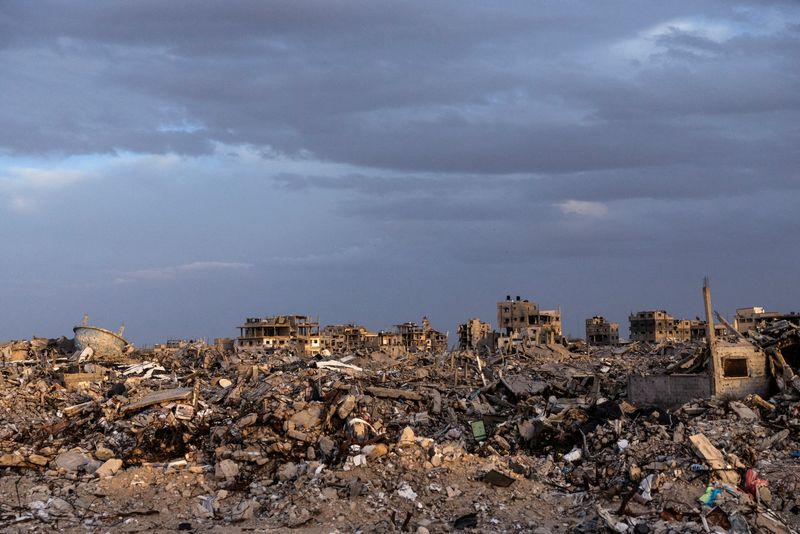
Planning maps show the “Emirates Temporary Housing Complex” to be built near Rafah, once a city of 250,000 people but now almost completely destroyed and depopulated by Israeli forces.
Rafah is close to the Egyptian border, where Gaza reconstruction is expected to begin under U.S. President Donald Trump’s plan to achieve lasting peace in the densely populated coastal enclave after two years of devastating war.
Donors have been reluctant to fund the plan, fearing disagreements over disarming Hamas militants could lead to a slide back into all-out conflict.
However, diplomats say there are doubts about the political viability of the UAE project because most Palestinians may be reluctant to be resettled in Israeli-controlled areas, while the vast majority of civilians live in Hamas-controlled Gaza.
Trump’s plan is to establish a U.S.-led multinational mission to Gaza in southern Israel, where Emirati officials shared details of their plans to build temporary housing and provide basic services in Rafah, four diplomats briefed on the initiative said.
Maps show that Emirati housing will be located near the “yellow line” agreed in the October ceasefire agreement to divide areas controlled by Israel and Hamas.
In response to questions for this article, an Emirati official said the Gulf state “remains committed to expanding humanitarian efforts to support Palestinians in Gaza” but did not confirm or deny plans to build temporary housing.
“Kill Hamas”
The Israeli military has cleared a large area from the Mediterranean coast to Rafah for temporary housing projects like the one being planned in the United Arab Emirates, a diplomat said.
Diplomats say the UAE initiative is similar to a U.S. proposal to build temporary housing for Palestinians in Gaza, still under Israeli control. U.S. officials initially described their plans as “alternative security communities,” and more recently as “planned communities,” diplomats said.
A U.S. official said the UAE is coordinating its housing plans with Washington, the Peace Council, the new global body set up by President Donald Trump to resolve the conflict, and the U.S.-backed Palestinian council that governs Gaza.
“We continue to be impressed by the UAE’s efforts to bring a better life to the people of Gaza,” the official said.
U.S. officials hope that building housing in Israeli-controlled areas will provide impetus for Hamas to disarm, encourage Gazans to leave Hamas-controlled areas and deprive the Islamist group of its civilian population.
Kenneth Katzman, a Middle East expert at the Soufan Center, a U.S.-based security-focused think tank, said the Alternative Security Communities were designed to gradually “contain Hamas” but that for them to be effective they would have to be built on a massive scale to house hundreds of thousands of Palestinians.
“Just a few housing projects are not going to defeat Hamas. You need to do a lot… to have an effect,” he said.
Skepticism about numbers
The UAE, which established diplomatic ties with Israel in 2020 under a Trump-brokered deal, views Hamas and other political Islamist groups as a threat to Middle East stability.
Four diplomats doubted whether Palestinians would move in large numbers to areas under Israeli control and questioned whether the proposals risked the permanent division of Gaza.
But diplomats said that unlike the U.S. initiative, the Emiratis identified a site where there had been no homes previously.
The Israeli military controls about 53% of Gaza, including the ruins of the southernmost city of Rafah. Hamas controls the rest of the territory, and nearly all of Gaza’s 2 million Palestinians live in crowded tent camps and the ruins of destroyed neighborhoods.
Foreign diplomats and aid workers say humanitarian aid and shelter should be targeted at more populous areas. Diplomats say some 20,000 Palestinians are believed to live in Gaza under Israeli military control.
(Reporting by Alexander Cornwell; Editing by Rami Ayoub and Mark Heinrich)

