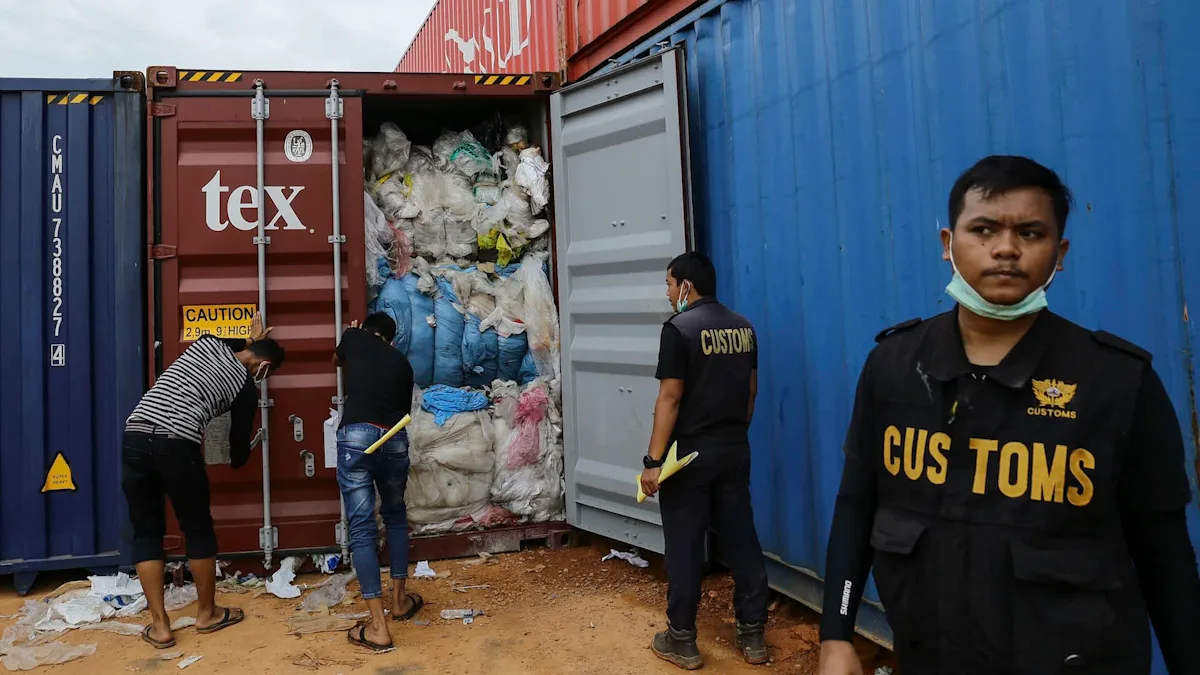
Indonesia is cracking down on imports of dangerous, unwanted goods from the United States and has officially begun sending them back, the South China Morning Post reported.
What happened?
Officials in the port city of Batam recently shipped four containers of banned electronic waste back to the United States
Four containers is not much, but Indonesian officials stressed that the shipment was just the tip of the iceberg.
According to the South China Morning Post, customs staff and inspectors from Indonesia’s Ministry of Environment and Forestry discovered an unknown quantity of cargo in September that was “allegedly misdeclared as recyclable material.”
In fact, these containers contained hazardous electronic waste. The discovery prompted Environment Minister Hanif Faisol Nurofiq to issue a statement on October 3.
“The government will not tolerate attempts to turn Indonesia into an illegal overseas waste dumping ground or processing site,” Hanif vowed, according to the South China Morning Post.
Port officials said the containers, which contained computer parts, disks and circuit boards, represented only a “small portion” of the illegally imported waste. The Washington Post cited local media reports that more than 900 containers had been marked for review.
According to the South China Morning Post, “dozens” of containers have so far been inspected and “confirmed to contain illegal electronic waste.” Zaky Firmansyah, head of Batam Customs, said all imported e-waste will be shipped back to its country of origin, the first four being the United States.
“All containers carrying hazardous and toxic waste must be re-exported. There is no other option,” Fairmancia said.
Why is this concerning?
Rich countries have long exported their worst waste, especially e-waste and plastics, in an “out of sight, out of mind” consumption style.
In 2018, China, which has long imported waste for manufacturing, banned the import of 24 categories of waste, including plastics.
In 2022, Earth.org reported that the ban had “immediate and widespread impacts, causing huge problems for the global recycling industry,” resulting in the displacement of millions of tons of plastic waste. As a result, the overflow cargo was diverted to other countries in Southeast Asia, triggering more import bans.
Although at first glance the problem may appear to be a logistical one, overconsumption and increasing amounts of hazardous waste are the underlying issues.
An October 2024 briefing from the World Health Organization warned that e-waste is one of the world’s “fastest growing solid waste streams”, with 62 million tonnes set to be generated by 2022. Less than 22.3% of waste is “formally collected and recycled.”
E-waste often contains toxic compounds, industrial chemicals and harmful heavy metals, and the public is often unaware that it must be properly disposed of. As a result, hazardous e-waste is often mixed with household waste and sent to landfills.
Landfilled e-waste contaminates soil, air and groundwater by leaching these materials into them.
In addition, single-use e-waste such as disposable e-cigarettes can be volatile, and lithium-ion batteries can cause fires in garbage trucks and waste treatment facilities.
What measures are being taken?
In October, Hanif warned that Indonesia intended to prosecute offenders despite enforcement challenges.
On a personal level, knowing how to properly dispose of waste, especially e-waste, can help curb the risks it poses to the planet and its inhabitants.
Get TCD’s free newsletter for simple tips to save more, reduce waste and make smarter choices, and earn up to $5,000 toward clean upgrades in TCD’s exclusive Rewards Club.

