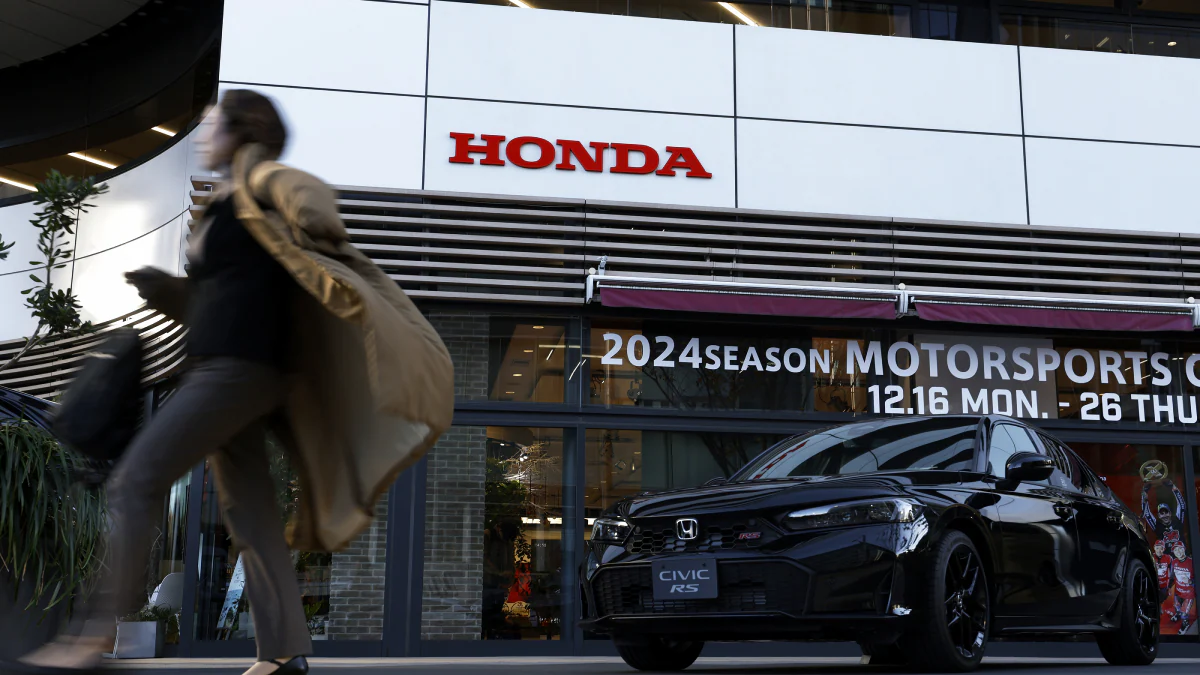
Honda Motor Co has drawn up a long-running deal that would amount to a takeover of Nissan Motor Co as the Japanese automaker struggles to keep pace with an increasingly competitive global auto industry.
The two companies announced a tentative agreement on Monday to form a joint holding company with plans to list in August 2026. While their executives are calling the deal a merger, Honda will take the lead in forming the new entity and nominate a majority of its directors. Nissan’s partner Mitsubishi Motors may also be involved in the deal.
Nissan shares fell 7.3% when trading opened in Tokyo on Tuesday. Honda rose 14.4%.
“On the face of it, this is an acquisition,” said Neal Ganguli, a partner and managing director in the automotive and industrial practice at consulting firm AlixPartners. “There are definitely advantages to scale and people have to take note of that.”
Honda and Nissan have both struggled to compete with rising domestic automakers in China, which overtook Japan last year to become the world’s largest auto exporter and is on pace to move further ahead by 2024. Honda CEO Mibe Toshihiro Mibe told a news conference that they aim to remain competitive by 2030, speaking of the level of difficulty the companies face.
“If a deal is reached in 2025, it will take some time for Honda and Nissan’s merger synergies to emerge,” Tatsuo Yoshida, senior industry analyst at Bloomberg Intelligence, said in a report. “Nissan’s financial pressure may be relieved, while Honda’s short-term gains may be limited.”
Honda did do some good for its shareholders, announcing plans to buy back up to 1.1 trillion yen ($7 billion, approximately Rs. 59,632 crore) in stock by this time next year. Buybacks are capped at 24% of outstanding shares.
Honda’s rescue would prevent Nissan and Mitsubishi Motors, whose conditions have worsened since the arrest of former chairman Carlos Ghosn in November 2018, from falling into full-blown disaster. Ghosn fled Japan for Lebanon more than a year after Nissan accused its longtime leader of financial misconduct.
Ghosn, 70, denies all charges and accuses Nissan of defaming him.
Mitsubishi Motors, in which Nissan holds a 24.5% stake, signed a preliminary agreement with Honda to explore joining the deal and said it expected to finalize the decision by the end of January.
Honda shares closed up 3.8% in Tokyo on Monday, recouping most of their losses since deal talks were first reported last week. Shares of Nissan Motor and Mitsubishi Motors rose 1.6% and 5.3% respectively.
A merger of the three companies would create one of the world’s largest carmakers, although the group would still be smaller than Japan’s Toyota Motor Corp. Joining forces could also strengthen their efforts to fend off Chinese manufacturers led by BYD, now one of the world’s leading electric car makers.
France’s Renault, Nissan’s largest shareholder, acknowledged its long-time alliance partner’s announcement and said talks with Honda were still in the early stages.
Renault, which owns 36% of Nissan, also said in a statement that it would consider all options and continue to execute its strategy, which includes joint projects with Nissan.
Honda CEO Mibe said the merger with Nissan would bring billions of yen in incremental operating profits, but he did not provide a timetable. The 63-year-old executive also did not address how the company would handle pressing issues such as closing factories.
“Both companies will continue as wholly-owned subsidiaries of the joint holding company and retain their respective brands,” Mibe said.
Honda’s share buyback replaces a previously announced plan to buy back 100 billion yen worth of shares from November 7 this year to October 2025. The massive buyback is being initiated now because Honda’s ability to repurchase stock is expected to be limited ahead of a deal the company plans to complete in 2026.
Nissan has declined in the years since Ghosn’s ouster, losing its status as an early contender in the transition to all-electric vehicles.
In China, the rapid popularity of locally made electric vehicles has left some foreign brands struggling to survive. Honda and Nissan have both had to cut staff and production, while Mitsubishi Motors has all but exited the world’s largest car market.
As gasoline-electric hybrids gain popularity again in the U.S., Nissan is in trouble. While Toyota dominates the powertrain segment, Honda is relatively well positioned to provide a welcome boost.
Falling sales in the United States and China have been devastating for Nissan, causing the company to lay off thousands of workers, cut production capacity and cut its annual profit forecast by 70%.
“Partnering with Honda does not mean we give up on our plan to turn around Nissan,” Nissan Chief Executive Makoto Uchida said on Monday.
Nissan was rescued from the last financial crisis more than two decades ago when Renault suddenly stepped in, injected cash and sent Ghosn to engineer a turnaround. The exiled executive, who was involved in deal talks in Beirut, told Bloomberg Television last week that Nissan was in “panic mode.”
Ghosn told the Foreign Correspondents’ Club of Japan via a conference call on Monday that Nissan’s sales have fallen by more than 40% since 2018, with the automaker barely breaking even.
Nissan’s Uchida and Honda’s Mibe said they knew nothing about Taiwanese iPhone maker Foxconn’s interest in acquiring Nissan.
Foxconn sent a delegation to France to meet with Renault, people familiar with the matter said last week. However, one person said Foxconn has shelved its interest in acquiring Nissan while negotiations with Honda are ongoing.
© 2024 Bloomberg
(This story has not been edited by NDTV staff and is auto-generated from a syndicated feed.)

