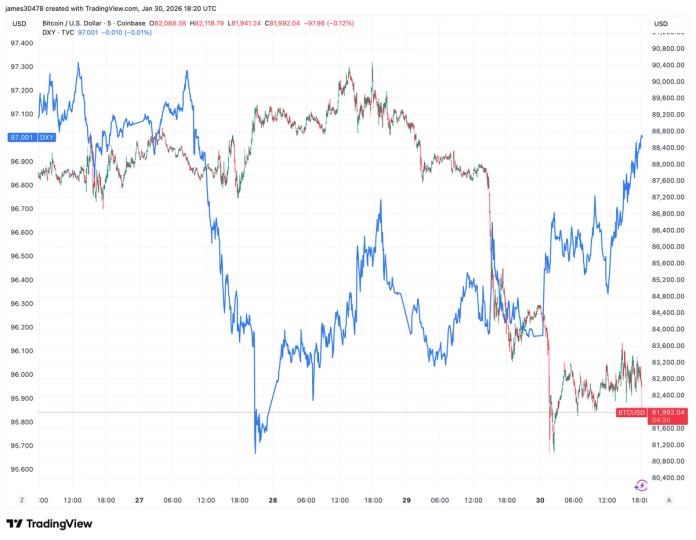
Bitcoin’s The sell-off later this week may have less to do with cryptocurrency-specific factors and more to do with the U.S. dollar.
After a regular weekend decline in cryptocurrency prices, Bitcoin actually rose throughout the week, in part due to an accelerated decline in the U.S. dollar.
Bitcoin reached its peak for the week late Wednesday afternoon just below $91,000, as the Federal Reserve kept interest rates steady and attention turned to who President Trump might nominate as the next leader of the Fed.
The peak coincided with the U.S. Dollar Index (DXY) falling to a multi-year low of 95.34. All else being equal, a weaker U.S. dollar is generally seen as supportive of the prices of assets such as Bitcoin, stocks and commodities.
While technicians sounded the alarm that a DXY break below 96 would mean further losses for the dollar, the market saw otherwise. The U.S. dollar began a steady climb, and at the same time, Bitcoin also began to retreat from the $91,000 level.
The U.S. dollar continued to strengthen on Thursday, and Bitcoin’s losses accelerated throughout the session. Finally, the leaked news late on Thursday that Kevin Warsh (and his hawkish reputation) would be nominated to serve as Fed Chair forced the dollar to surge again, and Bitcoin gapped lower, with Bitcoin eventually bottoming at $81,000.
Bitcoin has since managed to rebound to $83,000, but the dollar has continued to rise, raising questions about the sustainability of the cryptocurrency’s rise.

