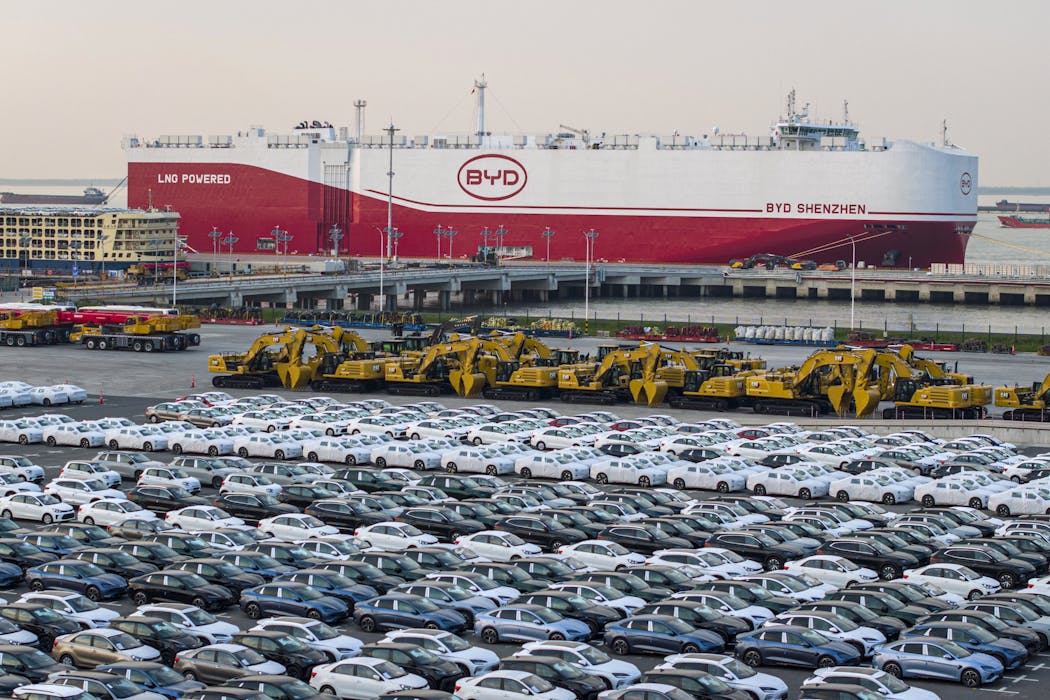
BYD electric vehicles wait at a Chinese port to be loaded onto the BYD Shenzhen car carrier, which is scheduled to sail to Brazil. STR/AFP (Getty Images)
By 2025, a quarter of new cars sold globally are expected to be electric – either pure electric or plug-in hybrid.
That’s up significantly from five years ago, when electric vehicles accounted for less than one-twentieth of new car sales, according to the International Energy Agency, an intergovernmental organization that reviews global energy use.
In the United States, however, electric vehicle sales are lagging, accounting for only one in ten by 2024. By comparison, in China, the world’s largest auto market, electric vehicles account for more than half of all new car sales.
The International Energy Agency reports that two-thirds of all-electric vehicles in China are now cheaper than gasoline vehicles. Electric vehicles are attractive because operating and maintenance costs are already cheaper than gasoline models.
Most electric cars purchased in China are also made in China by a range of different companies. NIO, Xpeng, Xiaomi, Zeekr, Geely, Chery, Great Wall Motors, Leapmotor, and especially BYD are household names in China. As someone who has been covering and publishing on the subject of electric vehicles for over 15 years, I expect that electric vehicles will soon become more widely known in other parts of the world.
Chinese automakers are producing a full range of electric vehicles, from subcompacts like the BYD Seagull to full-size SUVs like the Xpeng G9, and luxury cars like the Zeekr 009.
Recent European crash test assessments have given Chinese electric vehicles top safety ratings, and many of them cost less than similar models made by other companies in other countries.
There are several factors contributing to the success of Chinese companies in producing and selling electric vehicles. Granted, relatively low labor costs are part of the reason. So do generous government subsidies, as electric vehicles are one of several advanced technologies chosen by the Chinese government to boost the country’s global technological standing.
But Chinese electric carmakers are making other progress, too. They make extensive use of industrial robots and have even built so-called “dark factories” that can run with minimal human intervention. For passengers, they redesigned the vehicle’s interior with large touch screens for information and entertainment, and even added refrigerators, beds or karaoke systems.
Competition among Chinese electric vehicle manufacturers is fierce, which is driving more innovation. BYD is the largest seller of electric vehicles in China and the world. However, the company says it employs more than 100,000 scientists and engineers and strives for continuous improvement.
According to Reuters, it took BYD 18 months from the initial concept model to the actual rollout of a factory-built car, half the length of the product development process for U.S. and other global automakers.
BYD is also the world’s second-largest seller of electric vehicle batteries and has developed a new battery that charges in just five minutes, about the time it takes to refuel a gasoline-powered car.
The base model of the Xpeng M03 is priced at approximately US$17,000 and will be displayed at the Shanghai Auto Show in April 2025. VCG/VCG via Getty Images
The real test of Chinese cars’ appeal to consumers will come from export sales. Chinese electric carmakers are eager to sell overseas because their factories can churn out far more cars a year than the 25 million they sell in China, perhaps twice as many.
China already exports more cars than any other country, although now they are mostly gasoline-powered vehicles. The export market for China’s electric vehicles is developing in Western Europe, Southeast Asia, Latin America, Australia and other places.
The largest sales market for Chinese cars, both gasoline and electric, is North America. The U.S. and Canadian governments have imposed 100% tariffs on Chinese electric vehicle imports, creating what some call a “tariff fortress” to protect their domestic automakers, effectively doubling the cost for consumers.
The client’s budget is also important. The average price of a new electric car in the United States is about $55,000. Less expensive vehicles make up a portion of this average price, but without the tax credit (which the Trump administration will eliminate after September 2025), no vehicle will come close to $25,000. In contrast, several electric vehicles produced by Chinese companies priced under $25,000, including the Xpeng M03, BYD Dolphin and MG4, do not receive tax credits. However, if sold in the United States, a 100% tariff would eliminate the price advantage.
Tesla, Ford and General Motors all claim they are developing affordable electric vehicles. However, more expensive vehicles generate higher profits, and with the protection of the “tariff bastion”, their incentive to develop cheaper electric vehicles is not as high as imagined.
In the 1970s and 1980s, the United States strongly opposed the import of Japanese cars. But eventually, a combination of consumer sentiment and Japanese companies’ willingness to open factories in the United States overcame this opposition, and Japanese brands like Toyota, Honda and Nissan are a common sight on North American roads. Chinese automakers may go through the same process, although it’s unclear how long that might take.
This article is republished from The Conversation, a nonprofit, independent news organization that provides you with facts and trustworthy analysis to help you understand our complex world. Author: Jack Barkenbus, Vanderbilt University
Read more:
Jack Barkenbus does not work for, consult, own shares in, or receive funding from any company or organization that would benefit from this article, and has disclosed no relevant relationships beyond his academic appointment.
 BYD electric vehicles wait at a Chinese port to be loaded onto the BYD Shenzhen car carrier, which is scheduled to sail to Brazil. STR/AFP (Getty Images)