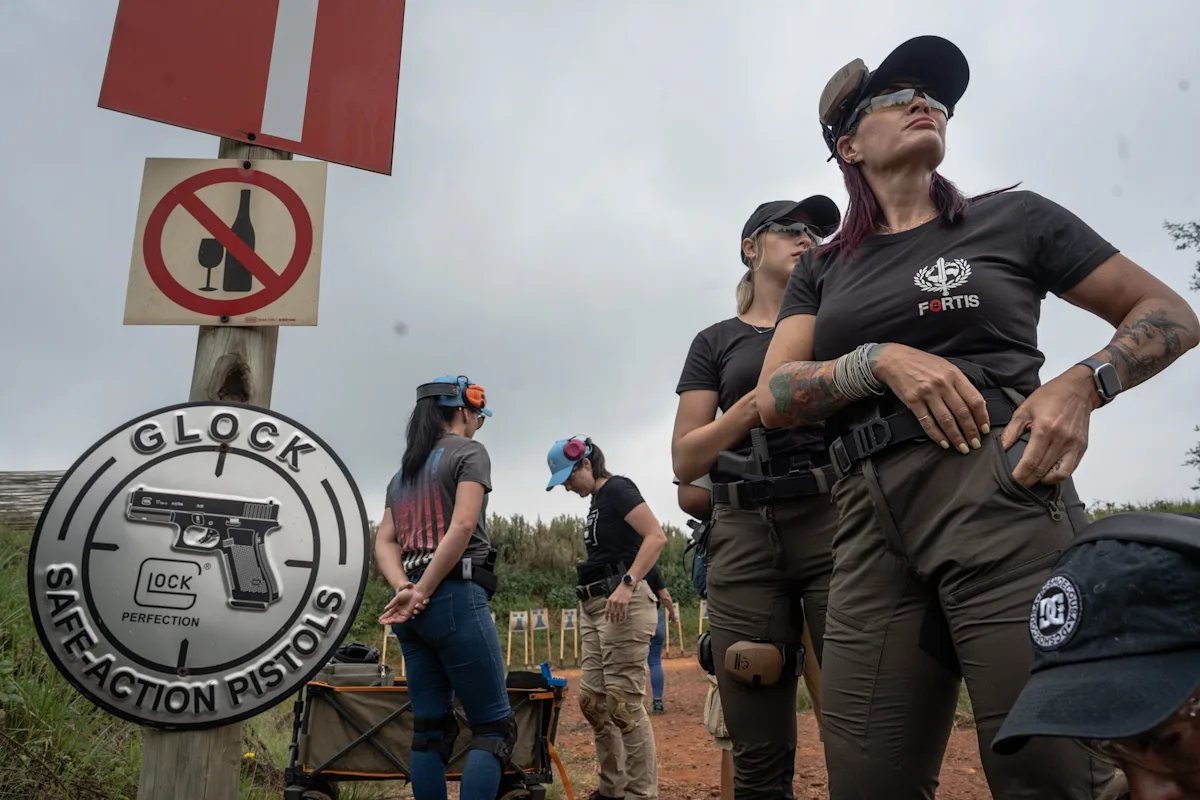
BLUMHOSTERSPRT, South Africa (AP) — At a shooting range in Blomhorstspruit, a farming town outside South Africa’s capital Pretoria, a group of girls and women, some wearing pink ear protection, received firearms training while firing five rounds from a 9 mm pistol at a target under the command of a female instructor.
The minimum age of the group is 13 years old and the maximum age is 65 years old. They are looking for ways to protect themselves in a country where gender-based violence is so serious that the government declared it a national disaster in November.
“Check your grip, check your sight,” yells Claire van der Westhuizen, the lead female instructor at the Lone Operator Range, as the woman with manicured nails reloads for another round.
Designed specifically for women, the training course provides practice in real-life scenarios such as self-defense shooting while prone and supine.
South Africa has the highest rate of femicide in the world, according to UN Women, the United Nations agency that promotes gender equality. A 2022 South African study found that more than 35% of South African women aged 18 and over had experienced physical or sexual violence at some point. In most cases, the perpetrator is an intimate partner.
Join Supporting Families
Sunette du Toit, a 51-year-old working grandmother, told The Associated Press that she survived a burglary in which five men tied her up and ransacked her house, forcing her to undergo firearms training.
“I couldn’t defend myself at the time,” Du Toit said. “I had to do this (firearms training) for myself to regain the confidence to be able to move around in public and even in my own home without feeling vulnerable.”
She called the women’s firearms training group “a supportive family.”
Firearms in South Africa are strictly regulated. Anyone who wants to own a firearm for self-defense must be 21 years or older and pass a proficiency test and a background check.
Various self-defense training programs for women are popping up across the country.
In Johannesburg, South Africa’s largest city, Tatiana Leyka, 33, started practicing jiu-jitsu for self-defense, aware of South Africa’s reputation.
“I think that’s the No. 1 priority,” she said at the end of Saturday morning’s class, which included escaping suffocation, avoiding being trapped in walls and other actions to help women escape male attacks. “With the amount of gender-based violence on the rise, it’s good for you to be able to protect yourself, even if it’s just to escape.”
Violence against women is a national disaster
According to UN Women, South Africa’s femicide rate is five to six times higher than the global average.
Mpiwa Mangwiro-Tsanga, policy development and advocacy manager at women’s rights organization Sonke Gender Justice, said statistics showed about 15 women were killed every day in South Africa due to gender-based violence. One in three women has been sexually abused or harassed.
“That’s how bad it is,” she said. “We are competing with countries in conflict.”
After years of pressure from women’s rights groups, South Africa’s President Cyril Ramaphosa has declared violence against women and girls a national scourge. They cited socioeconomic inequality, strong patriarchal attitudes and under-resourced police forces as factors.
“Sadly, our country is one of the worst in the world for violence against women and girls,” Ramaphosa said in a statement announcing “national action”.
The announcement means authorities can direct funds towards tackling the problem, but campaigners point to decades of high rates of gender-based violence and a national strategic plan announced six years ago that has yet to address the issue as evidence of a disconnect between policy and implementation.
Mangwiro-Tanga said the lack of women’s shelters and other safe spaces showed that South Africa’s policies were progressive on paper but poorly implemented.
“The reality in South Africa is that men who rape women are arrested and jailed. The country spends more money on rapists than on rape survivors,” she said.
South Africa has a very low rape conviction rate, with only about 8% of rape cases reported in 2021 resulting in a conviction. According to Amnesty International, many cases are withdrawn from the criminal justice system, while most are never prosecuted.
Women take their safety into their own hands
Despite assurances from authorities of renewed action, South African women are taking measures of their own, even if it means keeping their training secret from partners and husbands.
Jiu-jitsu gym manager Michael Palin said not all female partners were aware they were training. Someone said they were going to the mall in front of the gym.
Marguerite Hershensohn, a 49-year-old beauty therapist, attended firearms classes with her 21-year-old daughter Nika. Hershenson said she’s relieved her daughter is learning to protect herself with a gun instead of always relying on police.
“Yes, we have to respect these authorities,” she said. “But they’re not always around.”
The women who participated in the training “didn’t look like G.I. Jane,” Hershenson said. “We look like regular women.”
But Mangwiro-Tanga warned that the tendency for women to resort to guns or martial arts could also be problematic when society fails to protect them. “Instead of engaging the perpetrators, this puts a burden on women and girls who are already carrying a heavy burden,” she said.
Jiu-jitsu class instructor Stephanie Graham said that while many women gain confidence in her classes, there’s no guarantee they’ll always be able to protect themselves.
“We can only hope that it gives us more confidence and greater awareness so that we can detect threats earlier than the average person,” Graham said.
___
For more information on Africa and development: https://apnews.com/hub/africa-pulse
The Associated Press receives financial support from the Gates Foundation for coverage of global health and development in Africa. The Associated Press is solely responsible for all content. Find AP’s criteria for working with charities, supporter lists and grant coverage at AP.org.

