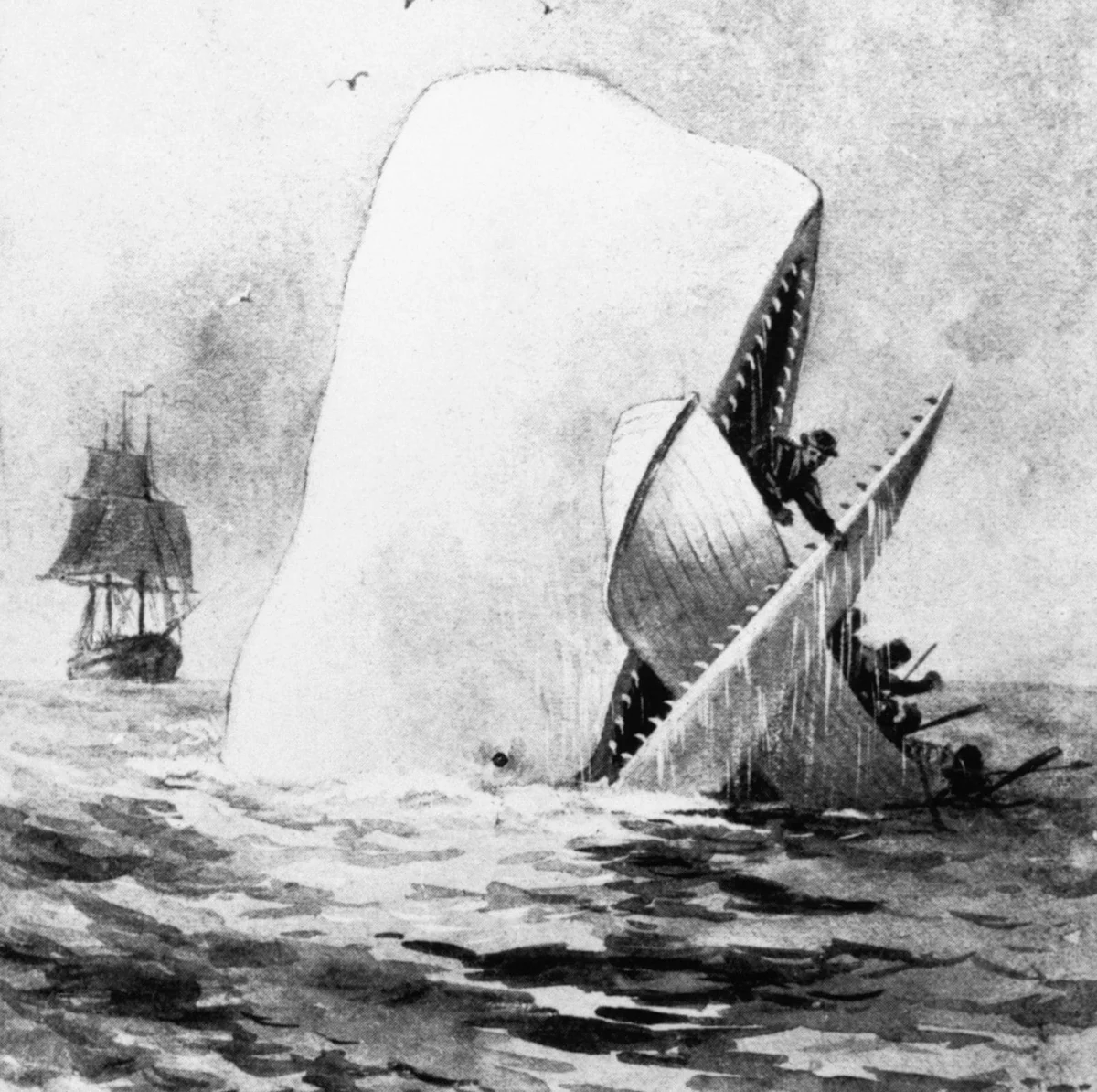
A whale ramming its head into a ship was captured on camera for the first time, and 200 years ago a mammal attacked a ship in the same way, inspiring the novel Moby Dick.
So far, there is only anecdotal evidence that sperm whales use their heads to push and hit objects.
Researchers from the University of St. Andrews finally captured the behavior on video after using drones to film the creatures in the sea around the Azores and Balearic Islands between 2020 and 2022.
The findings, published in the journal Marine Mammal Science, also reveal how young whales engage in head-butting, rather than between larger males as previously thought.
Herman Melville’s novel is said to have been inspired by an attack on the whaling ship Essex in 1820. The whaling ship suffered two frontal attacks in the waters near the Galapagos Islands.
The 27-meter-long sailing ship was destroyed in the attack. Only a handful of the crew survived and were rescued months later.

Moby-Dick, described in the novel as “the white whale,” destroys the Pequod and kills nearly the entire crew by the end of the story – A. Burnham Shute/Bettmann
The event attracted widespread attention at the time, and Melville drew on it when writing Moby-Dick, in which the eponymous white whale attacks and sinks the Pequod whaling ship.
Owen Chase, the Essex’s first mate and one of the few survivors, described the attack after his rescue.
He said: “I turned around and saw he had about a hundred strokes [approximately 500 metres] Directly in front of us, descending at twice its normal speed (about 24 knots), its appearance was ten times more angry and vengeful.
“Swells were coming from all directions around him and his tail was beating hard. His head was about half out of the water and that’s when he came towards us and hit the boat again.”

Color engraving of the crew of the whaling ship Superior fighting one of these creatures in 1835 – Image via History/Universal Images Group Editorial
Similar accounts of whalers attacked by sperm whales include the sinking of the Ann Alexander in 1851, published by Moby-Dick, and the sinking of the Catherine in 1902.
The University of St Andrews said the study raised “interesting” questions about the reasons behind this behavior and its impact on group dynamics.
“It was really exciting to observe this behavior, which we knew had been hypothesized for a long time but had not been systematically documented and described,” said lead author Dr. Alec Burslem, who conducted the study at the University of St. Andrews in collaboration with researchers from the University of the Azores and Asociación Tursiops.

Gregory Peck plays Captain Ahab in the 1956 film adaptation of Melville’s novel – Cine Text/Allstar/Sportsphoto Agency
“This unique overhead perspective for observing and recording near-surface behavior is just one of the ways drone technology is transforming the study of wildlife biology,” said Dr. Burslem, now at the University of Hawaii.
“It’s exciting to think about what undiscovered behaviors we might soon be discovering [as] How additional head-butting observations can help us elucidate the functions this behavior might serve.
“If anyone has similar footage we would be very keen to hear from them.”
Try full access to The Telegraph for free now. Unlock their award-winning website and essential news app, plus helpful tools and expert guidance on your money, health and holidays.

