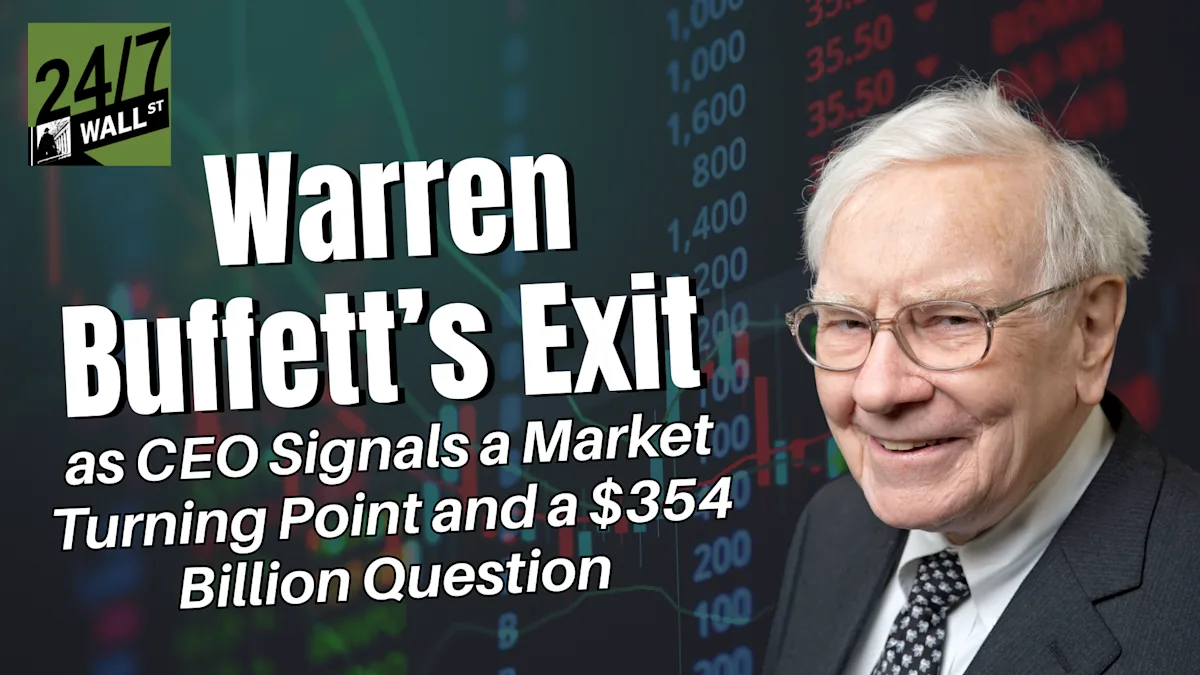
Warren Buffett’s resignation as CEO marks the end of an era, but his continued role as chairman maintains strategic continuity at Berkshire Hathaway.
Berkshire Hathaway has a cash position of $354 billion, which allows the company to act aggressively during major market corrections.
Investors are increasingly concerned about whether leadership transition risks could explain Berkshire Hathaway’s slight underperformance relative to the S&P 500.
If you’re thinking about retirement or know someone who is, three simple questions are making many Americans realize they can retire earlier than expected. Take 5 minutes to learn more here
Our conversation began with the realization that one of the most extraordinary careers in investing history is officially entering its final chapter. As Lee and I discussed, the idea of Warren Buffett no longer being CEO is almost surreal, given how long he has continued to be a presence in the market and in investment portfolios among generations of investors.
Lee began by reflecting on Buffett’s quintessential traits: disciplined value investing combined with ruthless opportunism in times of market panic. Time and time again, Buffett steps in when capital is scarce and fear is overwhelming. His investment in Goldman Sachs during the financial crisis exemplified this approach, providing not only capital but also confidence to markets in desperate need of reassurance. The same pattern was repeated at Bank of America, with preferred shares and warrants generating extraordinary long-term gains.
I noted that what makes this transition period particularly important is the sheer size of Berkshire’s liquidity. Buffett and his successor, Greg Abel, have about $354 billion in cash, a weapon that only gets stronger when markets are in disarray. Lee agreed the cash was unlikely to be deployed gradually. Instead, it’s reserved for moments of stress, sharp corrections, or systemic events where Berkshire can write a huge check on favorable terms.
We all agree that a 20% market reset is not unthinkable, especially if AI-related capex slows or funding expectations falter. In this case, Berkshire’s cash hoard becomes a competitive advantage that few companies can match.
We also discuss whether Berkshire’s recent underperformance relative to the S&P 500 reflects transition anxiety rather than fundamentals. Buffett’s longstanding philosophy of buying good businesses and holding on to them for decades remains deeply embedded in the company. While Berkshire has selectively increased its investments in companies like Alphabet and Amazon, his legacy holdings, including Apple, remain the backbone of the portfolio.
Lee made an important point about how things might change in the post-Buffett world. Wall Street has been urging Berkshire to pay dividends for years. Whether Greg Abel ultimately embraces the idea could materially reshape the shareholder base and the stock’s valuation framework.
We conclude by emphasizing that Berkshire’s shareholder base is fundamentally different from short-term traders. These investors buy the stock with the expectation of holding it for decades, believing in disciplined capital allocation rather than speculation. Buffett’s resignation as CEO doesn’t eliminate that culture, but it does mark a psychological turning point for a market accustomed to his steadiness.
[00:00:04] Doug McIntyre: This is Lee Jackson next to me. I’m Doug McIntyre. Tomorrow is New Year’s Eve, right? We expect a lot to happen next year.
[00:00:13] Doug McIntyre: What we’re talking about is that one of the greatest careers in investing history is coming to an end tomorrow. Yes.
[00:00:21] Lee Jackson: I mean, I’ve been in this business for 35 years.
[00:01:17] Doug McIntyre: Well, what happened with Goldman Sachs is a good example. Goldman Sachs has to take the money and the government is telling them they can’t have just one, one bank that doesn’t take the money and it makes everyone else look like they’re going out of business, right? They got the money from Buffett, and he got a sweet deal.
[00:01:49] Lee Jackson: Yes. Yes. Well, he did the same thing with Bank of America, because remember, I was working in this industry when things got really dangerous in ’07 and ’08, and then I was working at Morgan Stanley.
[00:02:21] He used to do it, but man, he got first priority and everything, high yield priority and a ton of common rights, and, he just acted like a gangster. He did the same thing with Occidental Petroleum Corp. (NYSE: OXY ). How that plays out now remains to be seen, but he’s also got some huge preferences from Occidental that I think will expire soon.
[00:02:44] But, man. He does a great job leveraging cash. Speaking of cash, he now has 354 billion. What do you think he will instruct Greg Abel to do?
[00:03:36] Lee Jackson: Yes, he absolutely will. And he had apparently never had so much cash. no way. And, especially the percentage of Berkshire Hathaway. And, he could always use it to buy private equity, which he often does, and he has a lot of it in his private equity portfolio, but he’s waiting for that home run swing, and it could be Abel who takes over.
[00:05:37] Lee Jackson: Yes. Again, he’s a value buyer and it’ll be interesting to see him now take a small stab at Alphabet, which is proving to be the best or one of the best Mag Sevens this year. So it will be interesting to see if he owns a little bit of Amazon, and of course he still owns a piece of Apple, which is probably still his largest position, even though he’s sold a lot of Apple shares over the last three years.
You might think retirement is all about picking the best stocks or ETFs, but you’d be wrong. Even large investments can become a burden in retirement. This is a simple distinction between accumulation and distribution, but it makes a huge difference.
Good news? After answering three quick questions, many Americans are rebalancing their investment portfolios and discovering they can retire earlier Better than expected. If you are considering retirement or know someone who is, please take 5 minutes to learn more here.