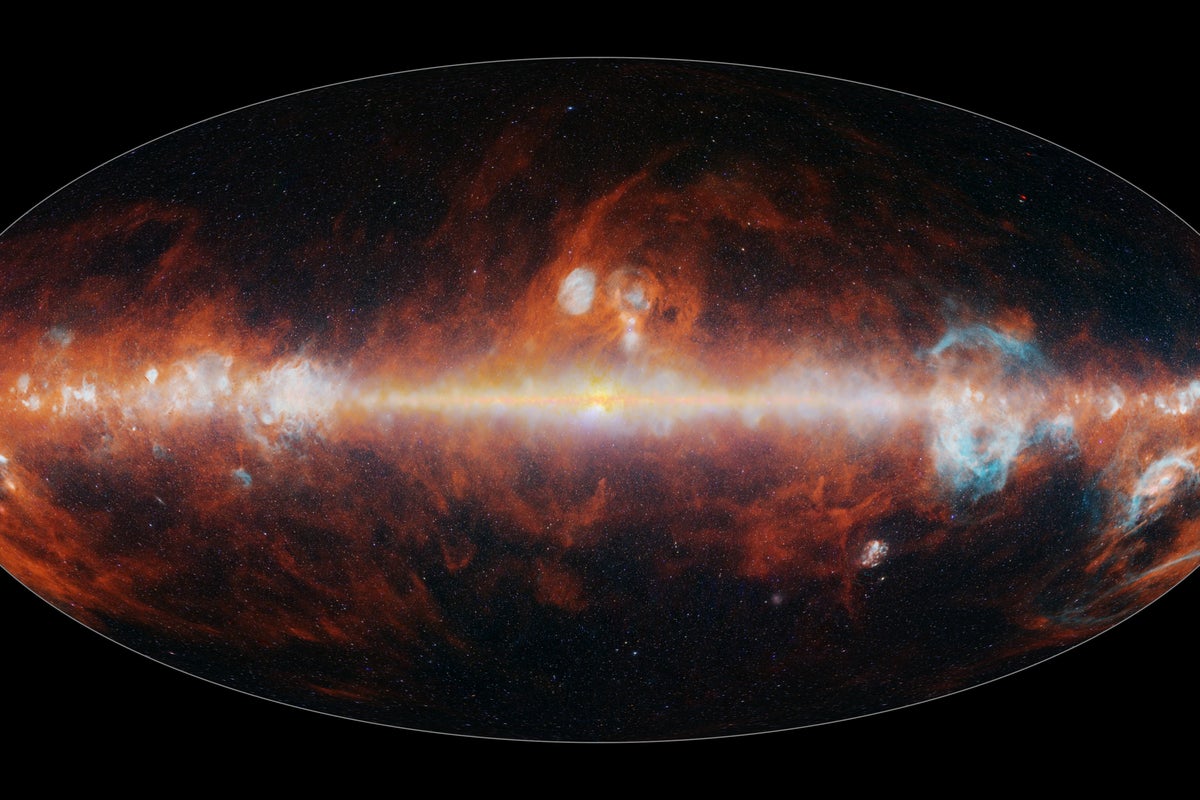
NASA has released a stunning new map of the universe that the agency says could help scientists solve some of the universe’s long-standing mysteries.
The first all-sky image, taken using the agency’s SPHEREx space telescope, simulates the instrument’s three-dimensional view of the sky, including burnt red cosmic dust, electric blue hydrogen gas, and white, blue and green stars.
Panorama View captures these and dozens of other colors using the telescope’s ability to see light in infrared wavelengths invisible to the human eye.
These colors allow astronomers to measure distances from telescopes to hundreds of millions of galaxies and measure how captured galaxies are distributed across the universe through a three-dimensional view of the map. As light stretches or shrinks, redder galaxies are farther away and closer galaxies appear blue, a phenomenon called “red shift.”
Scientists will use the data collected since the telescope was launched into low-Earth orbit in March to study how galaxies have changed over the nearly 14 billion years of the universe’s history, and potentially learn more about how key ingredients for life in the Milky Way formed.

NASA’s SPHEREx maps the entire sky in 102 infrared colors to reveal different features of the universe. Visible in this panorama are blue stars and hydrogen gas, green and white stars, and red cosmic dust. (NASA/JPL)
“Although invisible to the naked eye, these 102 infrared wavelengths of light are ubiquitous in the universe, and observing the entire sky in this way allows scientists to answer big questions, including how dramatic events in the first billionth of a trillionth of a second after the Big Bang affected the three-dimensional distribution of the hundreds of millions of galaxies in our universe,” NASA explained in a press release.
While the James Webb Space Telescope can also see infrared light, its range is thousands of times smaller.

This SPHEREx image shows a range of infrared colors emitted primarily by stars and galaxies (NASA/JPL-Caltech)
To date, no mission has been able to paint the entire sky in as many colors as SPHEREx.
The SPHEREx telescope – also known as the “Spectrophotometer for the Explorer of Cosmic History, Epochs of Reionization and Ice” – currently orbits about 400 miles above Earth.
It orbits the Earth approximately 14.5 times per day, taking approximately 3,600 images along a circular band of sky, constantly moving to capture the entire sky in 360 degrees.

Artist’s concept shows NASA’s SPHEREx telescope in action in space (NASA/JPL-Caltech)
It will complete three more all-sky scans during its two-year mission, collecting data on more than 450 million galaxies and more than 100 million stars in the Milky Way.
“SPHEREx is a medium-sized astrophysics mission that delivers big science,” said Dave Gallagher, director of NASA’s Jet Propulsion Laboratory. “This is a remarkable example of how we can turn bold ideas into reality and unlock huge potential for discovery in the process.”

