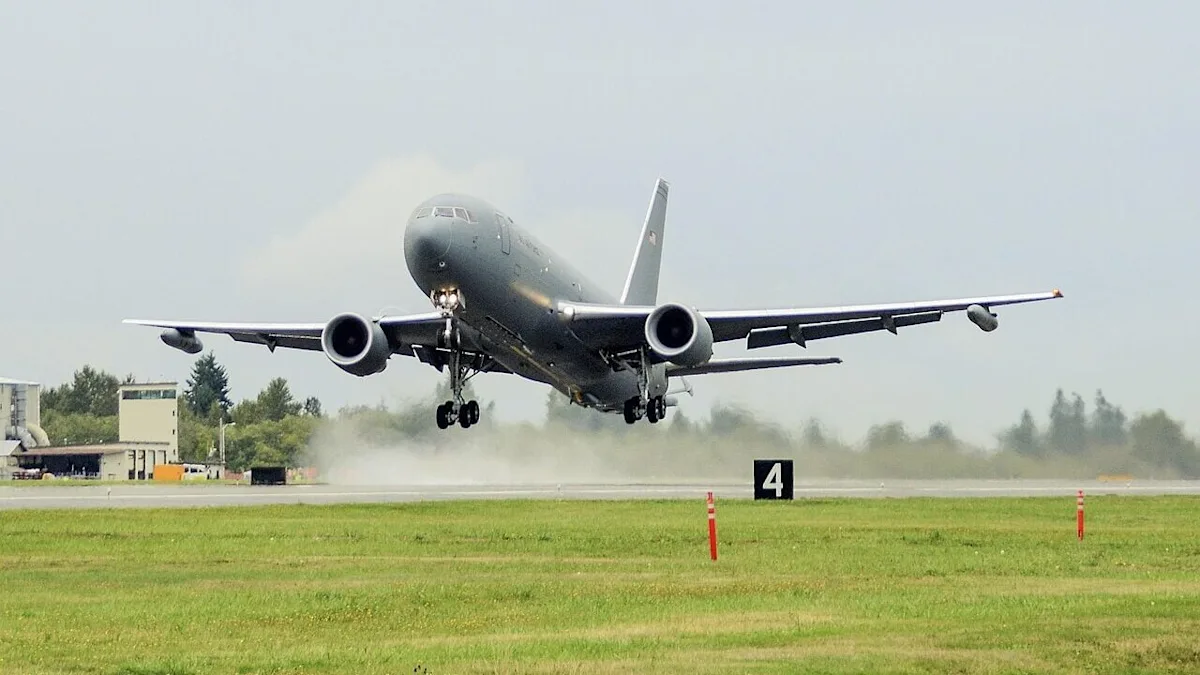
A senior U.S. Air Force official has warned that Boeing Co. must resolve ongoing technical issues with its KC-46 aerial tanker before the service will consider additional orders for the aircraft.
The comments put new pressure on the aerospace giant as it continues to grapple with a program plagued by delays, engineering challenges and billions of dollars in financial losses.
The aircraft at the center of the problem is the Boeing KC-46 Pegasus, a tanker developed by Boeing to replace the U.S. Air Force’s aging fleet of Boeing KC-135 Stratotankers. The KC-46 is designed to refuel military aircraft in the air, extending the range and endurance of fighters, bombers and reconnaissance aircraft while on missions.
Air Force leaders warn Boeing

Image credit: Senior Airman Matt Porter – Public domain, Wikimedia.
Despite the program’s strategic importance, the tanker has been plagued by technical flaws since its development phase.
Air Force Vice Chief of Staff John Lamontagne said in a recent address to lawmakers that the service wants Boeing to correct outstanding deficiencies before committing to any further purchases beyond those already on order.
The Air Force currently has 183 KC-46 tankers on order under existing procurement plans. More than one hundred of these aircraft have been delivered and are gradually put into operation.
However, the service remains cautious about expanding the fleet until manufacturers demonstrate that the most persistent issues have been resolved.
Ongoing technical challenges
One of the major concerns involves the tanker’s refueling boom, the rigid telescoping tube used to transfer fuel from the tanker to another aircraft during flight.

Image credit: Air Force 1st Class Trenton Jancze – Public domain, Wikimedia.
Early evaluations found that the stiffness of the boom may make it difficult to connect properly with certain types of receiving aircraft, particularly lighter models. Tweaks and modifications have been made, but the system continues to be under scrutiny.
Another major concern centers on the aircraft’s remote vision system, a high-tech camera and display unit that allows operators to control the refueling arm from inside the aircraft.
Unlike older tankers, where operators guide the boom visually through a window, the KC-46 relies on digital imaging. Issues such as glare, depth perception and lighting conditions raise concerns about system reliability during complex refueling operations.
Recent setbacks and financial losses
The tanker program has also encountered new setbacks in recent months. Deliveries were temporarily halted after cracks were discovered in parts of the plane’s structure, forcing Boeing and Air Force engineers to review the issue and take corrective measures before resuming production.

Photo credit: U.S. Air Force Master Sgt. Michael Jackson – Public domain, Wikimedia.
Financially, the program has become one of the most expensive fixed-price defense contracts in Boeing’s history. The company has absorbed more than $7 billion in charges related to development overruns, redesign efforts and production complexity.
Boeing has repeatedly had to record huge tanker-related losses because the contract structure puts much of the burden of cost overruns on the manufacturer.
The situation was highlighted again recently when the company disclosed additional costs associated with the program, underscoring just how difficult the KC-46 program has been for the aerospace manufacturer.
Even so, tankers remain central to the Air Force’s long-term strategy.
way forward

Image credit: Jacob Derry – Public domain, Wikimedia.
The service still expects the aircraft to play an important role in future aerial refueling operations once the technical issues are resolved. The Air Force could eventually buy about 75 more tankers under a potential follow-on acquisition program called the Tanker Production Expansion Program, officials said.
The decision is expected to take about two years, giving Boeing time to prove it has successfully addressed remaining technical shortcomings.
For Boeing, the message from Air Force leadership is that the KC-46 tanker must first prove it can meet operational expectations before the Pentagon is willing to commit to expanding the fleet. Until then, the program remains a critical defense project and a costly challenge for one of the world’s largest aerospace manufacturers.
Source: Reuters
Read more

