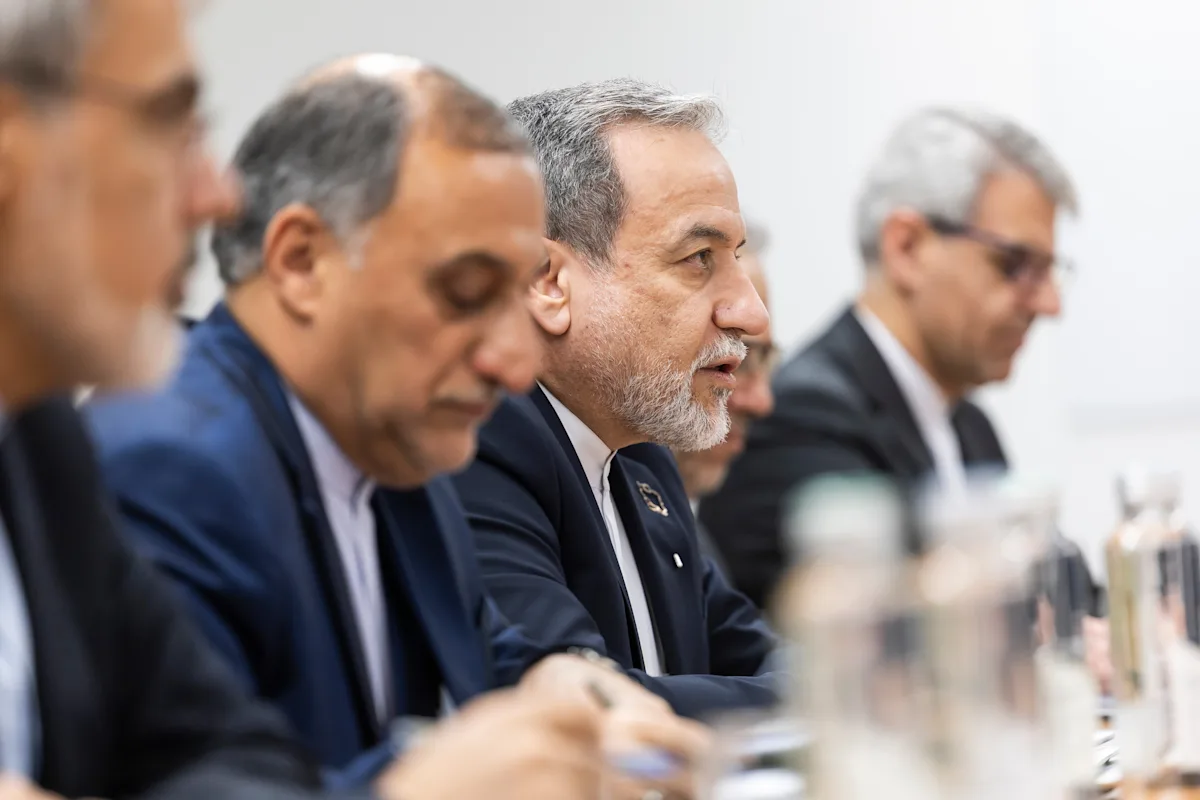
WASHINGTON (AP) — U.S. President Donald Trump warned on Friday that limited strikes on Iran were still possible, even as Iran’s top diplomat said Tehran expected to have a proposed deal ready within days of entering nuclear talks with the United States.
In response to a reporter’s question about whether the United States could take limited military action while the two countries negotiate, Trump said, “I guess I can say I’m considering that.” Hours later, he told reporters that Iran “would be better off negotiating a fair deal.”
Earlier on Friday, Iranian Foreign Minister Abbas Araghchi said in a television interview that Iran planned to finalize a draft agreement “in the next two to three days” and send it to Washington.
“I don’t think it will take a long time, maybe a week or so, before we can start real, serious negotiations on the text and come to a conclusion,” Araghchi said on MSNOW’s “Morning Joe.”
Tensions are rising between the two long-time rivals as the Trump administration presses Iran for concessions and builds the largest U.S. military presence in the Middle East in decades, with more warships and aircraft set to be commissioned.
The USS Gerald R. Ford aircraft carrier strike group passed through the Strait of Gibraltar and entered the Mediterranean on Friday after Trump dispatched it from the Caribbean, according to photos of the ship posted by maritime photographers on social media.
Iran and the United States have both said they are ready for war if negotiations over Tehran’s nuclear program fail. “We are ready for diplomacy, we are ready for negotiations, just like we are ready for war,” Araghchi said on Friday.
Ali Vaez, an Iran expert at the International Crisis Group, said Iran “will view any dynamic action as an existential threat.”
Vaez said he did not believe Iranian leaders were bluffing when they said they would retaliate, although they may believe they can retain power despite U.S. airstrikes.
What are Iran and the United States negotiating?
Trump said a day earlier that he believed 10 to 15 days was “sufficient” for Iran to reach a deal after recent rounds of indirect talks, including this week’s talks in Geneva, had made little apparent progress. But talks have been deadlocked for years since Trump decided in 2018 to unilaterally withdraw the United States from Iran’s 2015 nuclear deal with world powers. Iran has since refused to discuss broader demands from the United States and Israel to scale back its missile program and cut ties with armed groups.
Araghchi also said on Friday that U.S. counterparts had not made demands for zero enrichment of uranium as part of the latest round of negotiations, something U.S. officials have not said publicly.
“What we are discussing now is how to ensure that Iran’s nuclear program, including its uranium enrichment program, is peaceful and will always remain peaceful,” he said.
In return, Iran would implement some confidence-building measures in exchange for relief from economic sanctions, he added.
In response to Araghchi’s statement, a White House official said that Trump has made it clear that Iran cannot possess nuclear weapons or has the ability to build nuclear weapons, nor can it enrich uranium. The official was not authorized to comment publicly and spoke on condition of anonymity.
Tehran has long insisted that any negotiations should focus solely on its nuclear program and has not enriched uranium since the United States and Israel attacked Iranian nuclear facilities last June. Trump said at the time that the attack “destroyed” Iran’s nuclear facilities, but the exact damage was unclear because Tehran has banned international inspectors from conducting inspections.
Although Iran insists its nuclear program is for peaceful purposes, the United States and other countries suspect its goal is to eventually develop weapons.
What does Congress have to say?
Trump’s comments drew pushback from some lawmakers, who said the president should get congressional approval before launching any attack.
Sen. Tim Kaine, D-Va., said Friday he had submitted a war powers resolution calling for such a step. While the bill has no chance of becoming law — in part because Trump himself would have to sign it — senators have recently reached some bipartisan consensus, forcing them to vote on previous resolutions on military action in Venezuela.
None of the resolutions passed, but they succeeded in showing how troubled lawmakers are by some of Trump’s aggressive foreign policy tactics.
“If some of my colleagues support war, then they should have the courage to vote for it and be held accountable by their constituents rather than hide under their desks,” Kaine said in a statement.
___
Amiri reported from New York. Associated Press writers Michelle L. Price, Ben Finley, Stephen Groves and Konstantin Toropin in Washington, and Jon Gambrell in Dubai, United Arab Emirates, contributed to this report.

