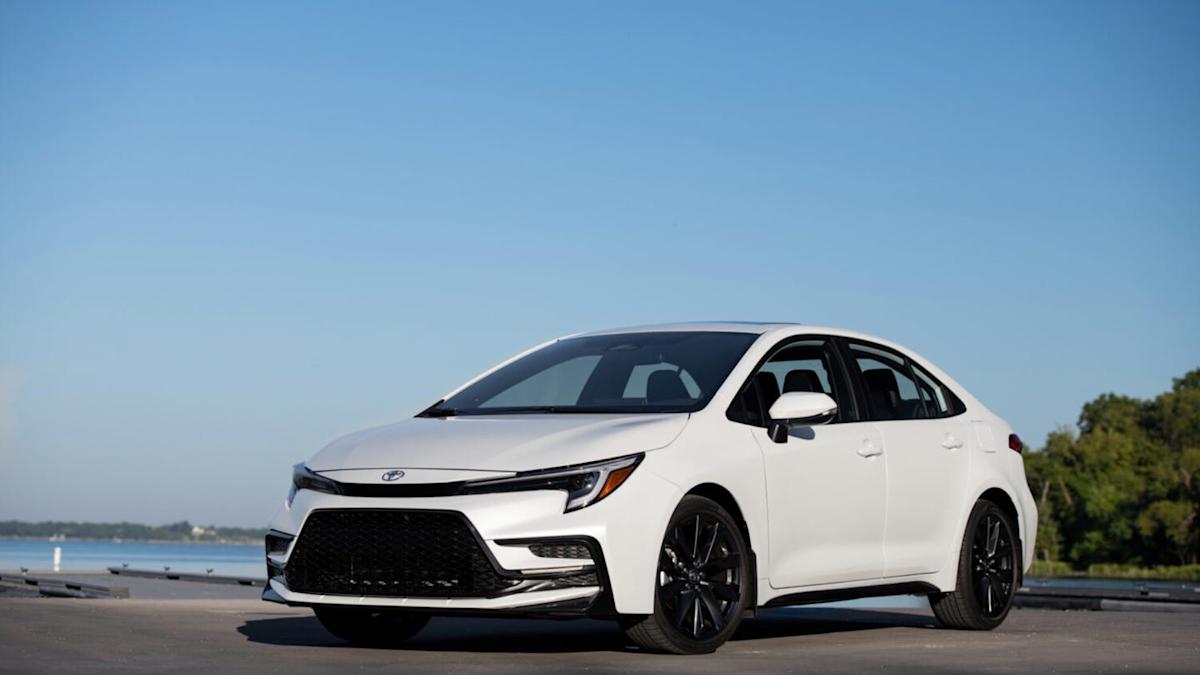
In 2025, Toyota Corolla sales in the United States increased by 6.5% to 248,088 units. We picked this compact sedan because it diverges from the overall trend of affordable new cars.
Last month, we reported that analysts at Cox Automotive said the surge in sales of sub-$30,000 compact cars that began in 2024 would end in the fourth quarter of 2025. U.S. vehicle sales figures for 2025 released by automakers at the start of the new year seemed to confirm this, although brands like Toyota and Honda — which have been clinging to shrinking compact sedan market share as brands like Chevrolet, Ford and Dodge shift to full-utility cars and trucks — are clearly not ready to give up on the segment.
If you include the eight fully equipped commodity brand compact cars on the market priced under $30,000, sales in 2025 will be 1.045 million units, a 0.55% decrease from 2024 sales.
Not bad, right?
That would account for 6.5% of the market of 16.17 million vehicles by 2025, according to analytics firm AFS AutoSolutions. Compact cars accounted for 10% of the market in 2019, according to Cox Auto.
Among the eight models we counted, sales of three models – Toyota Corolla, Hyundai Elantra and Kia K4/Forte – increased, while sales of the former No. 1 Honda Civic and Volkswagen Jetta, Subaru Impreza and Mazda 3 declined. Nissan Sentra sales also declined, but only by 81 units, retaining third place in the segment with 152,578 units sold.

Honda Civic sales were 238,661 units, a decrease of 1.4%. Honda
(The more expensive Audi A3, Mercedes-Benz A-Class, BMW 2 Series, Volkswagen Golf GTI and R, Acura Integra, Mini series and pure electric compact cars are also not discussed here.)
Toyota will sell 248,088 Corollas in 2025, up 6.5% from 2024, while Honda will sell 238,661 Civics, down 1.4%. The Civic is the best-selling model in the segment in 2024.
The fourth-placed Hyundai Elantra rose 8.4%, and the fifth-placed Kia K4/Forte rose 0.53% to 140,514 units.
Also in eighth place were the Volkswagen Jetta, which sold 54,291 units, down 24.4%, the Mazda3, which fell 24.5% to 29,266 units, and Subaru, which sold 27,942 Impreza units, down 10.9%.
The bottom line is that if at least three of these eight cars (Volkswagen Jetta, Mazda3 and Subaru Impreza) were discontinued from their respective U.S. lineups, most U.S. consumers wouldn’t notice. Value seekers are turning to subcompact CUVs like the Chevrolet Trax and Honda HR-V.
Even the Corolla’s 6.5% sales growth cannot keep up with the Toyota division’s 8% growth in 2025. But the Corolla still has value to the brand as an entrant onto Toyota’s “pricing ladder” (Alfred Sloan’s “brands for every wallet and purpose”) to build and retain lifelong customers, Toyota Division Group Vice President and General Manager David Christ said during a Jan. 5 webinar with reporters during Toyota Motor Sales U.S.’s 2025 fourth-quarter and full-year report.
The Toyota division had its fourth-best sales year ever in the U.S., while the Lexus premium/luxury division had its best-ever sales in 2025, reaching 345,699 units, a 7.1% increase.
Andrew Gilleland, senior vice president of automotive operations at Toyota Motor North America, said the brand would have ranked third in sales last year if supply could match demand. He said the Toyota unit will continue to push sales of commodity-priced cars as well as higher-margin Lexus models over the next year and beyond, avoiding a situation seen in much of the industry since the coronavirus pandemic in which automakers kept profit levels steady amid lower sales by prioritizing higher-priced models to buy semiconductors and other parts that are in short supply.

Toyota’s sales in 2025 will be 136,801 Grand Highlanders, an increase of 90.7%. toyota
To be sure, Toyota’s division has a plethora of successful models that help support the industry’s average transaction price, which Cox Automotive said reached $49,814 last November. Toyota sold 136,801 Grand Highlanders, up 90.7%, 98,805 4Runners, up 7.6%, and 43,946 Land Cruisers, up 50.9% (all new models, from partial annual sales in 2024).
Toyota Crown (sedan) sales fell 37.4%, or 7,339 units, to 12,309 units in 2015, but this was offset by the new Crown Signia, classified as an SUV, which saw sales rise 100.2%, or 10,287 units, to 20,550 units last year.
Looking ahead to 2026, Toyota will be keeping a close eye on price increases expected by other companies in the industry as a result of the Trump administration’s tariffs. Management expects several price increases this year, and since more than 20% of Toyota and Lexus products come from Japanese factories, the automaker may follow suit.
Gilleran said “we already have overcapacity” and no opportunity to move more production to U.S. factories.
“We’re hoping that Mexico and Canada will do something” to give North American factories greater production flexibility, Crist said. He was referring to the Trump administration’s plan to renegotiate the U.S.-Mexico-Canada trade deal due to be reached this year. He noted that it takes three to seven years to get a new assembly plant up and running in the United States.

Toyota has 14 manufacturing plants in North America, including one in Missouri. toyota
Like the rest of the Japanese auto industry, Toyota has been affected by Trump’s tariff rollercoaster since “Liberation Day” on April 2 last year.
“We believe our prices and those of our competitors will increase,” Christ continued. “Do we like 15%? The answer is no, we like 2.5%”, this is the tariff imposed on Japanese-produced cars on the eve of Liberation Day. “But it’s better than 27 percent.”
Despite these price pressures, Gilleran said Toyota expects the U.S. auto industry to sell 15.8 million to 16.2 million vehicles by 2026. That’s in line with Cox Auto’s forecast of 15.8 million units over the next year.