Author: Aaron Ross and Vincent Mumo Nzilani
Nairobi, January 9 – At around 8:30 pm on October 31, a group of police officers appeared in the Mjimwema community in Mwanza City, Tanzania, where residents were running errands and drinking coffee. They fired in different directions without any warning, causing panic.
Three witnesses told Reuters that police ordered the men who had taken refuge in a nearby cafe to lie on the ground and then shot them. By the time the shooting subsided, more than a dozen people were dead, they said.
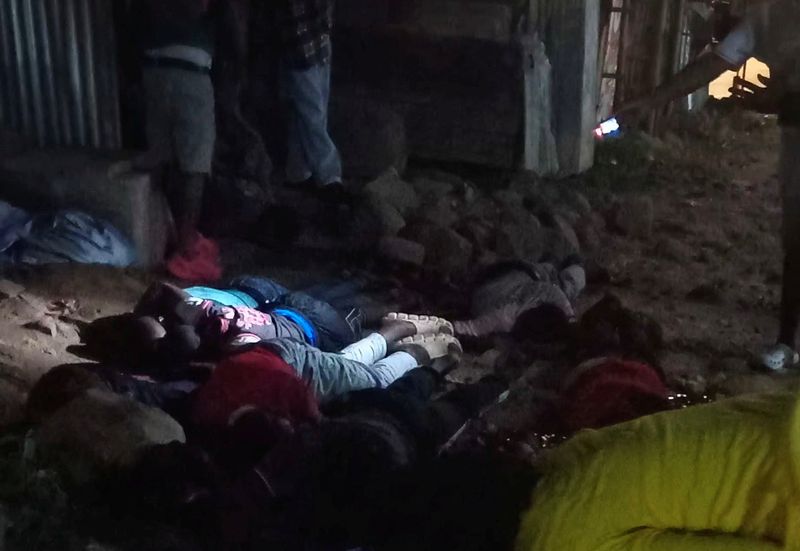
A video posted on social media in early November and confirmed by Reuters showed the aftermath – 13 limp bodies sprawled on the blood-stained ground.
Reuters has detailed for the first time the Mjimwema massacre, one of the deadliest known incidents in the days of violence surrounding Tanzania’s October 29 elections.
This is not an isolated case.
Nine witnesses interviewed by Reuters about eight other incidents in Mwanza and in Tanzania’s commercial capital Dar es Salaam and the northern city of Arusha said they saw police shooting at people who were not protesting, sometimes miles from any known demonstrations.
The violence is the worst political unrest in Tanzania’s post-independence history and has damaged its reputation for stability, amid the exclusion of main opposition candidates from the election and a surge in arrests and alleged kidnappings of government critics.
The U.N. human rights office estimates hundreds of people were killed, and the U.S. government says it is reviewing relations with the country, in part because of that.
The mostly young demonstrators are demanding more accountable governance, echoing so-called Generation Z protests in countries such as Kenya, Madagascar and Nepal that have forced major reforms or the overthrow of governments.
Charles Kitima, secretary-general of the Anglican Church of Tanzania, the country’s Catholic bishops’ organization, said police deliberately targeted civilians.
“We saw a lot of people being killed in their houses. That’s why we said it was intentional killings,” Kitima told Reuters.
He acknowledged that some looting had occurred: “But by and large, the protesters are not criminals. They are just expressing their needs.”
Paramagamba Kabudi, a senior Tanzanian official, said the government took concerns about the use of force seriously and had set up a commission of inquiry to look into the electoral violence. However, he said many of the accusations were based on unsubstantiated and taken out of context information.
“The government does not acknowledge policies or practices of deliberate brutality against civilians,” Kabudi, minister of state in the presidential office, told Reuters in a written response to questions.
“Security operations are carried out for specific law enforcement purposes and are subject to legal safeguards.”
hundreds of people killed
President Samia Suluhu Hassan won the presidential election with nearly 98% of the vote. In public speeches, she has defended the security response as a reasonable response to violence by protesters.
The vote is the first electoral test for Hassan, a former vice president who came to power in 2021 when her predecessor died in office. After initially pushing for democratic reforms, Hassan has in recent years launched a crackdown on government opponents accused of trying to disrupt elections and foment instability.
Authorities cut off internet connections across Tanzania for more than five days, limiting access to information and reliable records of the violence after young people took to the streets in several cities on election day.
Shortly before the connection was restored, police threatened legal action against anyone who shared images that “cause alarm or are degrading to persons.”
An independent human rights expert appointed by the U.N. Human Rights Council said in December that there were “disturbing reports” that security personnel had received “shoot to kill” orders during the mandatory curfew, but did not disclose the source of the information.
Kabudi said the government “categorically denies the suggestion that the ‘shoot to kill’ order was issued as policy”.
UN-appointed experts estimate that at least 700 people have been killed extrajudicially, but say other estimates suggest thousands may be victims.
Kabudi acknowledged casualties but said it was too early to give an exact death toll. He said the inquiry’s findings would be made public “in due course”.
Witnesses describe killings far from protests
Witnesses interviewed by Reuters in Tanzania’s three largest cities, Mwanza, Dar es Salaam and Arusha, described widespread vandalism during the protests, saying some demonstrators set fire to government offices, property of members of the ruling party and public infrastructure.
But according to eyewitnesses, police fired at civilians who were not participating in the demonstrations and fired indiscriminately at the protest crowd.
In most cases, witnesses said they didn’t know why police did what they did. In some incidents, police appeared to target civilians accused of ignoring police orders to go home, they said.
Reuters was unable to determine the legal basis for the orders.
Although police announced on state television a dusk-to-dawn curfew in Dar es Salaam after the initial violence, Reuters could find no evidence of an official curfew or lockdown order in Mwanza or anywhere else.
A national police spokesman did not respond to a request for comment.
Police shoot at cafe patrons
On October 30 and 31, people in Mjimwema could see demonstrations elsewhere in Mwanza from the hills above Lake Victoria, but there were no disturbances in nearby areas, six residents told Reuters in telephone interviews.
Still, police arrived nearby around 6 p.m. and ordered people who were shopping or watching TV in cafes to go home, but the instruction was largely ignored, a witness said.
About two hours later, about six police officers arrived on foot and began firing in different directions, four witnesses said.
Everyone dispersed in fear. One of the witnesses was hiding in a house. Another man holed up in a nearby bar.
Two witnesses at the scene said that in a wooden cafe that did not have an official name but was showing a football match, patrons turned off the televisions and lights in the hope of not being noticed. One of them said he then sneaked out the back door and rushed to a nearby compound. The other one stays inside.
Three witnesses said that when police arrived at the door, they ordered those inside to come out and lie down in the street.
Witnesses who were still inside the cafe said he followed police instructions and climbed out. He said he recalled a series of insults from the police, but the officers never explained their actions.
Then the shooting started. For about 30 seconds, the witness remained motionless. “If they see you moving, they’ll shoot again,” he said.
After the police left, he fired into the air and stood up, shaking but still alive. He said he saw more than 15 people dead and injured around him.
massacre scene
On November 5, a video posted by a Tanzanian activist living in the United States on the social media platform Sandals, glass bottles and mobile phones were scattered on the floor.
A voice can be heard saying: “They’re all dead. This is murder.”
In photos taken by witnesses and verified by Reuters, nine identical bodies can be seen.
Two witnesses – one hiding in the bar and the other fleeing to a nearby compound – said they saw at least 14 bodies after the shooting.
Minutes later, police in green uniforms pulled up in a large vehicle, loaded the body into it and drove off, according to four witnesses, with a fourth of them returning to the area after taking refuge on the side of the road.
At about 10pm, a man in his 20s arrived at nearby Sekou Toure Hospital with a gunshot wound, saying police were shooting at people at the Mjimwema Cafe, a hospital source said. Less than an hour later, police brought in about 15 young men, all but one of whom died from gunshot wounds, he added.
The hospital did not respond to a request for comment.
Kabudi said authorities were reviewing the Mjimwema incident but needed verified information before drawing any conclusions.
Some victims are still missing
Reuters confirmed the identities of the three victims.
A family member said Raphael Esau Magige, 39, and his nephew Johnson Patrick Deus, 27, went to the cafe that night to watch the news on TV.
Neither man was involved in political activities, the family member said. Deus has a job in Dar es Salaam, is learning to drive and has a young son. Maggie is a tailor and has a teenage daughter.
The family members identified their bodies at the Sekudur Hospital mortuary. The family member said Dius was shot four times, including in the ribs and chest, while Majigi was shot three times in the neck and chest. They were buried on November 4th.
Another victim was 20-year-old Juma Shaban Joseph, a domestic worker and an ardent supporter of Simba SC football club in Dar es Salaam, a family friend told Reuters, citing witnesses who saw his body at the scene.
Like many families of victims across the country, Joseph’s relatives searched in vain for his body at city hospitals and morgues, the person said.
The U.N. Human Rights Office cited “disturbing reports” in a November statement that security forces were taking bodies to undisclosed locations “in an apparent effort to conceal evidence.”
Kabudi denied having a policy of hiding bodies or evidence.
According to photos taken in mid-December, Mjimwema’s cafe no longer exists. Weeks after the incident, a witness said he saw workers demolishing the building. Reuters could not determine who ordered it.
(Editing by David Lewis)