Jonathan Saul
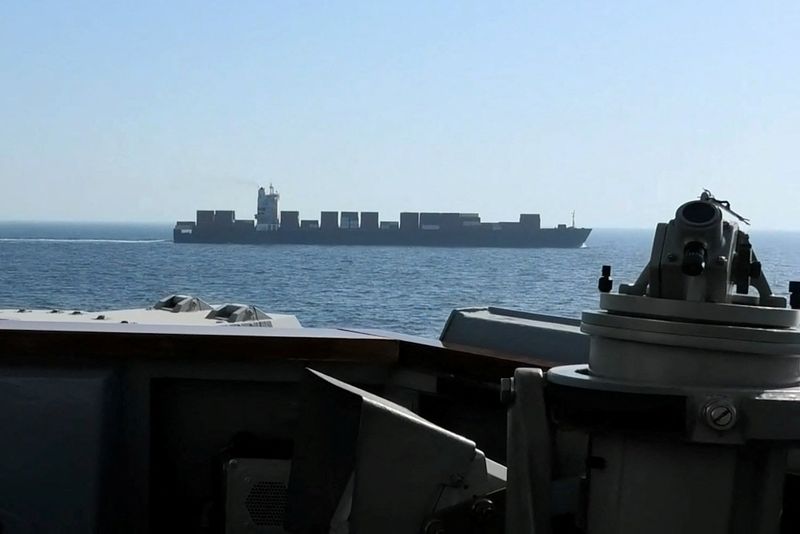
LONDON, April 20 (Reuters) – The Iranian-flagged container ship Touska, which was boarded and seized by U.S. forces on Sunday, may have been carrying dual-use items that Washington believes could be used by the military, maritime security sources said on Monday.
The small container ship, part of the U.S.-sanctioned Islamic Republic of Iran Shipping Lines (IRISL) group, boarded off the coast of Iran’s Chabahar port in the Gulf of Oman on Sunday and last reported its position at 1308 GMT, according to ship tracking data on the Marine Traffic platform.
U.S. Central Command said the ship violated the U.S. blockade after its crew failed to comply with multiple warnings over a six-hour period.
Security sources, who spoke on condition of anonymity, said their initial assessment was that the ship may have been carrying dual-use items after sailing from Asia.
One source said the ship had previously transported items considered dual-use.
The source did not disclose details of the items. U.S. Central Command lists metals, pipes and electronic components as commodities that may have military and industrial applications and can be seized.
Iran’s Foreign Ministry said on Tuesday that the US military attacked an Iranian merchant ship “Touska” near its coast, condemning the incident as “illegal and in violation” of international law, Iranian media said.
Iran’s foreign ministry said it demanded the immediate release of the ship, crew and their families, adding that the incident violated a ceasefire agreed this month and warning Washington would be responsible for further escalation.
Iran’s military said the ship sailed from China and accused the United States of “armed piracy,” state media reported on Monday. They said they were ready to confront U.S. forces over “blatant aggression” but were restrained by the presence of family members of the crew on board.
Washington imposed sanctions on IRISL in late 2019, describing it as “the shipping company of choice for Iranian proliferators and procurement agents,” including for transporting items used in Iran’s ballistic missile program.
One of the sources said the Tuska’s crew included an Iranian captain and Iranian crew, but it was not clear whether the entire crew were Iranian nationals.
Two other sources added that IRISL ships are controlled by the Revolutionary Guards and their crews are usually made up of mostly Iranians, sometimes using Pakistani seamen.
According to satellite analysis by data analysis specialist SynMax, the ship was discovered on March 25 in the Chinese port of Taicang, north of Shanghai, and arrived at the southern Chinese port of Gaolan between March 29 and 30.
According to SynMax analysis, the ship loaded containers at the high rail before docking near the Port Klang anchorage in Malaysia on April 11 and 12, where it loaded more containers.
The ship was loaded with containers when it arrived in the Gulf of Oman on Sunday.
A spokesman for the Chinese Ministry of Foreign Affairs said on Monday that China was concerned about the United States’ “forcible interception” of an Iranian cargo ship and urged relevant parties to abide by the ceasefire agreement in a responsible manner.
U.S. President Donald Trump posted on the Truth Social platform on Sunday that the Tuska was subject to U.S. sanctions due to its “previous history of illegal activity,” adding that the U.S. military was “seeing what’s on board.”
The U.S. military has expanded its shipping blockade against Iran to include cargo considered contraband and any vessel suspected of trying to enter Iranian territory will be “subject to belligerent rights of visit and search,” the U.S. Navy said in an announcement on Thursday.
Contraband includes weapons and ammunition.
(Reporting by Jonathan Saul; Additional reporting by Enas Alashray; Editing by Andrew Paradise)