Image source: Social media/Reuters/RIA Novosti
When a British man was arrested in Ukraine on suspicion of helping Russia carry out political assassinations, it exposed more than one betrayal.
Ross David Cutmore arrived in Ukraine in 2024 and was accused of importing and distributing weapons used in the murders of three prominent Ukrainian figures: activist Demian Hanul and two politicians, Iryna Farion and Andriy Parubiy.
His alleged role reveals a largely hidden dimension of the war, an intensifying campaign of assassinations that stretches from the streets of Kiev and Moscow to the outskirts of Madrid.
It also reflects Russia’s broader strategy in Ukraine. Unable or unwilling to deploy specialized agents, Moscow has relied on locals, immigrants and criminal networks to hunt down political and military figures in Ukraine and beyond.
Global conflict monitor Acled documented nine attempted or successful assassinations by Russia in Ukraine between 2023 and August 2025. Targets range from nationalist figures to serving intelligence officials and are often chosen to bolster the Kremlin’s narrative of fighting extremism.
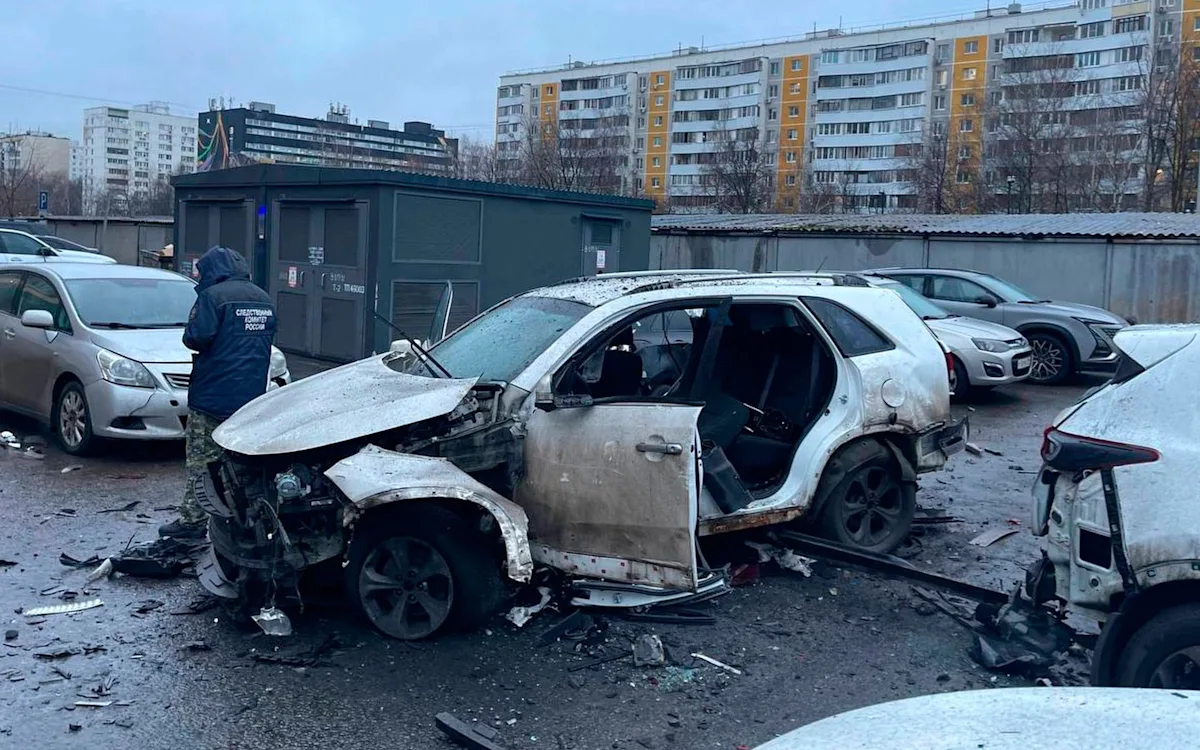
Ukraine has responded in kind, launching multiple attacks across Russia, including a car bomb in Moscow shortly before 7 a.m. on Monday that was suspected of assassinating Lieutenant General Fanil Salvarov.
Salvarov, who is responsible for training the Russian armed forces, is believed to have been on his way to work when the explosion occurred in the Yasenevo region.

Wreckage of a car believed to belong to Lt. Gen. Fanil Salvarov – Moscow Investigative Committee, AP
Ukraine has not yet taken responsibility for the attack, but Russia suspects Kiev was behind the “murder.”
Research shows Ukraine is winning this shadow war. Indeed, the speed and scope of Ukraine’s assassination campaign has somewhat surpassed that of Russia, with late 2024 marking a turning point.
Motorcycle bombs, drone chief and Putin’s chief of staff
With the number of assassination attempts in Ukraine in the first eight months of 2025 already exceeding the annual totals of 2022, 2023 and 2024, the focus in Kyiv shifts from propagandists to the architects and operators of Vladimir Putin’s war machine.
The most striking example was the killing of Lieutenant General Igor Kirillov on December 17 last year. The officer in charge of Russia’s nuclear, chemical and biological weapons was killed by a remote detonation device hidden in an electric scooter.

Lieutenant General Igor Kirillov killed in December 2024 – Associated Press

He died after a device hidden inside his electric scooter was remotely detonated (video below) – Shutterstock /Yuri Kochetkov
Image source: Social media/Reuters/RIA Novosti
A few days ago, Mikhail Shatsky, an engineer involved in the production of missiles and drones, was shot dead. In April 2025, a car bomb killed two senior figures related to electronic warfare and operational planning, including General Yaroslav Moskalik, a key figure in the Russian Armed Forces General Staff.

Russian General Yaroslav Moskalik was killed in April this year

He was one of two senior figures killed by a car bomb (below) – Shutterstock/Yuri Kochetkov
Image source: IZ.RU/Telegram
The killings were strikingly similar to Monday’s car bombings and were precise and increasingly sophisticated. Many involved explosives and mail bombs, assembled with the help of unwitting couriers recruited online.
Suicide bombings and the war in Russia
Akelaide also documents apparent suicide bombings in Russia, including the killings of Arbat Battalion founder Armen Sarkisian and Zaur Gurtsiev, who oversaw the devastating bombing of Mariupol. In the latter case, the person delivering the device may not even know he is carrying it.
Even in territories that Russia has controlled for more than a decade, Ukrainian influence has proven enduring. The 2018 assassination of Donetsk warlord Alexander Zakharchenko was an early example of Kiev’s ability to operate in Russian-controlled areas.
There have been at least five high-profile killings in Luhansk since 2022, including that of Russia’s appointed interior minister, Igor Kornet. In December 2024, Ukrainian agents also killed the warden of Olenivka prison in Donetsk, where a bombing in 2022 killed dozens of Ukrainian prisoners of war.

Igor Kornet, assassinated interior minister of Luhansk, Russia
The purges are unlikely to stop Russia’s war effort. But it imposes a psychological cost on those who serve, as the threat reaches far beyond the battlefield. Anyone associated with the invasion, from propagandists to engineers and military officers, found themselves saddled with a target.
Russia’s counterattack
Russia attempted to respond in kind. Acklade noted that there were at least nine assassination attempts in Russia between 2023 and August 2025, although many of these operations were poorly executed and relied on local proxies.
In July 2025, Colonel Ivan Voronich of the Ukrainian security services was shot dead in Kiev during the day (the following), a far-right group with suspected ties to Russia claimed to have killed him. In May, Serhii Sternenko was injured by a woman recruited by Russian training staff. In March, Demyan Hanul was shot dead in Odessa. These victims, along with Farion and Parubi, were linked by their nationalist or anti-Russian stance.
Image source: Telegram
Nichita Gurcov, senior analyst for Europe and Central Asia at Acled, told The Telegraph: “Assassination showdowns… occur alongside the rules of engagement of conventional warfare, such as indiscriminate targeting of civilians and the torture or execution of prisoners of war.”
“Unrestricted by battlefield constraints, this approach can become a self-sustaining spiral of violence that takes a dangerous shortcut from due process and leaves no immunity options for victims.”
Gurkov also told The Telegraph that the tactics were increasingly similar to those used by Israel’s spy agency Mossad, whose methods include the use of disguised explosive devices and cross-border targeting.
The assassination of former Ukrainian politician Andrei Portnov in Madrid in May showed just how far the conflict’s covert front lines now extend. A year ago, Russian pilot Maxim Kuzminov, who defected to Ukraine, was killed in Alicante.

Ukrainian politician Andrei Portnov was assassinated in May

Portnov murder scene in Madrid
Britain is well aware of how Russia’s influence extends far beyond its surrounding territories. A public inquiry on Thursday found that Putin ordered the 2018 Salisbury poisoning, in which agents brought a highly toxic nerve agent into a busy city in a failed attempt to assassinate double agent Sergei Skripal. This is to show Russia’s strength to the world.
If the war ends, the killing may not end. In the long years since Russia’s first invasion in 2014, assassinations on both sides have continued. As weapons flood society and issues may remain unresolved, the killings are likely to continue well beyond the scope of any peace settlement negotiated by the United States.
Try full access to The Telegraph for free now. Unlock their award-winning website and essential news app, plus helpful tools and expert guidance on your money, health and holidays.