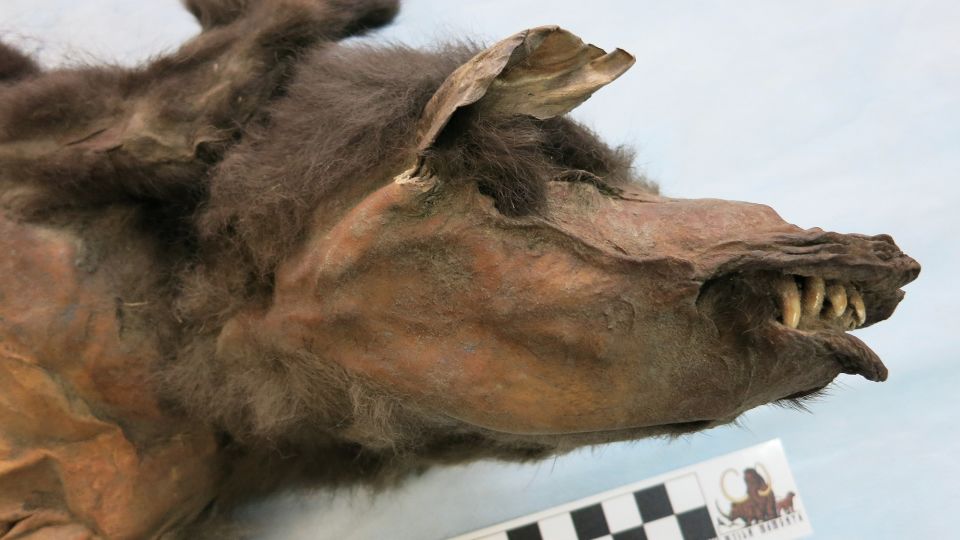
14,000 years ago, on the vast Siberian steppes, a two-month-old wolf cub devoured some woolly rhinoceros meat. After a while, its underground lair collapsed, killing the puppy and its sister.
With the wolf’s stomach contents frozen in the permafrost along with its carcass, scientists were able to sequence the DNA of one of the last known woolly rhinos, a horned ice giant that lived alongside mammoths. Now, the discovery of the wolf’s last meal sheds light on why the woolly rhinoceros went extinct.
The research was published Wednesday in the scientific journal Genome Biology and Evolution, This is the first time scientists have been able to sequence the entire genome, or entire genetic code, of one animal found in the stomach of another animal, said co-author Camilo Chacón-Duque, a bioinformatician in the SciLifeLab Ancient DNA unit at Uppsala University in Sweden.
“We were very excited because there are so few fossils from before and after the woolly rhinoceros extinction,” said Chacon-Duk, a former researcher at the Center for Paleogenetics at Stockholm University, where the study was conducted.
The mummified wolf pup, still covered in fur, was discovered in 2011 in the permafrost near the village of Tumat. A later autopsy revealed a small fragment of well-preserved tissue in its stomach. Scientists extracted DNA from the 14,000-year-old tissue, and DNA sequencing revealed it was a species of woolly rhinoceros known as Coelodonta antiquitatis.

A piece of woolly rhinoceros tissue found in the stomach of a young wolf. The hair is still attached. – Edalon
The hair on the woolly rhinoceros tissue was still intact, Chacon-Duque said, indicating that the pup was just beginning to digest food before it died.
“From the morphological analysis, it’s clear that they were just buried alive. They just died instantly and that’s how it was preserved,” he said. “I don’t think the digestive system has enough time to really penetrate the tissue.”
The wolf cub’s sister was later found in 2015, with neither showing signs of attack or injury. A study published last year suggested they likely died when their underground nests collapsed in a landslide. The study shows that wolves are capable of hunting young woolly rhinos. The size of an adult woolly rhinoceros is similar to that of the largest living rhino.
Woolly rhinos have long hair that allows them to adapt to cold environments and lived in northern Eurasia during the last ice age. Its range gradually shrank eastward from 35,000 years ago, but it still exists in northeastern Siberia and is thought to have become extinct sometime around 18,400 years ago, the study said.

A woolly rhinoceros preserved in permafrost is on display at the Yakutsk Museum in Russia. – Northeastern Mammoth Museum
While woolly rhinoceros fossils are relatively common in the fossil record, few remains have been found from its estimated time of extinction, and none yielded genetic information, making the wolf’s stomach contents valuable to researchers.
Chacón-Duque said it would be difficult to map the genome from woolly rhinoceros DNA samples because the presence of wolf DNA in the stomach complicates analysis. For example, wolves and rhinos are the same age, so they cannot use patterns of degradation as a tool to identify ancient DNA. Instead, Chacon-Duque and his colleagues looked to the woolly rhino’s closest living relative, the Sumatran rhinoceros, as a guide.
After sequencing the samples, they compared the genome to two other genomes sequenced from woolly rhinoceros fossils found in Siberian permafrost, dating to 18,000 and 49,000 years ago respectively.
Permafrost is exceptionally well preserved, and scientists have discovered 2 million-year-old DNA molecules in the northernmost reaches of the Earth.
The three genomes allowed the researchers to study how the species’ genetic diversity, such as levels of inbreeding and the number of deleterious mutations, changed over time during the last ice age.
The study found no signs of genetic degradation as the species neared extinction, suggesting that the woolly rhino may have maintained a stable and relatively large population until the species disappeared.
The researchers concluded that its extinction must have occurred relatively quickly, possibly as a result of global warming at the end of the last ice age, which ended about 11,000 years ago.
“Our results show that woolly rhino populations persisted 15,000 years after the first humans arrived in northeastern Siberia, suggesting that climate warming rather than human hunting caused the extinction,” co-author Love Dalén, professor of evolutionary genomics at the Center for Palaeogenetics, said in a statement.
Previously, the two wolf pups were thought to be early domestic dogs or tamed wolves. However, the 2025 study said there was no evidence the two animals had ever come into contact with humans.
Nathan Wales, a senior lecturer in archeology at the University of York in the UK, said the work was “extremely valuable” in understanding the evolutionary history of the woolly rhinoceros. He studied wolf pups but was not involved in the study of woolly rhinoceros specimens.
“Researchers knew that the species was approaching extinction at the time, and one might assume that the last lineages were small and highly inbred. But this sophisticated analysis shows that at the genetic level, the population appears to be stable,” he said via email.
“The authors propose a reasonable conclusion that external factors, such as rapid environmental changes, contributed to the extinction.”
Welsh noted that plants, insects and wagtails have also been found in the stomachs of young wolves, and it would be exciting to apply ancient DNA methods to the contents of these diets.
“Permafrost mummies give us a magnificent glimpse into the past. Usually paleontologists and archaeologists only find bones, but here we can better understand how these animals looked and lived,” he said. “Traces of their diet, microbiome and ecosystem are directly associated with these mummies, so they play a special role in scientific analysis.”
Sign up for CNN’s Miracle Theory Science newsletter. Explore the universe and get news about fascinating discoveries, scientific advancements, and more.
For more CNN news and newsletters, create an account at CNN.com

