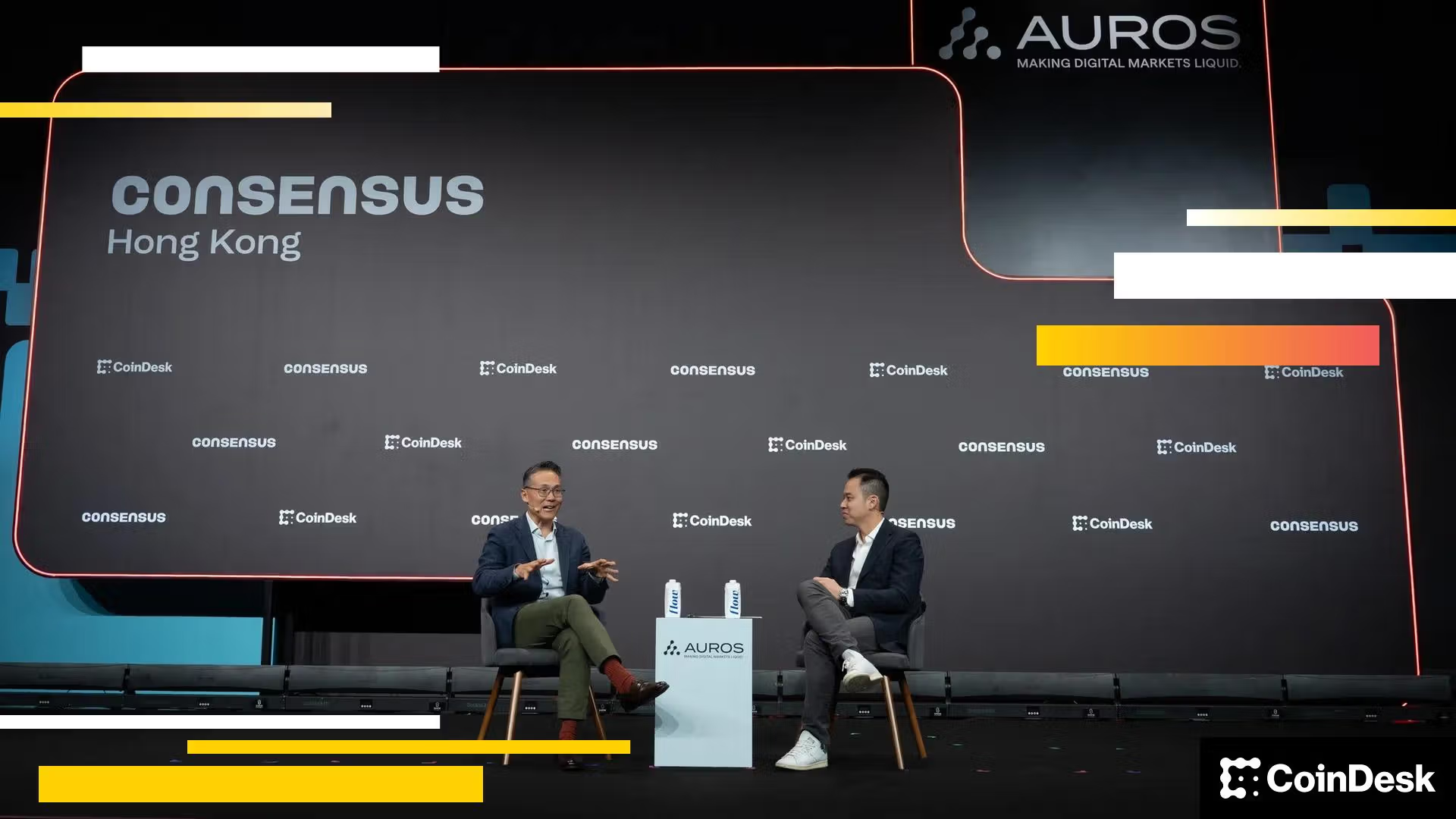
Wei Yitai, chairman of McKinsey Greater China, told Hong Kong Consensus on Thursday that almost all major companies in the world are experimenting with artificial intelligence, but almost no company has made meaningful changes as a result.
Ngai said internal surveys show 98% of business executives say they are implementing some form of artificial intelligence. But when asked how many of those were large-scale deployments, “the number dropped significantly” to less than 20%, he said. In terms of measurable profit impact, it’s 5%.
Ngai believes that the bottleneck is not technical capabilities but organizational design.
Modern businesses, he said, are built on “layers of people, hierarchies, managers and reporting.” In a world where AI is native, this structure becomes friction.
Rather than reimagining business models, most companies layer AI pilots onto legacy processes, seek approvals, test small use cases and protect reporting lines.
“That’s not really where you get the most benefit from AI,” Ngai said. “The bottleneck for the implementation of artificial intelligence is actually people.”
From China’s perspective, Ngai sees a different approach. Chinese companies have spent a decade digitizing their operations around mobile and data. As a result, “the acceptance of agents and AI is much higher” and there is less resistance from workforce structures and legacy governance.
Unlike Western discourse, which often centers on cutting-edge models and general artificial intelligence, China’s focus is pragmatic: “There is much less discussion about models…and much more discussion about use.”
Ngai also highlighted specific artificial intelligence such as robotics, automation and self-driving as a major frontier. Given the scale of China’s supply chains, he predicts a coming “robot dividend,” arguing that China may soon deploy more robots than humans, offsetting the impact of population decline and reshaping industrial productivity.
Ngai described 2026 as being defined by two opposing forces: geopolitical uncertainty and technological acceleration. CEOs are grappling with tariffs and fragmentation on the one hand and AI-driven transformation on the other. But corporate earnings remain resilient.

