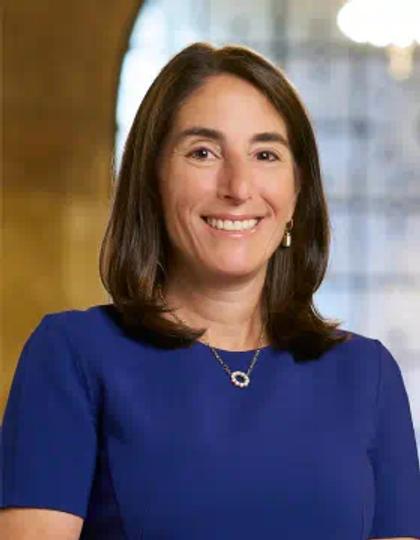
It’s no secret that Cleveland Fed President Beth Hammack has been viewed as perhaps the Fed’s most hawkish member since taking the job in 2024 after a tenure at Goldman Sachs.
Next year, however, she will be in a more prominent position to advance these ideas. The Federal Reserve’s Federal Open Market Committee (FOMC) sets interest rate policy. Among its 12 voting members are four of the 11 Fed regional chairs, who serve one-year terms. In 2026, Cleveland Fed President Hammack will join the voting panel.
“My base case is we can stay here [with rates] “It’s going to be a period of time until we get clearer evidence that inflation is falling back to target or that employment is weakening significantly,” Hammack told the Wall Street Journal over the weekend.
“I take it with a grain of salt,” Hammack said of last week’s November consumer price report. The report showed headline inflation fell sharply from 3.1% to 2.7%, with a similar decline in core inflation.
Hammack blamed data distortions caused by last fall’s government shutdown, and her own calculations showed the rate was more like the 2.9% or 3.0% economists had predicted.
All things being equal, easy central bank monetary policy is seen as good for stocks, commodities and risky assets like Bitcoin . While that’s been true this year for stocks and commodities like gold and silver, which are all at or near all-time highs, Bitcoin has struggled and began falling from its own record shortly after the Federal Reserve cut interest rates for the first time in September.
A major break with Waller
Current Fed Governor Chris Waller is one of President Trump’s finalists to be chosen as the next Fed chair.
Waller said three days ago that he judged the current federal funds rate range to be 3.5%-3.75%, 50 to 100 basis points higher than the neutral level, which means that the Fed’s policy is still quite strict.
However, Hammack told the Wall Street Journal that today’s federal funds rate range is “slightly below” the neutral rate, meaning she believes current policy is at least partly stimulative.
The gap between the two key policymakers in 2026 is huge. No matter which way rates go in 2026, there will certainly be dissent in what is usually a unanimous or near-unanimous vote. Whoever ends up as Fed chair may find it problematic to line up the seven votes needed to set policy at each meeting.

