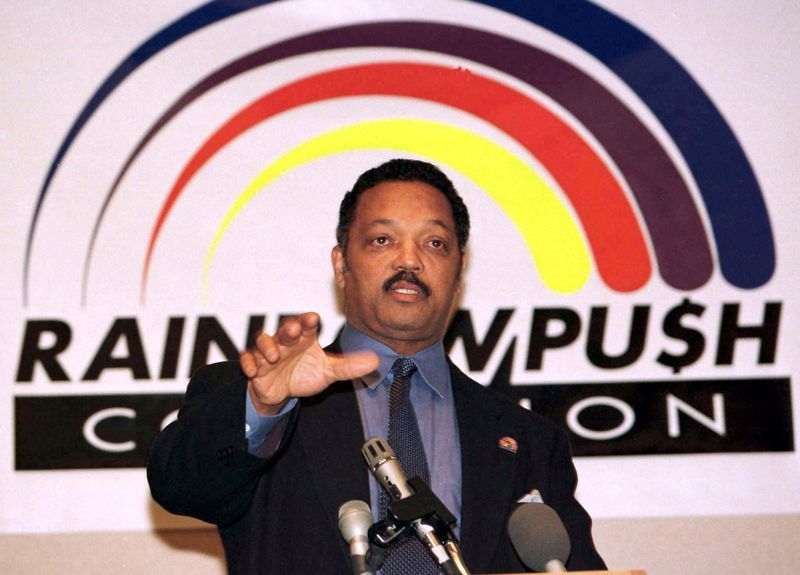
Will Dunham
WASHINGTON, Feb 17 (Reuters) – U.S. civil rights leader Jesse Jackson has died at the age of 84, his family said in a statement on Tuesday. Jesse Jackson was an eloquent Baptist minister who grew up in the segregated South and became a close associate of Martin Luther King Jr. and twice ran for the Democratic presidential nomination.
“Our father was a servant leader – not just for our family, but for the oppressed, the voiceless and the invisible around the world,” the Jackson family said.
Jackson, an inspirational speaker and longtime Chicago resident, was diagnosed with Parkinson’s disease in 2017.
His death comes as Donald Trump’s administration targets U.S. institutions, from museums to monuments to national parks, to stamp out what the president calls “anti-American” ideology, leading to the removal of slavery exhibits, the restoration of Confederate statues and other moves that civil rights advocates say could reverse decades of social progress.
The media-savvy Jackson advocated for the rights of black Americans and other marginalized communities, a movement that dated back to the tumultuous civil rights movement of the 1960s led by his mentor, King, a Baptist minister and prominent social activist.
Jackson weathered a series of controversies but remained a prominent American civil rights figure for decades.
He ran for the Democratic presidential nomination in 1984 and 1988, appealing to black voters and many white liberals, launching unexpectedly strong campaigns but failing to become the first black major-party White House nominee. Ultimately, he never held elected office.
Jackson founded the Chicago-based civil rights organizations Drive Action and the National Rainbow Coalition, and served as Democratic President Bill Clinton’s special envoy to Africa in the 1990s. Jackson also helped free Americans and others imprisoned in places such as Syria, Cuba, Iraq and Serbia.
captivating speech
Jackson relied on his mesmerizing speeches to pursue his political ambitions in the 1980s. Not until fellow Chicagoan Barack Obama was elected president in 2008 did a black candidate come as close as Jackson to a major party presidential nomination.
In 1984, Jackson won 3.3 million votes, about 18% of the total vote cast, in the Democratic nomination race and finished third in the race against Republican incumbent Ronald Reagan, behind eventual nominees Walter Mondale and Gary Hart. His candidacy lost momentum after it was revealed that Jackson privately referred to Jews as “Hymies” and New York as “Hymietown.”
In 1988, Jackson, a more polished and mainstream candidate, narrowly trailed Republican George HW Bush in the Democratic race. Jackson, who ran against eventual Democratic nominee Michael Dukakis, won 11 state primaries and caucuses, including several in the South, and received 6.8 million votes, or 29 percent, in the nominating contest.
Jackson positioned himself as a barrier-breaker for people of color, the poor and the powerless. He gave a speech at the 1988 Democratic National Convention telling his life story and calling on Americans to find common ground.
“America is not a blanket woven with one thread, one color, one piece of cloth,” Jackson told delegates in Atlanta.
“No matter where you are tonight, you can succeed. Keep your head high, chest high. You can succeed. Sometimes it will be dark, but the dawn will come. Don’t surrender. Suffering breeds character, and character breeds faith. Ultimately, faith will not disappoint,” Jackson added.
In 2017, Jackson, 76, announced that three years after developing symptoms, he had been diagnosed with Parkinson’s disease, a movement disorder characterized by tremors, stiffness, and poor balance and coordination.
southern roots
Born on October 8, 1941, in Greenville, South Carolina, his mother was a 16-year-old high school student and his father was a 33-year-old married man who lived next door. His mother later married another man who adopted Jackson. He grew up during America’s Jim Crow era, an era born in the South that often brutally enforced racist laws and practices to subjugate black Americans.
Jackson earned a football scholarship at the University of Illinois but transferred to a historically black university because of discrimination he said he experienced. He began his civil rights activism while a student at North Carolina Agricultural and Technical College and was arrested while trying to enter a “whites only” public library in South Carolina.
He attended Chicago Theological Seminary and, although he failed to graduate, was ordained a Baptist minister in 1968.
Jackson became a deputy to civil rights leader Martin Luther King Jr., sometimes traveling with him. The day King was assassinated by a white man named James Earl Ray on the balcony of the Lorraine Motel in Memphis, Jackson was one floor below. Jackson told reporters that he held the dying king in his arms and was the last person to speak to King, angering some of King’s other colleagues, but they dispute the account.
King, who headed the Southern Christian Leadership Conference, appointed the energetic Jackson to leadership positions to help create economic opportunities in black communities.
Jackson later broke with King’s successor at SCLC, Ralph Abernathy, and formed his own civil rights organization, Operation PUSH, in Chicago in the early 1970s. In 1984, Jackson founded the National Rainbow Coalition, whose broader civil rights mission also included women’s rights and gay rights, and the two organizations merged in 1996. He resigned as Chairman of the Rainbow Initiative in 2023 after more than 50 years of leadership and activism.
He met his wife, Jacqueline Brown, while in college. They married in 1962 and had five children. His son, Jesse Jackson Jr., was elected to the U.S. House of Representatives, but resigned and served time in prison on fraud charges. Jackson also became a scandal in 1999 when he fathered a daughter out of wedlock with a woman who worked for his civil rights organization.
Jackson was known for his personal diplomacy. In 1984, after he brokered the release of U.S. Navy pilot Robert Goodman Jr. in Syria, President Ronald Reagan invited Jackson to the White House and expressed his gratitude for Jackson’s “mission of mercy.” In 1990, Jackson met with Iraqi leader Saddam Hussein to free hundreds of Americans and others after Iraq invaded Kuwait. In 1984, he helped free dozens of Cuban and American prisoners from Cuban prisons, and in 1999 freed three American pilots imprisoned in Serbia.
From 1992 to 2000, he hosted a weekly show on CNN urging businesses to economically empower black people, and in 2000 he received the Presidential Medal of Freedom, the nation’s highest civilian honor, from Clinton.
Jackson continued his activism later in life, denouncing the police killings of George Floyd and other Black Americans amid the global movement for racial justice in 2020.
(Reporting by Will Dunham in Washington; Additional reporting by Gursimran Kaur in Bengaluru; Editing by Diane Craft, Kat Stafford, Kevin Liffey and Ros Russell)

