Jane Wolfe
WASHINGTON (Reuters) – The U.S. Supreme Court has been striking down campaign finance laws for decades, ruling that they violate constitutional protections by suppressing political speech. Next week’s case involving Vice President J.D. Vance gives the court and its conservative majority an opportunity to amplify this trend.
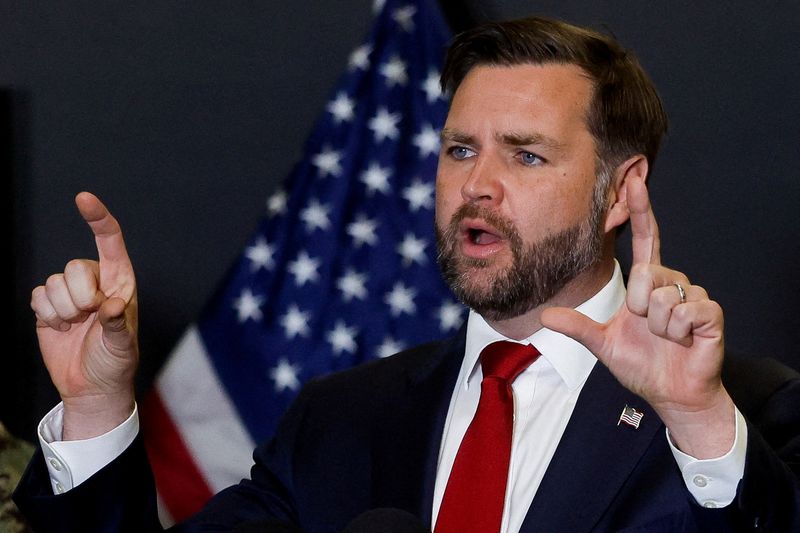
Vance is running for the U.S. Senate in Ohio when the lawsuit begins in 2022, and two Republican committees have appealed a lower court ruling that upheld limits set by Congress in the 1970s on parties coordinating spending with candidates for federal office.
The Supreme Court will hear arguments in the case on Tuesday, which could further reshape the U.S. campaign finance system by removing yet another spending limit at a time when critics say big-money donors already wield too much influence over U.S. elections.
Republican President Donald Trump’s administration has backed his vice president’s stance on the case. A ruling is expected by the end of June.
If history is any guide, the court, with a 6-3 conservative majority, is likely to rule in favor of Republicans challenging campaign finance regulations on free speech grounds, said Jessica Levinson, a professor at Loyola Law School in California.
“For more than two decades, the Supreme Court has been weakening and cracking down on campaign finance laws, finding that many of them violate free speech,” Levinson said.
Citizens United Judgment
In 2010, the Supreme Court issued a landmark ruling in Citizens United v. Federal Election Commission that allowed businesses and other outside groups, such as unions, to make unlimited independent spending on campaigns, holding that the restrictions imposed by Congress violated the right to free speech under the First Amendment to the U.S. Constitution.
The ruling paves the way for the creation of independent political action committees called “super PACs” and other groups that can accept unlimited donations.
In 2014, the court struck down limits on the total amount of federal political contributions an individual could make, also on First Amendment grounds.
In a 2022 ruling in favor of Republican U.S. Sen. Ted Cruz, the court struck down a federal campaign finance law that limited how and when candidates could repay their own campaign loans, again citing the First Amendment.
Republicans often argue that the rulings have been unfairly maligned by liberals. They touted the decisions as a boost for political speech, which the Supreme Court has determined should be protected at the highest level of the First Amendment.
The case being argued Tuesday, National Republican Senatorial Committee v. Federal Election Commission, involves part of the 1971 Federal Campaign Act, a cornerstone of the U.S. campaign finance system.
The law and its amendments, like the Bipartisan Campaign Reform Act of 2002, regulate the fundraising and spending of U.S. elections by limiting the amount that individuals, groups and political parties can contribute or spend to candidates, with the goal of preventing corruption.
Coordinate spending
Under federal campaign law, expenditures made by a political party to support or oppose a candidate but not coordinated with the candidate’s campaign are considered “independent expenditures” and are not subject to monetary limits.
However, spending coordinated between parties and campaigns is limited by law and varies based on the population of the state in which a candidate seeks office, with lower spending in less populous states and higher in more populous states. In 2024, the limit would be about $123,000 to $3.7 million for Senate candidates and about $62,000 to $123,000 for House candidates, according to court documents.
Congress enacted these limits to ensure that wealthy donors could not circumvent limits on the individual amounts they could donate to candidates.
“If coordinated spending is allowed without restrictions, political parties can become conduits for big donors seeking to funnel money through the party to their preferred candidates,” said Tara Malloy, an attorney at the Washington-based Campaign Legal Center, an advocacy group that supports strong campaign finance regulations.
The Justice Department under both Democratic and Republican presidents has long defended limits on coordinated spending in court. The Supreme Court ruled in 2001 that these restrictions were constitutional. But campaign finance laws have since changed, and Republicans now want to overturn the 2001 precedent.
In a 2022 lawsuit, the National Republican Senatorial Committee, National Republican Congressional Committee, Vance and Republican former congressman Steve Chabot sought a court order blocking the Federal Election Commission from imposing limits on coordinated party spending.
The plaintiffs argue that these restrictions “strictly limit political party committees from doing their First Amendment right: to fully endorse and support their own candidates for federal office.”
In its 2014 campaign finance ruling in McCutcheon v. Federal Election Commission, the Supreme Court declared that preventing corruption or corruption is the government’s only legitimate interest in regulating campaign finance.
Dan Backer, a conservative attorney who played a key role in the First Amendment challenge in McCutcheon’s case, said the ruling showed why the court now needs to overturn the 2001 precedent and lift limits on coordinated spending.
“It doesn’t make sense that a political party can corrupt its own candidate,” Barker said. “Political parties exist to nominate and elect candidates.”
With Trump’s Justice Department refusing to defend the federal law involved in Vance’s case, court-appointed attorney Roman Martinez will do so. Martinez argued that the limits on coordinated spending are sensible, well-written and consistent with free speech protections.
“The use of political parties as a conduit to evade grassroots restrictions and promote corruption is not speculation or hypothetical,” Martinez wrote in a court filing. “It is a real-world problem, reflected in evidence from the 1970s to the present.”
Martinez also made several jurisdictional arguments as to why the Supreme Court should dismiss Vance and others’ lawsuit without ruling on the case on its legal merits.
Malloy said these arguments are an attractive “exit” for judges if they are unwilling to take the step of overturning another precedent.
(Reporting by Jan Wolfe; Editing by Will Dunham)