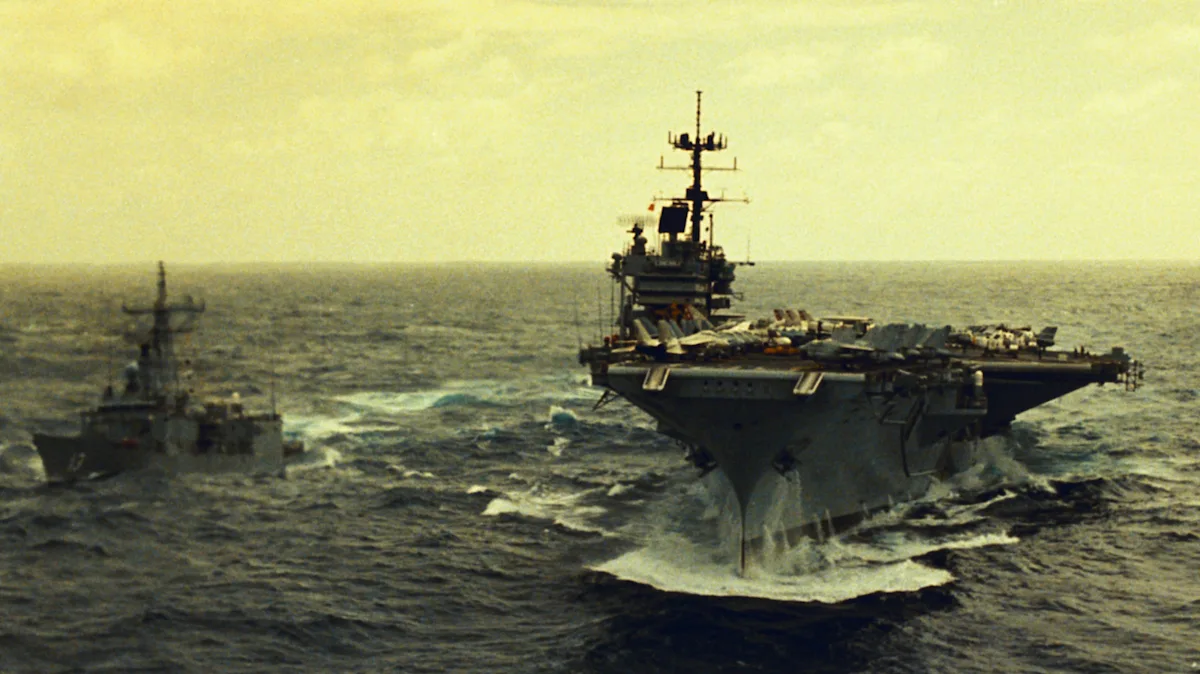
By any standard, a modern aircraft carrier is a behemoth. The U.S. Navy’s Ford-class aircraft carriers are massive and possess impressive technology and combat capabilities. However, despite their size and capabilities as maritime readiness cities, aircraft carriers, like all other ocean-going vessels, can be hit by huge storms while operating in waters around the world.
Because of their ability to launch and recover dozens of state-of-the-art fighter jets, we sometimes overlook the fact that these giant floating air bases can be tossed about quite violently at sea. With flight decks and hangars filled with aircraft, how does the Navy ensure that these expensive and important aircraft don’t get damaged or washed overboard as its carriers are tossed around in rough seas?
It’s a multi-layered process, starting with high-tech weather models that predict storms, specific plans to arrange and secure aircraft on board, and finally the multiple systems and navigation techniques that keep aircraft and other personnel and equipment on the carrier safe during storms.
Read more: The 10 largest navies in the world, ranked by self-reported total naval assets
Be prepared for rough seas

The deck of the USS John F. Kennedy during a hurricane – U.S. Navy/Getty Images
Aircraft carriers fight ships first and foremost, but some of the greatest dangers they face actually come from nature. During World War II, Typhoon Cobra wreaked havoc on the aircraft carriers and support ships of Admiral Halsey’s Task Force 38 in the Philippines, damaging or destroying nearly 150 aircraft and killing hundreds of sailors. In 1988, the first historic Midway-class aircraft carrier survived a 26-degree roll during a typhoon in the Sea of Japan.
Modern aircraft carriers benefit from the latest weather monitoring technology, which is the first step in protecting the carrier’s wings during storms. Carriers rely on shore-based and onboard meteorologists to monitor weather and ocean patterns and issue accurate forecasts to bridges. If possible, ships would adjust course to avoid the worst of the storm, but sometimes (especially in combat situations) this was not possible.
So the next step is to prepare the flight deck and hangar for the storm. Depending on the severity of the storm and the size of the waves, different plans are made, but aircraft on the deck typically move from ready-to-launch positions at the edges to the center, where there is less movement and risk. Each aircraft will be secured to the deck at multiple points with heavy-duty chains and wheel blocks to prevent them from rolling. Some aircraft were also moved to hangars below decks; crews were also responsible for protecting these facilities, and the hangar bays’ watertight doors were sealed.
weather the storm

F/A-18 Super Hornet on the deck of the USS Gerald R. Ford – Finnbarr Webster/Getty Images
From there, carriers have many systems and procedures in place to help them ride out the waves as safely and securely as possible. The carrier’s navigation team and helmsman adjust the ship’s course, often to ensure that it sails into the wind at a slight angle. Speed is adjusted and the ship adjusts its ballast tanks and stabilizers to keep it upright and as stable as possible during the storm.
Many of these tips and techniques are not unique to aircraft carriers and are used by all types of large ships during storms at sea. It’s just that for aircraft carriers, there are additional challenges in securing and protecting dozens of extremely expensive combat-ready aircraft, all of which must be locked down and kept safe until the storm passes.
As long as aircraft carriers operate on the ocean, they will have to deal with storms — and the Navy has well-established procedures to protect jets at sea. Nonetheless, on rare occasions, accidents resulting in damage or loss of carrier-based aircraft can and do occur. In other words, the two U.S. jets that crashed from the aircraft carrier in 2025 were not actually killed because of rough seas, but because of equipment failure and lack of warning during evasive maneuvers.
Want to stay up to date on the latest tech and automotive trends? Sign up for our free newsletter to get the latest headlines, expert guidance and how-to tips, one email at a time. You can also add us as your preferred search source on Google.
Read the original article on SlashGear.