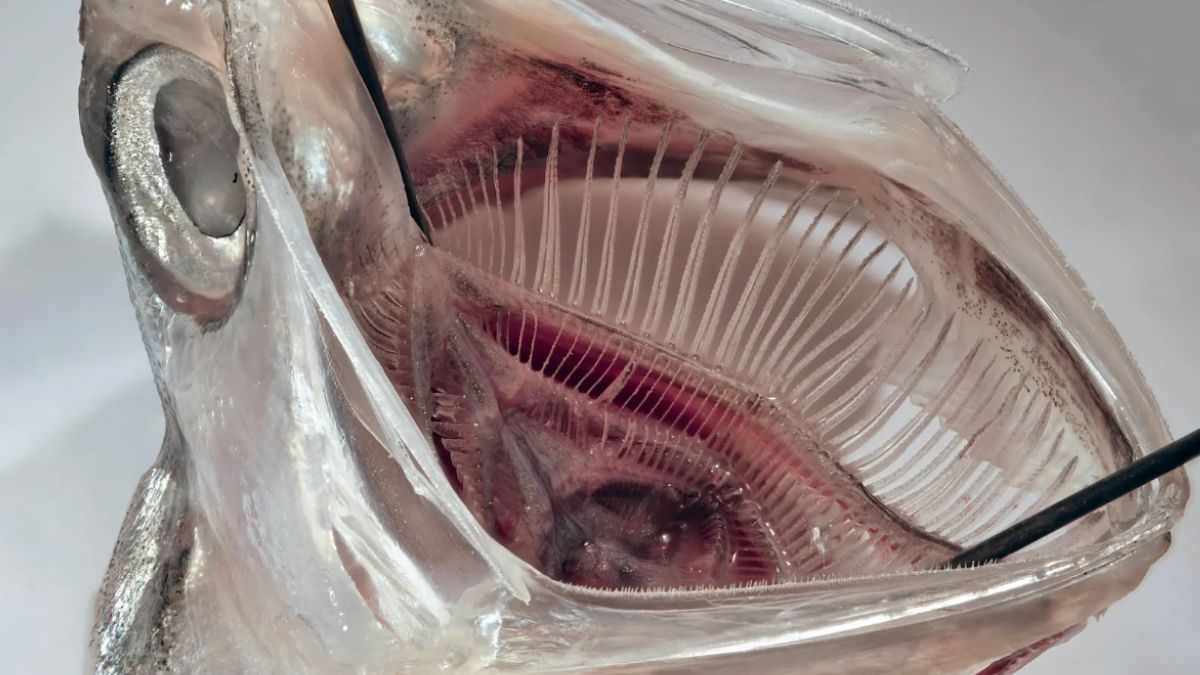
The ancient evolution of fish mouths may help tackle modern sources of plastic pollution.
Inspired by these natural filtration systems, German scientists have developed a method to remove 99% of plastic particles from water. It’s based on how some fish eat tiny prey through filter feeding.
The research team has applied for a patent in Germany, and in the future, they hope their invention will help curb the widespread plastic pollution that many people are unaware of.
RELATED: There’s a very simple way to remove microplastics from drinking water
Every time a load of laundry is done, millions of microplastics are washed from the fibers of our clothes into local waterways.
It is estimated that up to 90% of the plastic in “sewage sludge” comes from washing machines. This material is often used in agriculture as soil or fertilizer, potentially exposing those who eat the resulting crops to these contaminants.
At this stage, it’s unclear what impact microplastics will have on human health when they invade our bones and organs, but some toxicologists are concerned about their initial findings in animals.
Finding a way to capture plastic contaminants before they leave your washing machine is challenging. Filtration systems currently on the market can easily become clogged.
Researchers at the University of Bonn and the Fraunhofer Institute for Environment, Safety and Energy Technology looked to nature for inspiration. They decided to create a water filtration system that mimics the mouths of some fish, such as mackerel, sardines and anchovies.
These sea creatures swim through the water with their mouths open, feeding on tiny plankton. Over millions of years, comb-like structures evolved in their mouths to capture tiny prey.

The researchers mimicked the mesh-like structure formed by the anchovy’s gill arches (A) and its fine-toothed gill rakers (B and D). (Harman et al., npj emerging. Cantam.2025)
“During feeding, water flows through the permeable funnel walls, is filtered, and particle-free water is then released back into the environment through the gills,” explains Alexander Blanke, a functional morphologist at the University of Bonn.
“However, the plankton is too large; it is blocked by the natural sieve structure. Because of the funnel shape, it then rolls toward the esophagus, where it is collected until the fish swallows it, thus emptying and cleaning the system.”
Based on this anatomy, the researchers designed a conical filtration system lined with mesh surface areas.
Instead of hitting the filter directly like other filtration systems, the plastic particles “roll” along the edges of the new device.

New plastic filter unit for washing machines. (Harman et al., npj emerging. Cantam.2025)
This provides a greater surface area for filtration as wastewater passes through the device. The plastic particles are then trapped on the outside of the filter and flushed into a separate compartment that is emptied every dozens of washes, much like the lint filter in a dryer.
RELATED: Microplastics can spread dangerous pathogens, scientists warn
Unlike other plastic filtration systems on the market, this system reduces clogging by 85%.
According to recent projections, at least 5.6 million tons of synthetic microfibers such as polyester and nylon have been released into our clothing since the first mass production of them in the 1950s.

Sign up for ScienceAlert’s free fact-checking newsletter
While many people are now aware of the presence of plastic in the kitchen, our clothes continue to leach pollutants into the environment unabated and often unnoticed.
Unless we change the materials in our clothes, efficient plastic filtration systems are critical to mitigating future pollution.
Thankfully, nature has come to our aid.
The study was published in npj emerging pollutants.