CARACAS (Reuters) – Cuban security advisers and doctors have left Venezuela as the government of interim President Delcy Rodriguez faces intense pressure from Washington to dissolve Latin America’s most important left-wing coalition, 11 people familiar with the matter said.
Venezuela’s interim president Delcy Rodriguez has entrusted her protection to Venezuelan bodyguards, according to four sources, unlike deposed President Nicolas Maduro and his predecessor, the late President Hugo Chavez, who both relied on elite Cuban troops.
The U.S. military raid that captured Maduro on January 3 left 32 Cubans dead, according to the Cuban government. The soldiers and bodyguards are part of a deep security agreement between Caracas and Havana that began in the late 2000s, under which Cuban intelligence operatives infiltrate the entire military and Venezuela’s powerful DGCIM counterintelligence unit, which is crucial to clearing out domestic opposition.
“Cuba’s influence is absolutely critical to the survival of the Chavez government,” said Alejandro Velasco, an associate professor of history at New York University and an expert on Venezuela.
Within the General Intelligence Directorate, a number of Cuban advisers have been removed from their posts, according to former Venezuelan intelligence officials. A number of Cuban medical personnel and security advisers have flown from Venezuela to Cuba in recent weeks, two sources said.
A source close to Venezuela’s ruling party said the Cubans will leave on Rodriguez’s orders due to U.S. pressure. It is unclear from other sources whether the Cubans were forced to leave by Venezuela’s new leadership, left voluntarily, or were recalled from Havana.
The decision to exclude Cubans from the presidential guard and counterintelligence services has not been previously reported.
Trump wants to end Venezuela-Cuba ties
Before the operation to clear out Maduro, thousands of Cuban doctors, nurses and sports coaches were working in Venezuela as part of welfare programs launched under Chavez. In exchange, Venezuela provided Cuba with a much-needed source of oil.
Following the US attack, US President Donald Trump vowed to end security ties between Venezuela and Cuba. “For years, Cuba lived on vast amounts of oil and money from Venezuela. In return, Cuba provided ‘security services’ to the last two Venezuelan dictators, but no more!” he wrote on Truth Social on January 11.
In response to a question about U.S. pressure on Venezuela to sever ties with Cuba, a White House official said the U.S. “has a very good relationship with Venezuela’s leadership” and believed Rodriguez’s “self-interests are aligned with advancing our key objectives.”
Cutting off Venezuela’s ties with Cuba is part of Washington’s broader strategy to overthrow the communist government in Havana. Since mid-December, Washington has blocked Venezuelan oil shipments to Cuba, strangling the island economically.
The official said the U.S. government was “negotiating with Cuba and Cuban leaders should reach an agreement.”
The Cuban government has expressed a willingness to engage in equal dialogue, while condemning the oil blockade and vowing to resist U.S. intervention.
The governments of Cuba and Venezuela did not respond to requests for comment. The two countries have publicly confirmed their ongoing relationship.
Rodriguez, the daughter of a former Marxist guerrilla, has been a long-time ally of Maduro and a member of Venezuela’s ruling Socialist Party. She also has close personal ties to the Cuban government, according to ten U.S. and Venezuelan sources.
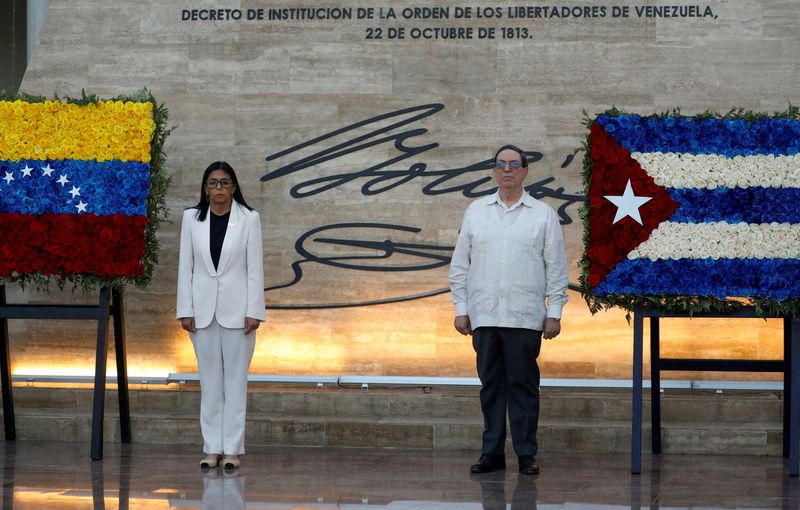
On January 8, Rodriguez appeared with Cuban Foreign Minister Bruno Rodriguez at a floral memorial service in Caracas for the victims of the U.S. attack.
“We express Cuba’s deepest solidarity with the brave people of Venezuela,” Bruno Rodriguez said at the event, before voicing the battle cry of Ernesto Che Guevara, one of the leaders of the Cuban revolution: “Hasta la victoria siempre.”
Delcy Rodriguez also spoke by phone with Cuban President Miguel Díaz-Canel later in January, saying afterwards that the two countries remained “united.” Díaz-Canel said after the same phone call that Cuba was committed to “continuing to strengthen the historical ties of brotherhood and cooperation.”
Regarding the relationship between the two countries, a White House official said: “President Trump understands that they must make certain statements for domestic political reasons.”
Return flights to Cuba
A source familiar with the Cuban government’s thinking said some military personnel injured in the U.S. attack have returned to Cuba, but others remain active in Venezuela. Sources also said many Cuban doctors continue to provide care in Venezuela.
Cuban state media said in early January that the suspension of commercial flights and the closure of Venezuelan airspace had led to a backlog of supplies, preventing Cuba from bringing furloughed doctors home or ending their missions in Venezuela. Those reports said the flights resumed a week after the January 3 attacks in the United States.
A U.S. source familiar with the matter said that while the presence in Cuba is being reduced, some undercover intelligence agents may remain in the country to monitor political developments.
“Rodríguez is acting very cautiously,” said Frank Mora, who served as U.S. ambassador to the Organization of American States during the Biden administration.
“She wants to keep her distance from the Cubans until the situation calms down and until her hold on power is clear, but also not to leave them completely aside,” Mora said.
At least some Cuban military advisers are still working in Venezuela, four people familiar with the matter said. The Cuban professor also continues to teach at the National University of Police and Security Forces (UNES), according to a former police officer.
John Polga-Hecimovich, a professor at the U.S. Naval Academy in Maryland who has studied the role of Cuban security advisers in Venezuela, said the legacy of Cuban counterintelligence operations is still evident in Caracas, where Maduro’s top loyalists remain in power.
“The Cubans failed to protect Maduro, but they played a key role in keeping the Chavez government in power,” Polgar-Hersimovich said. “The effectiveness in preventing coups has been outstanding.”
(Reporting by Sarah Kinosian and Julia Symmes Cobb in Caracas and Laura Gottesdiener in Monterrey, Mexico. Editing by Stephen Eisenhammer and Michael Learmonth)