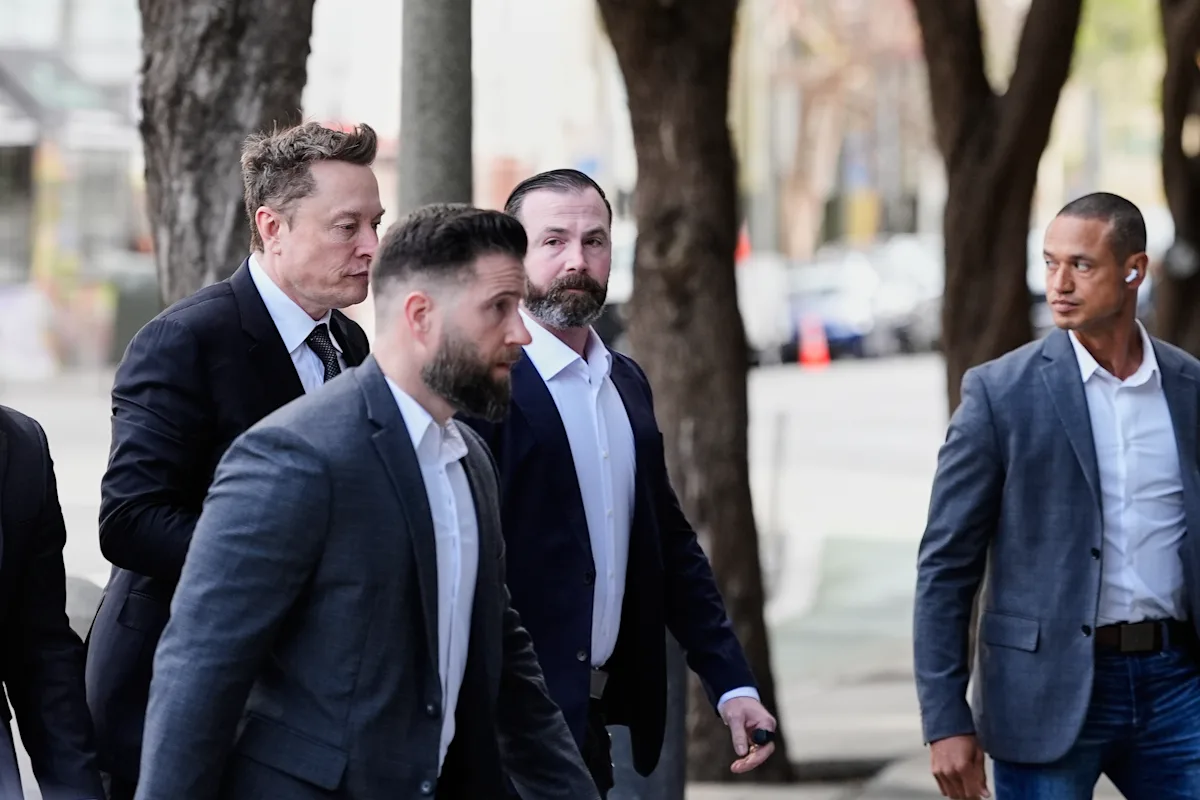
Elon Musk defends himself against accusations of misconduct leading up to Twitter takeover

SAN FRANCISCO (AP) — A defiant Elon Musk took the stand Wednesday in a jury trial to defend himself against accusations that he misled investors by trying to back out of a $44 billion deal to buy Twitter before it was finally completed.

The civil trial in San Francisco centers on a class-action lawsuit filed before Musk took control of Twitter, the social media service he renamed X, in October 2022, six months after Musk agreed to buy the troubled company for $44 billion, or $54.20 a share. The price paid to the world’s richest man is a fraction of his current fortune, estimated at $841 billion.

The case, which represents Twitter shareholders who sold their stock between May 13 and October 4, 2022, accuses Musk of violating federal securities laws while taking a series of calculated steps to drive down the company’s stock price in an attempt to ruin the deal or secure a lower sales price.

Musk has insisted that the deal is worth renegotiating or terminating, while insisting that Twitter’s board deceived him about the proportion of fake or “bot” accounts on its platform – a position he took again in testimony Wednesday wearing a black suit and tie.

Asked whether he threatened to “go after” Twitter’s board unless they returned to the negotiating table to discuss a revised sale price, Musk didn’t rule it out, and his answer reflected the heated row surrounding the deal.

“There are a lot of threats on both sides,” Musk said. “I’m very unhappy with the Twitter board because I feel they were involved in fraud.”

See also  Ferrari F1 parts ways with reserve driver Zhou Guanyu after 2025 stint

The issue of bots and fake accounts on Twitter was not new when Musk negotiated the deal. The company paid $809.5 million in 2021 to settle charges that it inflated growth and monthly user figures. Twitter has also disclosed its bot estimates to the Securities and Exchange Commission for years, while also warning that its estimates may be too low.

During Wednesday’s testimony, Musk repeatedly described the information provided by Twitter’s board of directors and used the abbreviation of bull scatology. “I did make it clear that I think this is bullshit,” Musk said of Twitter’s calculation that only about 5 percent of its accounts are bots.

But charges in the case accuse Musk of making a series of misleading statements about the Twitter deal before he sent notice in July 2022 to terminate the deal.

After Musk quit, Twitter took him to a Delaware court to force him to honor his original agreement. Just before the case was scheduled to go to trial, Musk again changed his position and agreed to pay the fees he had originally promised.

Musk testified Wednesday that he ultimately closed the deal because his attorneys told him that Delaware Chancery Court President Catherine St. Jude McCormick, who was handling the case, was “extremely biased” against him and that he had no chance of winning.

He pointed out that McCormick canceled the $55 billion compensation package awarded to him as CEO of electric car maker Tesla, but The decision won’t be made until January 2024 —15 months after he completed the Twitter acquisition. The Delaware Supreme Court overturned McCormick’s ruling late last year.

See also  Former Chelsea Target Keen For A Fresh Challenge: Why The Blues Must Reignite Interest

By linking McCormick’s belief that he was biased to his attorney, Musk shielded himself from widespread questioning of the decision through legal protections shielding discussions between the attorney and his client.

But U.S. District Judge Charles Breyer on Wednesday cited other evidence suggesting Musk may personally believe McCormick was biased, which could lift attorney-client privilege. Breyer said he may rule on the matter in the trial, which is currently scheduled to continue on March 19.

Musk claimed in his testimony that his decision to complete the transaction at the original selling price resulted in a huge windfall for most Twitter shareholders.

But Twitter’s stock price fell below $33, about 40% below Musk’s original purchase price, and the deal was pending. The downturn has come at a cost to shareholders who sold their shares during the uncertainty caused by lawsuits alleging deception by Musk.

“I can’t control whether people sell or not, but everyone who holds shares is doing really well,” Musk said.

This is not the first time Musk has been dragged into court to defend himself against accusations that he deceived investors with social media posts. Three years ago, Musk spent about eight hours testifying at a federal trial in San Francisco about his proposed 2018 deal to buy Tesla, the electric car maker he still operates as a public company, for $420 a share, but that deal never materialized. A nine-member jury cleared Musk of wrongdoing in the case.

See also  Oldest evidence of human fire-making discovered at site in England

Before Wednesday’s testimony ended, Musk acknowledged that his frequent social media posts may have revealed too much about his thinking.

“What I think privately is what I say publicly,” Musk said.

Musk is expected to return to court on Thursday to continue testifying.

Spread the love

Leave a Reply

Your email address will not be published. Required fields are marked *