In recent days, more than 20 earthquakes have occurred in the Coachella Valley, causing concern among some residents.
A 4.9-magnitude earthquake was reported about 12 miles north of Indio on Monday night, January 20, marking the first moderate-sized earthquake in the area in some time.
Following several smaller aftershocks, a larger magnitude 4.3 earthquake woke many residents from their sleep at 12:30 pm on Wednesday, January 21.

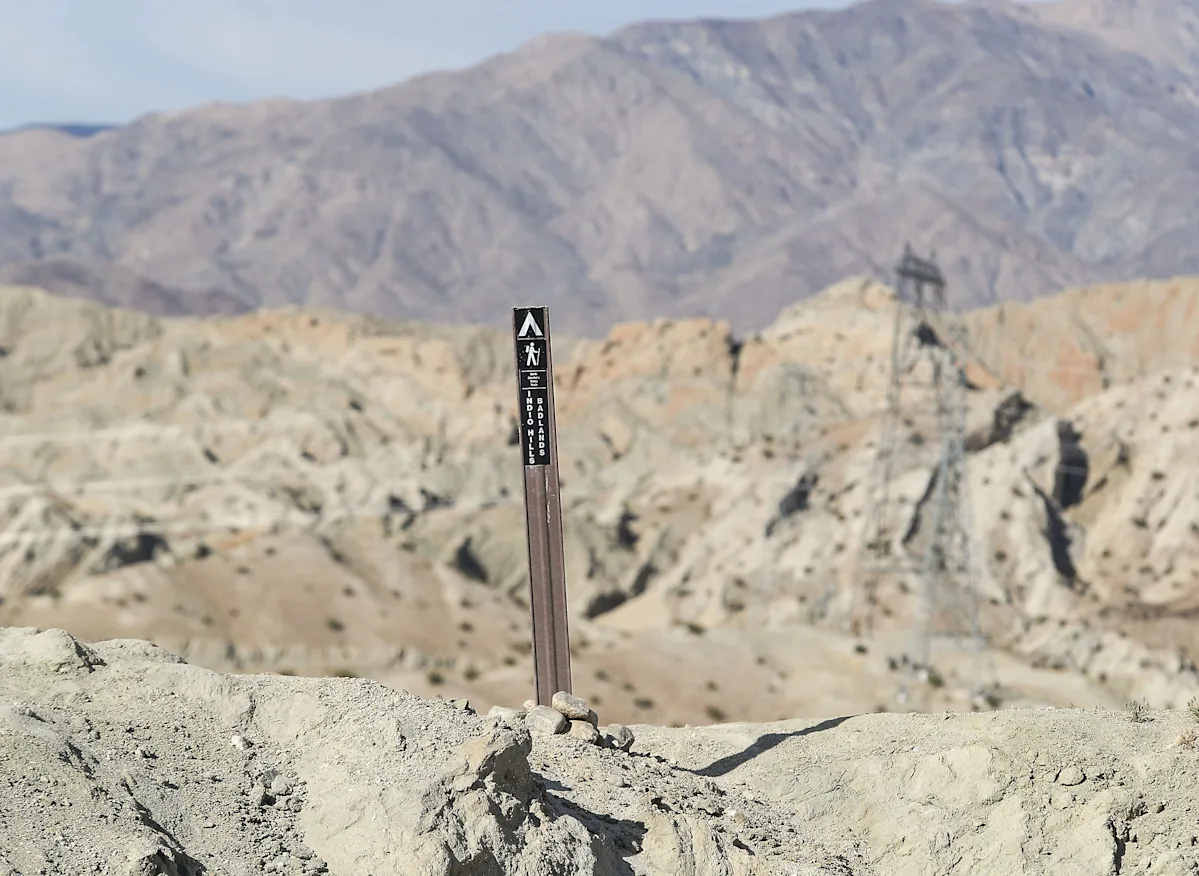
Signs guide hikers in the right direction on the Indio Mountain Badlands Hiking Trail north of Indio on March 6, 2020.
As Californians have been worried about “the big one” — and in some ways, the predicted big one on the country’s west coast is long overdue — it’s understandable that some will be more nervous.
However, experts say the recent moderate earthquakes in Indio are relatively normal for the region. All earthquakes that follow the initial wave follow a typical aftershock pattern.
“The sequence behaves as you would expect, a typical decay after a 4.9,” said Kate Scharer, a research geologist with the U.S. Geological Survey. “If you have a magnitude 4.9, you’re probably going to get 10 or so three-magnitude earthquakes next week.”
It is not unheard of for earthquakes to be traced as “foreshocks” to the main event. In 1992, a 6.1-magnitude earthquake struck Joshua Tree more than a month before the 7.3-magnitude Landers earthquake.
However, from a statistical perspective, the likelihood of such an event occurring is very low.
According to the U.S. Geological Survey, there is a 5% chance of an earthquake of equal or greater intensity occurring within a week of each earthquake. Scharer said that after a magnitude 4.9 earthquake struck Indio, there is a 1 percent chance of an earthquake of magnitude 7 or greater.
“This is exactly what we want for this region,” she added. “We should expect these earthquakes to occur.”
fault line
The latest set of quakes occurred on a little-known fault line beneath Beldue Canyon, a remote road through Joshua Tree National Park.
About eight miles from the San Andreas Fault, recent earthquakes may be far enough away from it not to interact with it, but it’s impossible to predict.
One reason geologists are interested in the interaction between fault lines is that the San Andreas Fault is overdue for major earthquakes. There has not been a major rupture along the San Andreas Fault in about 300 years.
Sharer said it’s a little longer than average, but not unheard of.
“It’s really a good reminder that one day there’s going to be a big earthquake and it’s going to be very challenging for your community or your city,” she said. “So it’s a good reminder for us to stop and ask ourselves what do we need to do to be better prepared for an earthquake?”
What should I do during an earthquake?
In the event of an earthquake, experts urge people to “drop, cover, and hold on.” This is mainly to prevent them from being crushed by heavy objects.
Falling to the ground prevents falls. Covering your head and neck can protect sensitive body parts. Experts also recommend that people crawl under a nearby table or table.
Why do earthquakes occur?
The Earth has four layers: inner core, outer core, mantle and crust. According to USA Today, the crust and top of the mantle make up another region called the “lithosphere,” which acts like the skin surrounding the Earth’s surface.
However, the lithosphere is not a whole but exists like a puzzle or a series of pieces, according to the U.S. Geological Survey. These parts of the lithosphere are not stationary and move slowly. These are called “tectonic plates.”
As tectonic plates move in and out of each other, they occasionally collide or collide. This puts pressure on the edges of the board. When the stress is too great, cracks called “faults” can develop. The points where these faults move against each other are called “fault lines.”
When there is too much friction between fault lines, energy is suddenly released, causing seismic waves, which can cause earthquakes.
What are the largest recorded earthquakes in California history?
According to the California Department of Environmental Conservation, it was the largest earthquake recorded by magnitude in California since 1800.
-
7.9: Killed at Fort Tejon II, January 9, 1857; caused 220 miles of surface scar
-
7.8: April 18, 1906, San Francisco, possibly 3,000 dead; 225,000 displaced
-
7.4: March 26, 1872, Owens Valley. 27 deaths; 3 aftershocks with magnitude >6
-
7.4: November 8, 1980, west of Wound 6, Eureka; $2 million in damage
-
7.3: Twelve people were killed in Kern County on July 21, 1952; three aftershocks of magnitude 6 or above occurred within five days.
-
7.3: June 28, 1992 at Randers. One killed; 400 injured; $9.1 million in damage
-
7.2: January 22, 1923 at Mendocino. Houses in several towns were damaged
-
7.2: April 25, 1992, Mendocino Point. 356 injured; $48.3 million in losses
-
7.1: November 4, 1927, southwest of Lompoc. No major casualties, minor damage in two counties
-
7.1: October 16, 1999, Ludlow. Minimal damage due to remote location
When will the next earthquake hit California?
It’s not yet possible to predict earthquakes, but USGS scientists can calculate “the probability of a major earthquake occurring in a given area within a given year,” according to the U.S. Geological Survey.
While earthquake forecasts and probabilities are certain, the USGS said the reports are “comparable to climate probabilities and weather forecasts” rather than the same as forecasts.
The USGS map of the United States shows that parts of California have a greater than 95% chance of experiencing a minor or major damaging earthquake within 100 years. In other words, a powerful earthquake on the Modified McCallie scale “felt by all” could move some heavy furniture and cause minor damage.
No, California won’t “fall into the sea” due to earthquakes
Hours before Monday’s quake, the Berkeley Seismological Laboratory released a message about California and earthquakes, saying it was fiction that the state could eventually break apart and fall into the ocean.
“This is because earthquakes in California cause horizontal movements, rather than giant sinkholes or land sinking into the sea,” the lab shared on X. “No part of California sits on an ‘edge’ that could snap off,” the lab said.
That means the state won’t break away, sink, or disappear into the Pacific Ocean. Earthquakes will continue to occur and coastlines will slowly move over millions of years, the lab said, “but the land will not suddenly disappear.”
This article originally appeared in the Palm Springs Desert Sun: Do recent earthquakes make a ‘big one’ more likely? What do scientists say

