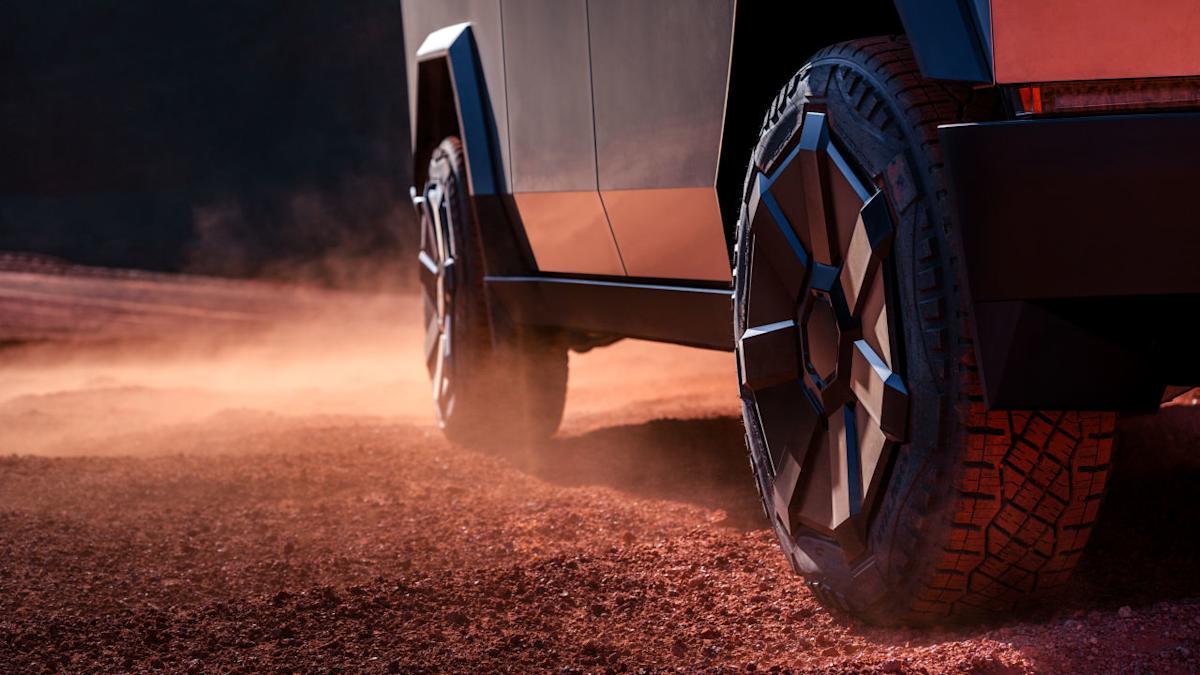
Tesla’s Cybertruck has something most electric cars don’t: a near-cult-like community of owners obsessed with real-world performance. From reviews of its stainless steel exoskeleton to debates about the behavior of fully autonomous driving, the surprisingly heated discussion right now isn’t about the software; This is about tires.
Owners are replacing existing Goodyear all-terrain tires with BFGoodrich KO3 All-Terrain Plus, which not only tracks grip and quietness, but also energy efficiency measured in watt-hours per mile (Wh/mi), a key metric for electric vehicle range.
It started with a forum member’s post higar He documented his experience after driving 31,000 miles on the original Goodyear AT tires and then installing a full set of BFGoodrich KO3s. What’s the reason? Seasonal weather and a combination of highway driving and occasional off-road use.
Like many electric car owners, Shygar doesn’t just replace his tires; He treated it as an experiment.
Does efficiency increase or decrease after exchange?

Image credit: MargJohnsonVA/Shutterstock
On the way to and from the tire shop, Shygar used Tesla’s fully self-driving “Hurry” mode to track his energy usage:
-
Equipped with Goodyear AT tires Before replacement, energy consumption was slightly over 400 Wh/mile.
-
Using BFGoodrich KO3 On the return trip, that figure rises to the low range of 430 Wh/mile—a significant increase in energy consumption.
That’s not a huge blowout, but it’s a quantifiable difference and one that many EV enthusiasts are concerned about. Electric vehicle use watt hours per mile Just like using a gasoline car miles per gallonso an increase in Wh/mi usually means a decrease in mileage per charge.
Why has efficiency dropped? The BFGoodrich KO3 is heavier and has a more aggressive tread designed for traction in all terrains, which increases rolling resistance and means the motor has to work a little harder, especially at highway speeds.
Even online reviewers who have played KO3 say range suffers – sometimes significantly – although noise isn’t always a drawback. Many owners say the KO3 isn’t as loud as its aggressive appearance might suggest.
subjective feedback
Metrics are one thing, but what does it feel like? In a forum post, Shygar and several commenters noted:
-
There’s a slight increase in highway noise, but it’s no worse than the Goodyear.
-
The steering wheel vibrated briefly at one point, but nothing serious.
-
Some people have complained that the original tires’ foam inserts detached during removal, which can cause vibration in some vehicles.
Other owners also reported that the KO3 they drove had a smoother highway feel, especially when balanced with ceramic beads rather than traditional wheel weights, showing that the setup can make a real difference.

Image source: wedmoments.stock / Shutterstock.
But what about tire wear?
This isn’t just a curiosity from one owner. Several Cybertruck owners are sharing stories about how quickly the tires on these big, heavy-duty electric trucks wear out. Another report shows that some stock Cybertruck tires are wearing out quickly, with a set lasting only 15,000-22,000 miles, well below the 50,000-plus mile ratings many all-terrain tires advertise. Others need to replace tires after 14,000 miles, even with regular rotation and no off-road use.
These anecdotes suggest that Cybertruck tire life may be shorter than expected, possibly affected by truck weight, torque and tire alignment patterns, though the data remains largely anecdotal.
Now what?
The takeaway from this forum thread is surprisingly practical for potential customers and current owners: Tire selection is no longer a cosmetic or off-road performance detail; it affects real-world efficiency, ride feel, and long-term wear.
Aggressive all-terrain models like the BFGoodrich KO3 offer powerful performance and durability with modest energy costs. Stock tires may offer better road efficiency, but sometimes have shorter tread life. Community testing, not just manufacturer claims, is filling the gap that Tesla isn’t releasing.
In an age where every Wh/mi matters, DIY data from forums and user reports can be as valuable as any official spec sheet.

