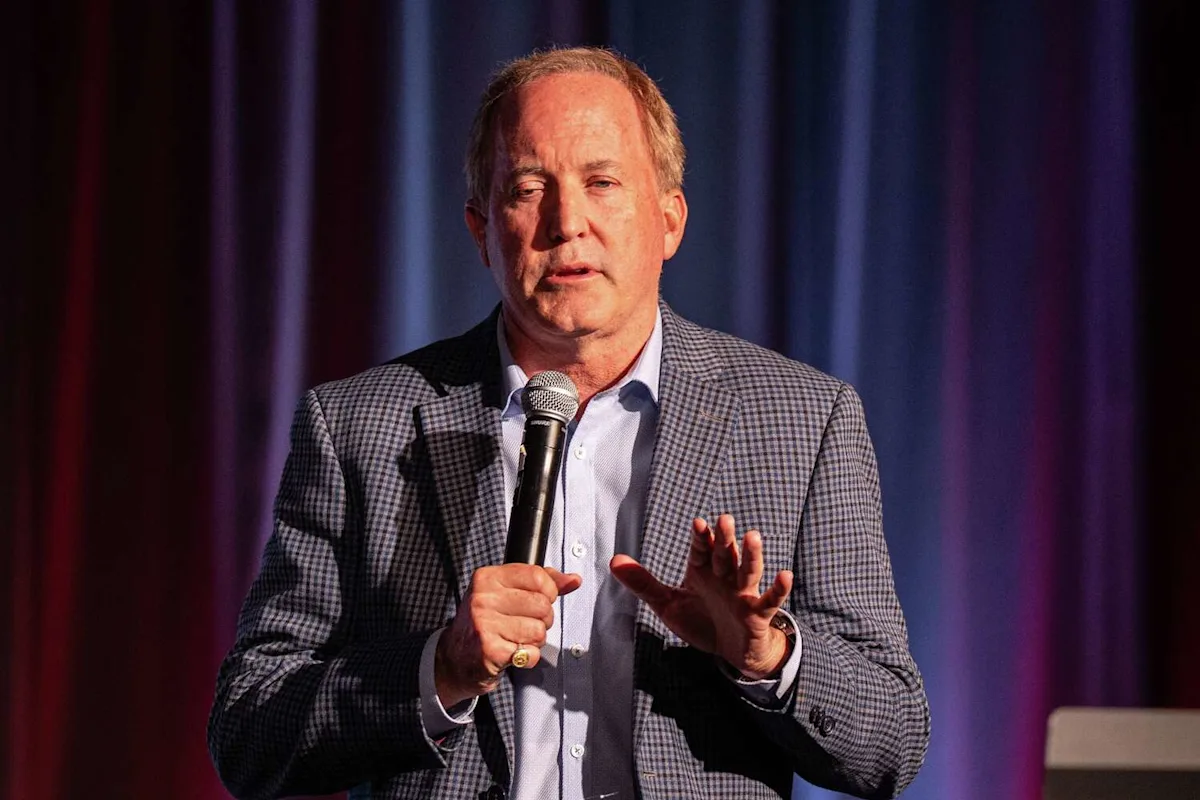
A Texas appeals court has temporarily blocked Attorney General Ken Paxton from enforcing new rules that require district attorneys in large counties to submit detailed reports on criminal prosecutions.
The unanimous ruling by three conservative judges on the 15th Court of Appeals dealt a setback to Paxton’s plan to rein in “rogue district attorneys” whom he blames for being lax on crime, and a win for district attorneys in major counties who argued that Paxton’s rules were unconstitutional and would create significant administrative and staff burdens.
background: ‘Troubling’: Judge blocks Texas attorney general’s request to access district attorney’s criminal files
In the majority opinion issued Monday, Justice Scott Field wrote that Paxton exceeded his legal authority when he finalized the reporting rules in March. He wrote that while state law allows the attorney general to request information from individual prosecutors, it does not authorize him to mandate permanent, full disclosure.
The challenged rule, passed earlier this year, would require prosecutors in counties with more than 400,000 residents to submit initial, quarterly and annual reports covering a wide range of information, including case files, internal policies and correspondence. The rules also create an oversight board and consider failure to comply as “official misconduct,” putting prosecutors at risk of removal.
In May, elected prosecutors in Travis and El Paso counties filed suit over the regulations, and were joined by Harris, Dallas, Bexar, Williamson and Fort Bend counties. A Democratic state district court judge temporarily blocked the rule in July.
In a majority opinion on Monday, the 15th Court of Appeals held that there was sufficient evidence to show that the rules would cause direct and irreparable harm. Prosecutors testified that compliance would require thousands of staff hours, divert resources from active prosecutions and risk the disclosure of sensitive and private information, including grand jury materials and victim records.
However, the appeals court narrowed the scope of the lower court’s injunction, ruling that it applied only to the seven prosecutors who filed the case, rather than all 13 prosecutors bound by the rules. The court reversed the trial court’s order prohibiting statewide enforcement of the rules and remanded the case for further proceedings.
Chief Justice Scott Brister wrote in a unanimous opinion that the Legislature’s decision not to give Paxton the power to remove recalcitrant prosecutors was detrimental to Paxton’s position. In 2023, lawmakers passed a statute that states counties must provide information to the attorney general only upon written request related to specific criminal matters and created a separate process for local residents, not the attorney general, to seek the removal of prosecutors accused of refusing to enforce certain laws.
Brister also noted that in nearly 150 years, the Texas attorney general had never attempted to adopt similar rules under the statute. Under the Texas Constitution, the Attorney General’s Office handles primarily civil matters but can provide assistance upon request from local prosecutors.
Paxton argued that the reporting requirements were necessary to oversee what he said was a refusal by some prosecutors to enforce state law, particularly in Democratic-led urban counties.
In his concurring opinion, Brister said he also would like to see more energy on the part of prosecutors.
“Our customs and laws have long left room for prosecutorial discretion and the allocation of resources in criminal cases,” Brister wrote. “But prosecutors’ legal responsibilities are embodied not just in the letter of the law but also in its spirit. Prosecutors cannot expect their discretionary decisions to be respected unless they extend the same deference to the discretionary decisions of those charged with making the law.”

Harris County Prosecutor Christian Menefee responds to Texas Attorney General Ken Paxton’s lawsuit against the Elevate Harris Plan (Guaranteed Income Program) during a news conference at the Harris County Administration Building in Houston on Wednesday, April 10, 2024. Harris County officials called Paxton’s lawsuit a targeted act. (Li Yijin/Photojournalist)
Paxton first proposed the rule in March 2024. The 13 counties required to comply with the new rules are Harris, Dallas, Tarrant, Bexar, Travis, Collin, Denton, Fort Bend, Hidalgo, El Paso, Montgomery, Williamson and Cameron counties, according to the lawsuit.
Paxton’s office did not respond to Hearst’s request for comment by Wednesday’s deadline.
Harris County Prosecutor Christian Menifee called the ruling “another clear victory” for local governments.
“The court has once again confirmed that Ken Paxton does not have the authority to implement this scheme to oversee local elected officials,” Menifee, who is running to represent the 18th Congressional District, said in a statement Monday. “State officials like Ken Paxton and Greg Abbott regularly overstep their bounds, and Harris County continues to fight back every time.”
Travis County Prosecutor Delia Garza also celebrated the ruling and dismissed Paxton’s reporting requirement as a political ploy.
“Texas already has effective laws requiring full transparency from its public officials,” Garza told Hurst in a statement Wednesday. “Ken Paxton should stop trying to politicize the work of honest, hard-working prosecutors elected by local communities.”
This article was originally published on Conservative Texas appeals court says Ken Paxton overstepped authority in plan to curb ‘rogue district attorneys’.