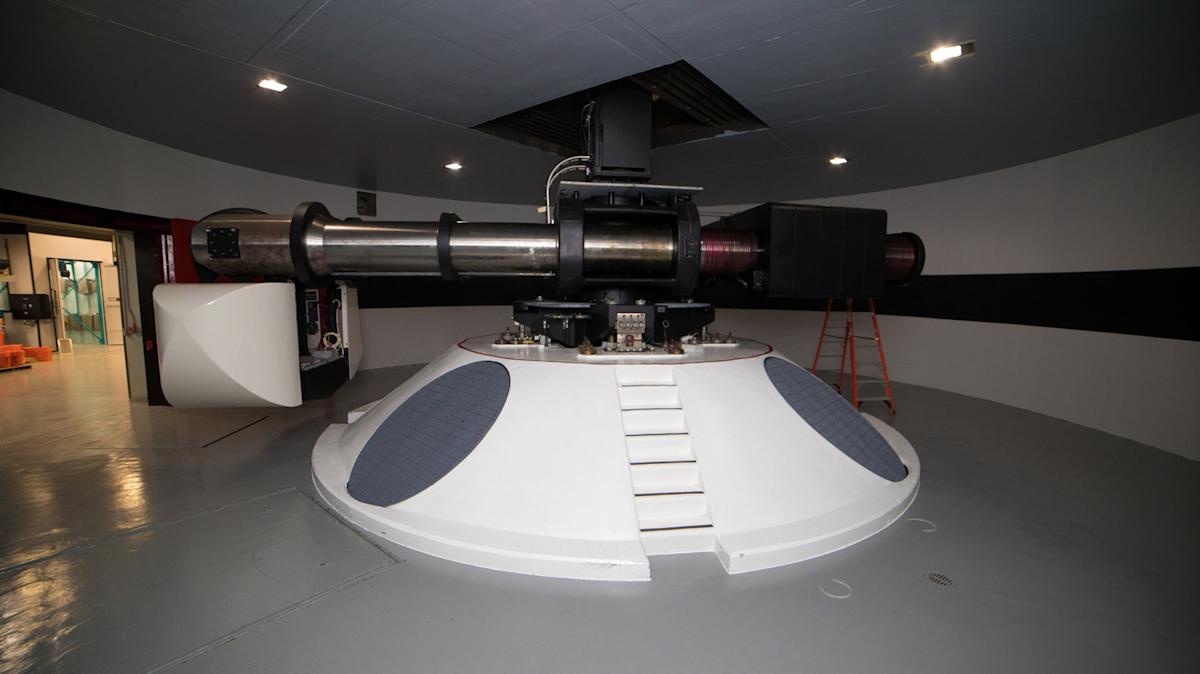
After holding the record for nearly three decades as having the world’s most powerful centrifuge, or supergravity machine, the United States ceded that title to China in 2025. When China’s new hypergravity machine — the CHIEF1300 — enters service in September 2025, it takes that title away from the centrifuge installed at the U.S. Army Engineer Research and Development Center (ERDC) Centrifuge Research Complex (CRC) in Vicksburg. Mississippi. However, CHIEF1300’s (CHIEF stands for Centrifugal Hypergravity and Interdisciplinary Experimental Facility) dominance would only last a few months. In December 2025, China launched another more powerful centrifuge, the CHIEF1900, which is currently the most powerful centrifuge in the world.
A hypergravity centrifuge is a machine designed to generate a force thousands of times greater than Earth’s. They do this by spinning at extremely high speeds, creating artificial gravity in the process. The machines have been used by agencies such as NASA and ESA for a variety of research purposes, including earthquake simulations, dam failures and the effects of high-gravity environments on living things. As opposed to hypergravity centrifuges, there are also machines that simulate lower gravity than Earth’s.
As for the claim that these machines compress space and time, it doesn’t actually work like you think. One use for these machines is to test small models of larger structures such as dams or foundations. Under high gravity, these miniature models feel the same forces that real-world structures feel, so the small devices behave like something much larger. Higher gravity also speeds up slow processes such as soil settlement or water flow, so real-world behavior can be observed over many years over days or weeks. This is how a hypergravity machine “compresses” space and time.
Read more: 8 worst places to put a TV and why
How powerful is the CHIEF1900 centrifuge? Where is it located?

Russian-era centrifuges used to train Soviet cosmonauts – Sven Creutzmann/mambo Photo/Getty Images
The capacity of large centrifuges is measured using a unit called gram-ton (gravity ton). The centrifuge that most people use in their daily lives is the typical washing machine, which in its fastest spin cycle produces an effective force of close to 2 gram tons. The American centrifuge in Vicksburg has long held the record, with a load rating of 1,200 g·ton—already hundreds of times greater than any centrifuge encountered in daily life. China’s CHIEF1300 pushes this figure to 1,300 gt. If it wasn’t already obvious, the current record holder – the CHIEF1900 – is rated to produce up to 1,900 gram-tons of force.
China’s two record-breaking supergravity centrifuges are both located at the CHIEF facility, which is part of the Zhejiang University campus in Hangzhou and has been under construction since 2019. The facility is located 49 feet underground, a move designed to minimize vibrations that can occur when these centrifuges operate.
Although CHIEF1900 has just been installed, its predecessor CHIEF1300 has been used in several experiments. Notable among them is a study that measured the seismic energy that hydropower-focused dam foundations could withstand. Another group of scientists used it to study the effects of large waves on the seafloor. These included observing the impact of 13-foot-high wind waves and a 65-foot-high tsunami on the seafloor. The purpose of this study is to determine whether the selected site is suitable for the installation of an offshore wind farm. CHIEF1300 is also capable of reproducing the extreme pressures experienced at ocean depths of approximately 2,000 meters (6,500 feet).
Want to stay up to date on the latest tech and automotive trends? Sign up for our free newsletter to get the latest headlines, expert guidance and how-to tips, one email at a time. You can also add us as your preferred search source on Google.
Read the original article on SlashGear.

