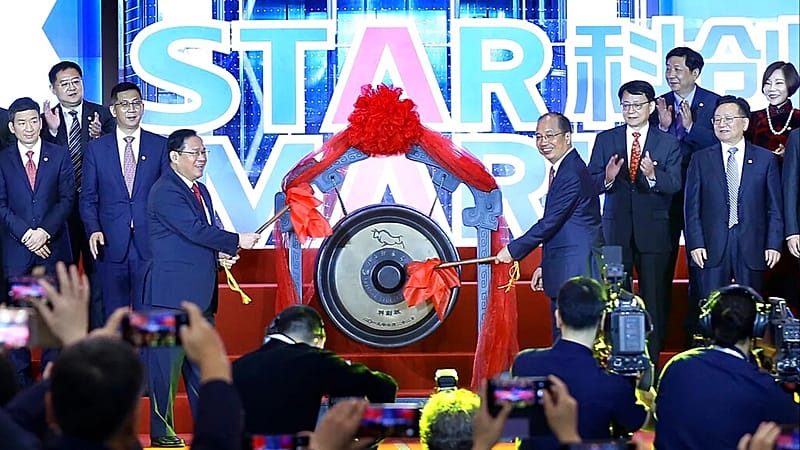
After raising 8 billion yuan (970 million euros) in funding, Moore Threads, China’s leading artificial intelligence chip maker, saw its share price surge 425% on its first day of listing in Shanghai, the largest first-day gain for a major IPO.
It is one of the largest issuances since China reformed its listing rules in 2019, when Beijing introduced a Nasdaq-style registration system on the Science and Technology Innovation Board to facilitate the listing of high-tech companies.
Moore Thread was founded in 2020 by former NVIDIA China executive Zhang Jianzhong and is regarded as a second-tier domestic chip manufacturer. This is because compared with those of Huawei HiSilicon, which dominates China’s high-end data center and AI training market, or Cambrian, a leading AI chip designer, its GPUs are still not sufficiently advanced, less energy efficient, and not widely deployed enough.
China’s semiconductor inventories have soared this year as the United States maintains full control over China’s advanced chip exports.
Washington’s export control regime, originally developed under former President Joe Biden, restricted Nvidia, Advanced Micro Devices and other U.S. companies from selling their most advanced artificial intelligence processors to China and targeted loopholes that allowed “China-only” chips to bypass earlier rules.
The rationale is that restricting access to high-end technology is intended to protect U.S. national security by slowing China’s advances in military artificial intelligence, cyber operations, and mass surveillance.
Relevant
In the short term, these restrictions largely exclude China from the world’s most advanced U.S.-made accelerators, forcing them to train and deploy large language models on less capable, less efficient hardware. This widens the performance gap with U.S. rivals as global competition to generate artificial intelligence intensifies.
However, the long-term effects are the opposite. By denying Chinese companies access to top foreign chips and chipmaking tools, Washington has reinforced Beijing’s long-standing push for semiconductor self-reliance.
Chinese leaders have responded by implementing subsidies and emergency financing to help tech giants like Tencent, Alibaba and ByteDance phase out Nvidia as much as possible and accelerate the use of domestic alternatives.
The combination creates a vast, protected domestic market for Chinese chipmakers. Even if domestic products lag behind advanced Western processing, they enjoy a protected market where China can focus on local demand and the needs of companies in non-U.S. markets such as the Southern Hemisphere. This is similar to the Huawei effect, where a U.S. ban leads to initial chaos, followed by rapid state-backed replacement and catch-up.

