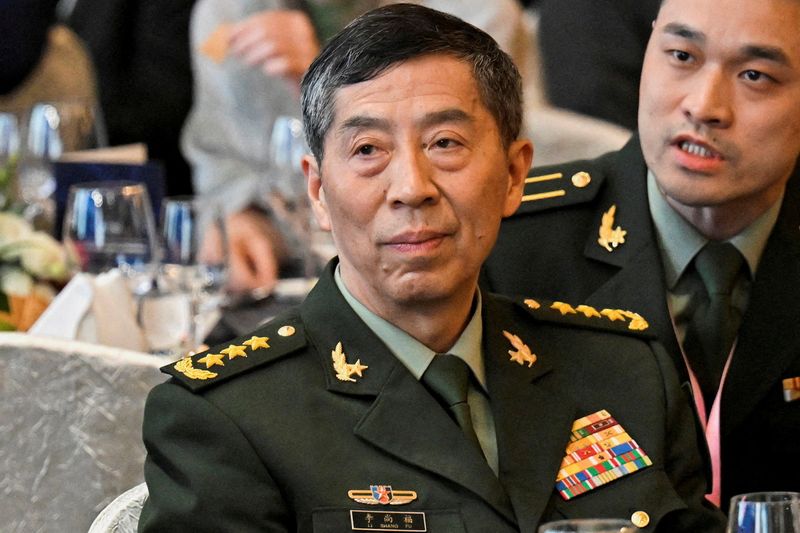
Authors: Anthony Slodkoski, Liz Lee, and Greg Torode
BEIJING/HONG KONG, May 7 (Reuters) – China’s former defense ministers Wei Fenghe and Li Shangfu were both sentenced to death with a two-year suspended sentence, state news agency Xinhua reported on Thursday, underscoring the seriousness of a purge in the military.
The armed forces have been one of the main targets of a wide-ranging anti-corruption campaign ordered by President Xi Jinping after taking power in 2012. In 2023, the purge spread to the elite Rocket Force, which oversees nuclear weapons and conventional missiles.
Earlier this year, the situation further escalated, leading to the removal of Zhang Youxia, the People’s Liberation Army’s top general. Zhang Youxia is a member of the Politburo and has long been considered an ally of Xi Jinping.
Xinhua News Agency reported in the past that Li was suspected of accepting “huge bribes” and bribing others. An investigation found that he “failed to fulfill his political responsibilities” and “seeked personal benefits for himself and others.”
Xinhua News Agency reported in 2024 that an investigation into Wei in 2023 found that he accepted “huge amounts of money” in bribes and “helped others to seek improper benefits in personnel arrangements,” adding that his behavior was “extremely serious in nature, extremely influential, and extremely harmful.”
In China, a suspended death penalty is usually reduced to a life sentence if the offender commits no crime during the suspended sentence.
Xinhua News Agency said that after the reduced sentences, Wei and Li will be sentenced to life imprisonment without further commutation or parole.
Reducing sentences for ministerial convictions is not uncommon in China. Former Justice Minister Fu Zhenghua was sentenced to death in 2022, which was later commuted to life imprisonment. The same situation happened to Liu Zhijun, the former Minister of Railways who was convicted in 2013.
Alert example
In its official newspaper, the People’s Liberation Army called on party members and military cadres to learn lessons from the two cases, warning against harboring “split loyalty to the party,” referring to China’s ruling Communist Party.
“Party cadres across the military, especially senior officers, must take corrupt officials such as Wei Fenghe and Li Shangfu who have been investigated and dealt with as a warning,” the People’s Liberation Army Daily said in a commentary published on Friday.
The military said Wei and Li had caused great damage to the party’s cause, national defense and military building, and the image of senior leaders.
Char, a China security scholar in Singapore, said the suspended death penalty was the harshest sentence handed down in recent years to members of the Central Military Commission, the Communist Party’s top military leadership body.
Char, a scholar at the S. S. Rajaratnam School of International Studies, said: “Wei and Li’s ‘commuted sentences to life imprisonment without the possibility of parole or commutation’ underscore the seriousness of their crimes, as such sentences are usually reserved for serious crimes.”
Foreign diplomats and analysts are closely watching the ongoing anti-corruption campaign.
The International Institute for Strategic Studies, a London-based think tank, said the purge earlier this year left serious flaws in the army’s command structure and may have hindered the readiness of its rapidly modernizing armed forces.
(Reporting by Antoni Slodkowski, Liz Lee and Beijing Newsroom and Greg Torode in Hong Kong; Editing by Peter Graff, Alison Williams and Kate Mayberry)