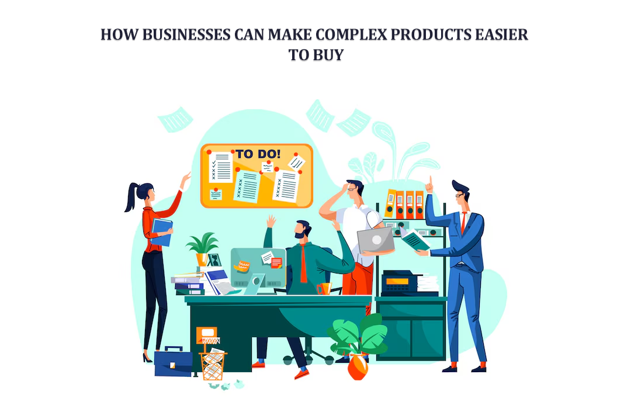
We’ve all been there. You are looking to solve an enterprise-level problem—maybe you need to upgrade your cybersecurity infrastructure, overhaul your supply chain logistics, or integrate a new core data platform. You head over to a vendor’s website, expecting to find a clear path forward. If the product page is too complex, you would be confused.
Understanding Why Complex Products Are Difficult to Buy
The Information Overload Problem
One of the biggest problems with complex products is not a lack of information. It is having too much of it. The customer may have a very simple question of whether this is the right product for them. “Is this the right product for what I need?”
Too Many Choices Can Create Decision Fatigue
Choice is normally associated with freedom. The customer now has to compare every specification to determine which differences actually matter. Instead of asking customers to understand every possible option, you can add labels.
-
Best for beginners
-
Best for professionals
-
Best for frequent use
-
Best value
-
Best for advanced requirements
These labels do not remove choice. They give customers a starting point.
Building a Customer-Friendly Product Experience
Start With the Customer’s Problem
A common mistake in product marketing is starting with the product instead of the problem.
Businesses naturally think about what they have created. Customers are usually thinking about what they are trying to solve.
Someone looking for accounting software may not care initially about the software’s architecture. They may want to stop spending hours preparing financial reports.
A homeowner looking for a security system may not be interested in technical specifications at first. They want to know whether the system will protect their home and whether they can operate it without difficulty.
This difference should influence the way products are presented.
Know Who Is Actually Buying
Complex products often have more than one type of customer.
A software platform, for example, might be used by employees, evaluated by a manager, approved by an IT department, and purchased by someone in finance. Each person is likely to ask different questions.
The employee may want to know whether the software is easy to use.
The manager may care about productivity and reporting.
IT may focus on security and integrations.
Finance may want to know how much the product will cost over time.
A single generic product description cannot answer all of these questions equally well.
You should know the different people involved in the buying process. According to that, you can consider what each one needs to know. This can influence everything from the structure of the website to the information included in product comparisons, FAQs, demonstrations, and sales materials.
Even in consumer markets, different buyers can have very different priorities.
Consider a laptop. A university student might care most about battery life, weight, and price. A video editor may be far more interested in processing power, graphics performance, storage, and screen quality.
The product has not changed. The customer’s decision-making process has.
The easier businesses make it for people to find information relevant to their particular situation, the less effort customers have to put into filtering through information that does not apply to them.
Making Product Variations Easier to Navigate
Presenting Choices Visually
Product variations can be one of the biggest sources of confusion in online shopping.
A shirt may be available in ten colors and six sizes. A laptop may have several storage and memory configurations. Furniture may come in different materials, finishes, and dimensions.
If all these options are placed inside basic dropdown menus, customers may have to open one menu after another to understand what is available.
Visual selection can make this process much easier. Let’s take the example of attribute swatches. They can allow shoppers to see other product characteristics directly on the page.
This becomes particularly valuable for products where appearance is an important part of the decision. A customer choosing between black, white, blue, and several other finishes should not have to rely entirely on text to understand the differences.
Visual variation displays can also reduce uncertainty because customers can see the relationship between their selection and the product itself.
Helping Customers Choose the Right Configuration
Displaying choices clearly is only part of the solution. For WooCommerce stores specifically, a tip is to use the WooCommerce Variation Swatches plugin. It can make product options more visible. These plugins help shoppers interact with different variations. The objective is not simply to make the page look better. It is to make the customer’s decision easier.
Explaining Technical Products in Simple Language
Turn Features Into Practical Benefits
A feature describes what a product has. A benefit explains why the customer should care.
The technical specification can still be included. The important thing is to provide context around it. Businesses should therefore avoid forcing customers to translate technical information themselves.
Use Examples and Demonstrations
Product photography can show how an item looks from different sides. An interactive tool can demonstrate how changing one configuration affects another—adding images to make a page longer does not necessarily improve the buying experience.
Building Trust Before the Purchase
Clarifying Pricing and Additional Costs
Price becomes more important as the complexity and cost of a product increase.
Complex pricing can make an otherwise appealing product feel risky.
This is especially common with subscriptions, customizable products, enterprise services, and products with optional accessories. A customer should get answers to these three basic questions quickly:
-
How much does it cost?
-
What is included?
-
What might I have to pay extra for?
Using Reviews, Comparisons, and Social Proof
Another point about the psychology of customers that you need to keep in mind is that they often look for evidence that a product works before making a significant purchase. Instead of writing long descriptions, you can add a section of reviews. Reviews can provide that reassurance.
However, generic praise is less useful than specific experiences. A statement such as “Great product!” tells a potential buyer very little.
A review explaining how a product solved a particular problem is much more informative.
These are particularly useful for professional products where customers want to know how the product performs in situations similar to their own.
Comparisons can serve another purpose.
Make Compatibility Easy to Check
Compatibility issues will stop a customer from purchasing even when they want to. Businesses should make compatibility information easy to find.
Depending on the product, this could involve:
- A compatibility chart
- A product selector
- A compatibility checker
- A list of supported systems
- Clear technical requirements
- Frequently asked questions
Give Customers Multiple Ways to Get Help
Not every customer wants to contact sales.
Some prefer to research independently. Others want to speak to someone before spending their money.
Businesses should support both approaches.
Useful options can include:
- Live chat
- Email support
- Product guides
- Video demonstrations
- Buying guides
- Detailed FAQs
- Online documentation
- Sales consultations
The important thing is to make assistance available without making it mandatory.
A customer who wants to research alone should be able to do so. Someone who has a specific question should not have to search through the entire website to find a way to ask it.
For complex products, support can actually become part of the value proposition.
Knowing that help is available after purchase can make customers more comfortable purchasing in the first place.
Using Data to Improve the Buying Experience
Learning From Customer Questions
Businesses do not have to guess what customers find confusing.Customer questions provide direct evidence. If shoppers frequently search for compatibility information, that information should be easier to find. Every repeated question represents an opportunity to improve the buying experience.
Customer service teams can therefore provide valuable insights to marketing and product teams.
Conclusion
Your job is to make the customers’ lives easier. They should not have to go through confusing product tiers or unclear pricing to figure out whether it is right for them. So, remember the rule: make the customers’ lives easier. It’s about removing the unnecessary hurdles that stand between a buyer and a clear decision.