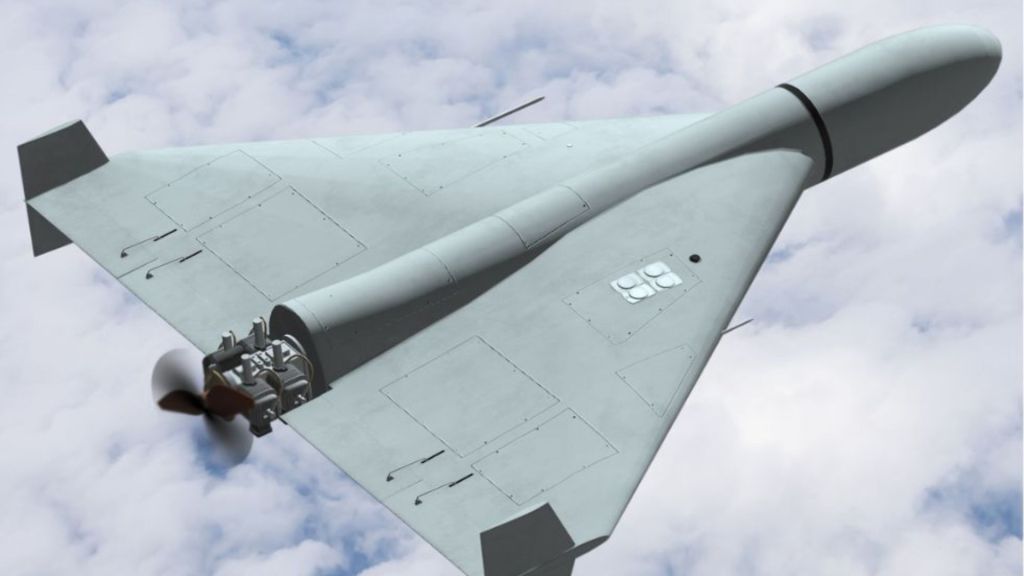
As Iran depletes its Shahed-136 stockpile in conflicts with the United States and Israel, analysts have stressed that China’s drones look similar but operate very differently and could be more threatening.
Developed by China’s Northwestern Polytechnical University, the ASN-301 shares the same unique profile as the Shahed-136: low aspect ratio, tailless delta wing, cylindrical fuselage, spherical optoelectronic head and rear-mounted propulsion propeller.
The similarity stems from Israel’s Harpy anti-radiation drone, which China legally acquired in the 1990s and later reverse-engineered after the United States blocked an upgrade deal with Tel Aviv.
The Shahed-136 is essentially a GPS-guided flying bomb targeted at a fixed location, while the ASN-301 is a more sophisticated anti-radiation loitering munition designed to seek out and destroy radar systems.
Drones that hunt air defense systems
This distinction is crucial on a highly competitive battlefield. Iran’s Shahed-136 weighs approximately 441 pounds and carries a warhead of 66 to 110 pounds. It follows pre-programmed coordinates and detonates on impact. While cheap and mass-produced, it cannot adapt to mobile or newly activated targets.
معلومة
إسرائيل 🇮🇱 أنتجت درون عام ١٩٨٩ اسمها Harop
كدرون متسكعة راكبة للاشعاع (مضادة للرادارات)عام ١٩٩٤ باعتها للصين 🇨🇳وقامت الصين بهندسة عكسية وانتجت ASN-301
عام 2021 طلعت لنا إيران 🇮🇷 بشاهد-١٣٦
وسلامتكم 😁 https://t.co/NPK4VAj5vs pic.twitter.com/Oex21lzZOj— Ismaeel Khouja 🇸🇦 (@IsmaeelK_21) March 19, 2026
ASN-301 takes a different approach. It weighs 298 pounds and is 8.2 feet long, making it smaller and lighter than the Shahed-136, which has a 66-pound warhead. It is equipped with a passive anti-radiation seeker tuned to a wide range of radar frequencies and can autonomously detect, track and destroy active radar emitters, including air defense systems targeting them.
Its warhead is equipped with a laser proximity fuse that disperses approximately 7,000 prefabricated metal fragments upon detonation and is specifically optimized to damage radar antennas, dish arrays and control systems rather than causing blunt force damage.
Has swarming capabilities and ship-based launch capabilities
The ASN-301 can be launched from a vehicle-mounted tank system, with multiple drones launched simultaneously from a single vehicle or warship, providing land and naval deployment flexibility. Recent footage shows multiple ASN-301s launching rapidly, confirming their swarming capabilities.
Its ability to loiter over a target and attack only when its radar is activated has classified it as a Suppression of Enemy Air Defenses (SEAD) weapon, a role traditionally filled by expensive stand-off missiles such as the U.S. AGM-88 HARM. The use of drones to perform this function at lower cost and in swarms marks a significant shift in large-scale air defense suppression.
The cheapest version of the ASN-301 is the Feilong-300D, which takes this concept a step further. The FL-300D can fly at a maximum speed of 136 miles per hour (220 kilometers per hour), which is higher than Shahid’s top speed. Additionally, its maximum range is comparable to Shahed’s.
The drone can carry a 110-pound warhead and, depending on the mission, can fire explosives for maximum damage, a pre-fragmentation warhead to hit radar, or an armor-piercing projectile.
China is quietly arming Iran’s adversaries
ASN-301 is again in the spotlight as reports from Middle East Eye and regional intelligence officials confirm that China has supplied Iran with prowling munitions (dubbed a “Shahed-like system”) through a land corridor in Pakistan under an oil-for-arms deal.
In the first six days of the conflict with the United States and Israel, Iran launched more than 2,000 Shahed-136 drones into the Gulf. Deploying a significant number of ASN-301s (aimed at radar arrays rather than buildings) would significantly change the strategic considerations of regional air defense operators.
The drone’s most recent live-fire demonstration in October 2025 showed the PLA’s capabilities ahead of what analysts believe will be accelerated exports.

