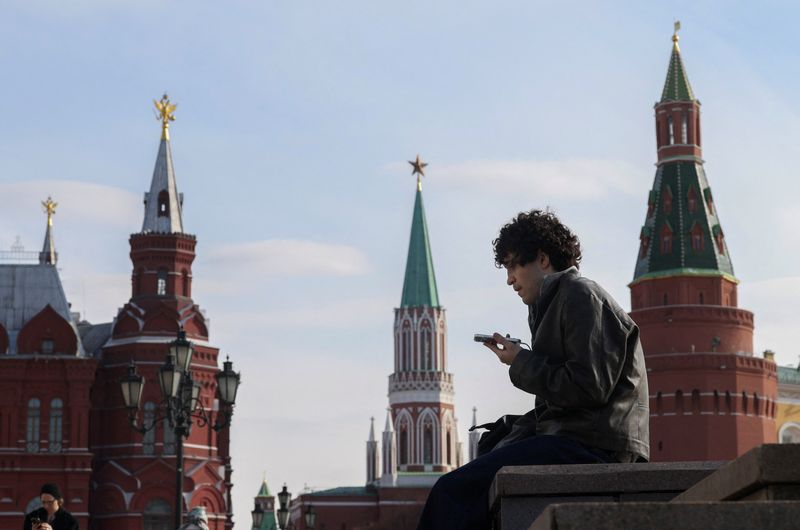
MOSCOW, March 20 (Reuters) – Office workers are toiling away with the internet blocked. Teenagers are constantly being forced to change VPNs. Taxi drivers have a hard time finding their way around Moscow without online navigation.
The Kremlin is flexing its muscles on the Internet.
The government regularly disrupts networks across Russia, while restricting messaging services Telegram and WhatsApp and shutting down dozens of virtual private networks that could be used to circumvent website and app bans.
Mobile internet has been completely paralyzed every day over the past week in parts of central Moscow, St. Petersburg and other major cities, according to Reuters reporters in the areas and eight senior foreign diplomats in Russia.
Asked about restrictions on messaging apps and internet services, Kremlin spokesman Dmitry Peskov told Reuters: “These measures are being implemented.”
“This is partly due to the refusal of many foreign companies to comply with Russian legislative norms and partly due to security measures against the Ukrainian drone threat.”
Attack drones can use cellular networks to aid navigation.
Russia also introduced new laws this year in its cyber crackdown, requiring mobile operators to cut off service to any customer at the request of the Federal Security Service and giving the agency the power to set up a network of pretrial detention centers within its jurisdiction.
Diplomats, who spoke on condition of anonymity to discuss sensitive matters, said the broader goal of strengthening cyber power is to help the Kremlin tighten domestic control in the context of its war in Ukraine.
Envoys say popular support could become increasingly strained if the conflict continues. They added that Russian officials may be keen to prepare for any dissent that might arise if the war ends. One person said Moscow had amassed power that would give it the option to carry out “massive repression” online.
The end of the war in Afghanistan in Moscow in 1989 caused major social unrest in Russia, and returning veterans helped fuel the lawlessness of the 1990s. The collapse of the Soviet Union in 1991 worsened the chaos.
“Russian leaders and security services remember 1991, and they remember what happened in Russia and what happened to them after Moscow stopped a major war in Afghanistan: the country collapsed, the security services were torn apart, and it was a disaster,” said Andrei Soldatov, a Russian investigative journalist and security service expert.
“What’s happening now is that the security services are trying to create a situation where even if Putin signs a peace deal, or if Putin launches a protracted war, it doesn’t destroy the whole thing.”
Two Russian sources with knowledge of the network blockade said Moscow studied the experience of other countries, particularly China and Iran, and tasked authorities with developing a way to block large swaths of the mobile and fixed internet while controlling online communications.
Kremlin targets messaging apps
After invading Ukraine in 2022, Russia implemented its toughest laws since the Soviet era, strengthening censorship powers and the influence of Russia’s FSB, the main successor to the Soviet-era KGB.
This year, Moscow has further beefed up security. Russian President Vladimir Putin, who served as a KGB officer from 1985 to 1990, attended the annual meeting of Russia’s Federal Security Service (FSB) in Moscow on February 24 to mark the fourth anniversary of the war in Ukraine.
He told the agency to step up the fight against terrorism – which includes attacks from Ukraine – while strengthening “information and digital space.”
Kremlin spokesman Dmitry Peskov said all measures were taken legally to ensure security in the conflict in Ukraine, which Putin views as a confrontation with the West.
Two Russian officials close to the Kremlin questioned moves targeting the internet and messaging apps as repressive, arguing they are crucial to improving security and ensuring national unity against Western attempts to sow discord.
Russia’s national digital and communications regulator Roskomnadzor did not respond to a request for comment.
The eight diplomats said Moscow’s crackdown on the internet this year was far more severe than they had seen in the country before.
Mobile internet has been regularly shut down in some parts of Russia for months, often following major Ukrainian drone attacks. According to Kommersant, Russia had blocked more than 400 VPNs as of mid-January, a 70% increase from the end of last year.
Moscow has stepped up its crackdown in recent weeks, with the government also taking action against Dubai-based Telegram and the U.S. service WhatsApp, according to diplomats and Reuters reporters.
Last month, Russia slowed down Telegram, which has more than 1 billion active users and is widely used in Russia and Ukraine, and investigated its billionaire founder Pavel Durov as part of a criminal case involving terrorism charges.
Russian officials said Telegram had been infiltrated by Ukrainian and NATO member intelligence agencies, resulting in the deaths of Russian soldiers.
Telegram denies it has been infiltrated and says Moscow is trying to force Russians to use MAX, a state-backed messaging app that schools and universities are told to use for parent and student chat groups.
“Every day the authorities are making up new excuses to restrict Russians’ use of Telegram because they are trying to suppress the right to privacy and freedom of expression,” Durov told Reuters. “It’s a sad sight for a country to be afraid of its own people.”
The Kremlin also blocked WhatsApp outright last month for not complying with local laws. The app’s owner, tech giant Meta, condemned the move as a step backwards for the security of the Russian people.
As services are banned, some young Russians have vowed to evade the crackdown by switching to a different VPN, not for politics, but simply to interact with Western apps like Instagram and Snapchat, which are restricted in Russia.
“If these old politicians want to stop everything, why don’t they develop any interesting Russian apps?” said Andrei, who declined to give his name due to the sensitivity of the situation.
(Reporting by Guy Faulconbridge; Editing by Pravin Char)

