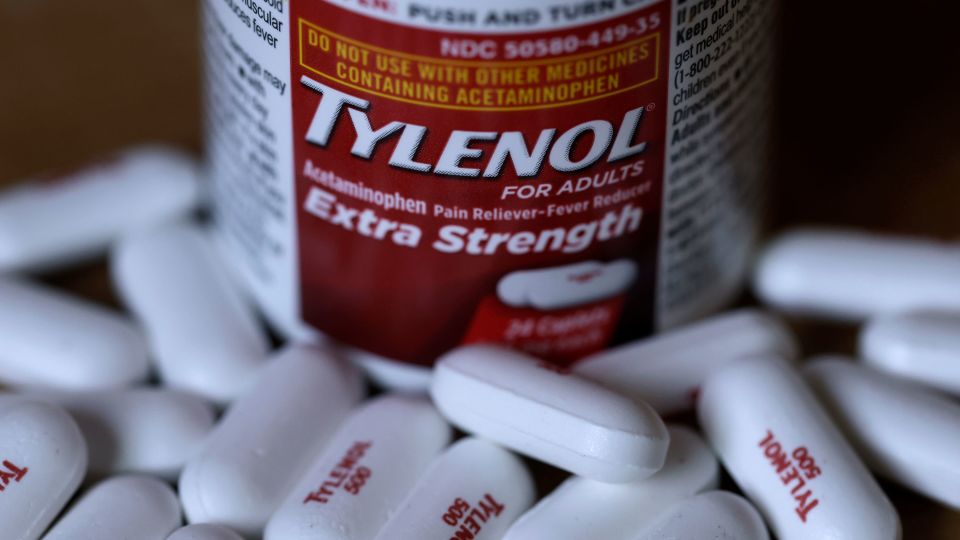
Last year, when President Donald Trump claimed that taking Tylenol during pregnancy might increase the risk of autism, ob-gyn Dr. Nathaniel DeNicola’s office was flooded with questions and confusion, but only for a few days.
“Then, a week later, it’s not a hot topic anymore,” said DeNicola, who lives in Newport Beach, Calif., and helped write the American College of Obstetricians and Gynecologists’ guidelines on the use of acetaminophen during pregnancy.
At the time, DeNicola said, the scientific medical community “reacted so quickly and was so clear in its assertions about the utility and safety of Tylenol during pregnancy that I don’t think there was any lasting confusion, at least among those who listened to the medical experts.”
“I think patients are going to see their doctors,” he added. “The public seems to have accepted the guidance of the experts and they trust their voices on this.”
Dr. Lynn Yee, a maternal-fetal medicine physician in Chicago, said fewer patients are worried about Tylenol now than they were in the fall.
“In September, October, November, there was a fair amount of public attention and concern about this topic, and now, in January, I feel like things are changing and I’m getting fewer patients asking me about Tylenol or acetaminophen,” said Yee, director of maternal-fetal medicine in the Department of Obstetrics and Gynecology at Northwestern University Feinberg School of Medicine.
“I’m really proud of our professional organizations, like the American College of Obstetricians and Gynecologists and the Society for Maternal-Fetal Medicine. They do a lot of advocacy around the safety of acetaminophen and ‘talk to your doctor,'” she said. “All of these trustworthy organizations are doing a commendable job in getting the right information out, and maybe it’s making a difference.”
Experts stress that autism has many potential causes, including genetics, older parents and prenatal exposure to air pollution or certain pesticides, and that the science linking autism to acetaminophen is far from conclusive.
In guidance issued after Trump’s September statement, ACOG reiterated that “acetaminophen remains the preferred analgesic and antipyretic drug during pregnancy. Used judiciously and at the lowest effective dose for the shortest time necessary, in consultation with an obstetrician-gynecologist or other obstetric care professional, remains consistent with best practices.”
Acetaminophen, also known as paracetamol, sold under the brand name Tylenol, is widely considered the only safe, over-the-counter option for treating pain or fever during pregnancy. Other common medications, such as ibuprofen or regular-dose aspirin, may increase your risk of serious complications during pregnancy.
In many cases, your doctor may recommend Tylenol to treat pain or fever. Experts warn that if a fever is left untreated, it can be dangerous for both the fetus and the mother, increasing the risk of miscarriage, birth defects, high blood pressure and neurodevelopmental disorders.
“Untreated fever can have short- and long-term effects on fetal neurodevelopment,” Yee said. “Treating fever is important because we know that untreated fever during pregnancy is unhealthy for both mom and baby. … And we don’t have a better, safe alternative for reducing fever during pregnancy.”
It is estimated that approximately 65% of pregnant women use acetaminophen at some point during pregnancy.
Medical issues become political issues
The White House released a fact sheet in September citing multiple studies showing that acetaminophen use during pregnancy, especially late in pregnancy, may cause long-term neurological effects in children, such as autism or ADHD.
At the time, the FDA sent a letter to doctors stating that “clinicians should consider minimizing the use of acetaminophen during pregnancy to treat routine low-grade fevers” and that in recent years, “increasing evidence suggests that maternal use of acetaminophen may increase the risk of neurological disorders such as autism and ADHD in children.”
One of the documents cited by the Trump administration is an analysis of 46 previous studies. The review, published in August in the journal BMC Environmental Health, found evidence of a link between acetaminophen exposure during pregnancy and increased rates of neurodevelopmental disorders.
“The association was strongest when acetaminophen was taken for four weeks or longer,” Dr. Andrea Baccarelli, the paper’s senior author and dean and professor of environmental health at the Harvard T.H. Chan School of Public Health, said in a statement in September.
Baccarelli said he discussed his research with Health and Human Services Secretary Robert F. Kennedy Jr. in the weeks leading up to the White House announcement.
“In the meantime, as the only drug approved for pain relief and fever reduction during pregnancy, acetaminophen remains an important tool for pregnant patients and their doctors. High fever may pose risks to mother and fetus, including neural tube defects and premature birth,” he said.
“After reviewing the evidence, my colleagues and I recommend a balanced approach based on the precautionary principle: Patients who require fever reduction or pain relief during pregnancy should take the lowest effective dose of acetaminophen for the shortest possible time, after consulting their physician to calculate their individual risk-benefit.”
Now, new research is adding to the discussion.
“Reassure rather than alarm”
A paper published Friday found no sign that children born to mothers who used acetaminophen during pregnancy were more likely to develop autism.
The study, published in The Lancet Obstetrics and Gynecology and Women’s Health, reviewed 43 published studies on prenatal acetaminophen exposure and potential links to child neurodevelopment, including data from more than 300,000 pregnancies. Seventeen studies were included in the meta-analysis.
“We looked at a number of outcomes, including autism, ADHD and intellectual disability,” lead author Dr Asma Khalil, consultant obstetrician and fetal medicine specialist at St George’s Hospital in London, said in a news release.
Researchers found no evidence that acetaminophen use during pregnancy increases a child’s risk of autism, attention-deficit/hyperactivity disorder, or intellectual disability.
The U.S. Department of Health and Human Services said in a statement that the new paper did not address questions about Tylenol’s potential risks and excluded most studies on the topic.
In response, Khalil said in an email that the review paper “does not exclude evidence,” but rather systematically evaluates all studies and places greater emphasis on those that “best address bias and confounding factors.”
“While we acknowledge that even small effects may have population-level consequences, public health guidance must be based on the strongest available evidence and not on signals driven by bias or indication confusion,” she wrote. “This review provides reassurance rather than alarm and supports current clinical guidance that paracetamol remains an appropriate first-line treatment for pain and fever in pregnancy if used as recommended.”
Some studies in the new analysis included data on siblings, in which the mother may have used acetaminophen while pregnant with one child but not the other.
“Sibling comparison meta-analyses represent the main body of evidence because they account for shared familial and genetic factors,” the researchers wrote in their paper.
Dr. Steven Karp, senior lecturer in psychology at the University of Portsmouth, who was not involved in the new study, said in a statement released by the UK’s Science Media Center that prioritizing these sibling studies is a strength of the new study.
“Its scientific rigor includes taking into account co-founders, such as having a sibling with the disorder, because these neurodivergences run in families. Parents of children with disabilities may be more likely to take acetaminophen because of pain related to parenting stress or their own chronic illness,” Karp said.
“Sibling comparisons in these studies show that drugs do not cause disability in children. As a neurodivergent researcher and advocate, I think this means society needs to stop falling down the rabbit hole of seeking to falsely prevent developmental disorders,” he said. “Instead, we should focus more on creating a better world for people with disabilities.”
DeNicola, who was not involved in the study, also praised the work but added that, as noted in the paper, “there have only been three sibling studies to date.”
“So, can three studies answer any given question? That’s a fair limit. You always want to get more information,” he said. “But given that all three studies came to the exact same conclusions and used more advanced methods, it at least reassures us that we should be using Tylenol for its therapeutic benefits without any unfounded risks so far.”
“Sibling comparison analyzes have important limitations that affect their interpretation,” Baccarelli and colleagues wrote in their August paper, and “while sibling comparison studies eliminate the influence of shared family factors as confounders, they also eliminate potential mediating factors that are shared among families who interact with acetaminophen, potentially introducing bias.”
Some potential modulating factors that may cluster within families include disruptions in the body’s hormone systems or increased oxidative stress, they said.
But Khalil described sibling comparisons as one of the “best” research designs to account for shared factors that may influence autism risk.
“This may be the best design to help take into account shared genetic factors or shared family environment – the two children are exposed to the same environment, or long-term parenting characteristics, socioeconomic background, educational background – and many other studies included in the literature or published do not adequately account for this,” she said.
Khalil said the new study was conducted because she and her colleagues encountered pregnant women who were concerned about the safety of acetaminophen because of Trump’s comments last year.
The fear of patients at the time “was certainly my experience,” Khalil said.
National and international medical groups “reacted quickly, issuing statements to try to reassure pregnant women,” she recalled. “It sends a clear message to pregnant women that paracetamol is safe when used at the right dose, for the right duration, when needed.”
For more CNN news and newsletters, create an account at CNN.com

