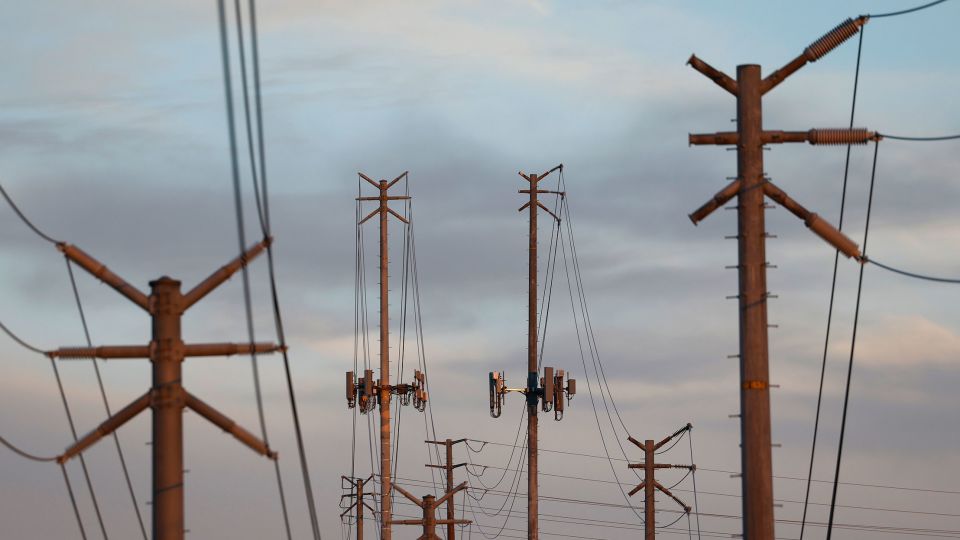
Electricity costs are rising almost everywhere in the United States. But in recent months, the Trump administration has framed the issue as one affecting only blue states.
While a few blue states like California, Massachusetts and Hawaii do have some of the highest electricity prices in the country, federal data shows that electricity prices are rising in every corner of the country. In fact, some of the highest increases since last year came from purple Pennsylvania and red Ohio.
While high energy prices are seen as a policy option for blue states to pursue wind and solar, there are more factors at play. Experts tell CNN that costs are rising in both red and blue states and have nothing to do with voting patterns. Many red states, chief among them Texas, have installed far more renewable energy than many blue states.
Residential electricity prices across the U.S. have risen about 40% since 2021, according to nonprofit utility PowerLines.
“This is a very significant increase that far exceeds the inflation during this period,” said Charles Hua, founder and executive director of PowerLines.
A spokesman for the Edison Electric Institute, a utility trade group, disagreed, saying federal data shows “power prices have largely tracked overall inflation in recent years, with only a few areas experiencing significant price increases.”
Regardless, electricity costs are only expected to increase; the PowerLines report found that utilities are demanding an additional $31 billion in rate increases in 2025, more than double the rate increase requested the year before. About half of that funding is focused on Southeastern utilities in red states where grid reinforcement, hurricane recovery and expensive new nuclear power plants in Georgia are all factors driving up costs for ratepayers.
“Lowering electricity prices is a top priority for President Trump,” White House Press Secretary Taylor Rogers said, adding that Trump is “aggressively unleashing reliable energy sources like coal and natural gas to reverse the catastrophic damage Joe Biden has inflicted on our grid.”
But experts warn that reliance on coal and natural gas could drive up prices further in the future.
Why New England and California are so expensive
Several blue states do have some of the highest electricity bills, including California, New York, and New England (Hawaii and Alaska are also expensive outliers).
In past statements, the White House has described high housing prices in blue states as a policy choice. Rogers said in a previous statement to CNN that blue states “stubbornly choose green energy scam policies that result in unaffordable power bills.”
But the reasons behind high bills are more complex and vary from state to state. However, they all have one thing in common: infrastructure is expensive to maintain and upgrade.
Massive, deadly wildfires are driving up costs in California, where the state’s utilities are working to shore up their electric infrastructure and spending money clearing vegetation and trees from power lines.
“This results in huge costs for the electricity system to adapt to wildfire risk,” said Brendan Pierpont, director of the electricity division at think tank Energy Innovation.
New England has also been upgrading and modernizing its aging distribution and transmission systems, despite far less wildfire risk, leading to higher bills for consumers there. The region also faces a lack of available energy. It is the last stop on the nation’s natural gas pipeline system, burning large amounts of oil to help generate electricity during the cold winter months.
“We don’t have fossil resources in this part of the country, but [fossil fuels] “Electricity still accounts for the largest share of New England’s electricity generation,” said Ari Peskoe, director of the Electricity Law Initiative at Harvard Law School. [fossil fuels] Came in from somewhere else. “
Because of this, the region hopes to rely more on offshore wind to help alleviate seasonal power shortages, especially in the winter, when temperatures drop and high winds are frequent. District energy data shows the Vineyard Wind wind farm in Massachusetts performed well during the recent winter storm.

Wind turbines operate at the Vineyard Wind 1 offshore wind farm off the coast of Massachusetts on July 19, 2025. -Carolyn Kaster/AP
Offshore wind is still being built in New England states and New York, despite attempts by the Trump administration to halt construction. A recent court order overturned the government order, allowing four projects to continue construction. Delays have proven costly, but unlike natural gas or oil, wind’s fuel costs are free.
“Blue states that refuse to implement President Trump’s common-sense energy dominance agenda will continue to see prices rise at astronomical rates, just as they did under Joe Biden,” White House spokesman Rodgers said.
Despite the fiery rhetoric, wind power has proven to be a bipartisan form of energy. Red states in the central United States, such as Iowa, Texas, North Dakota and Kansas, which have relatively low electricity prices, also rely heavily on onshore wind power.
Why are prices rising in other parts of the country?
Recent federal data shows a clear trend in the United States: Electricity prices are rising in every region of the country. Only four states — Nevada, North Carolina, Rhode Island and Connecticut — saw year-over-year decreases in electricity prices, according to Energy Information data released last week. All states are blue except for the swing state of North Carolina.
Meanwhile, in other parts of the country, prices are rising exponentially in both red and blue states.
Nowhere in the United States have electricity prices soared as much in recent years as in the mid-Atlantic region, which has the highest concentration of data centers in the world and consumes far more power than the current grid can produce.
Tightening electricity prices in states such as Pennsylvania, Ohio, New Jersey, Indiana and Maryland have drawn attention from the White House, which has recently been urging big tech companies to pay for more of the electricity they consume rather than passing the cost burden on to households. This dynamic is starting to play out in other parts of the country as data center development booms.
Data centers and the artificial intelligence they power are driving significant growth in overall electricity demand: A 2024 U.S. Department of Energy report estimated that data centers will use 6.7% to 12% of the nation’s electricity by 2028. A growing number of tech companies have vowed to pay for the power and infrastructure required by these power-hungry centers, but there are few federal regulations on the issue.

A technician works at the Amazon Web Services AI data center in New Carlisle, Indiana, on October 2, 2025. -Noah Berger for Amazon Web Services/Reuters
The high cost of energy infrastructure and rising gas prices across the country are hitting consumer wallets. In addition to being used to heat homes, natural gas is the largest source of electricity generation in the United States. Its price surged ahead of last week’s winter storm as user demand soared.
“Even if the price fluctuation lasts only a year or so, the impact on rates could be felt for years after the fact,” as utilities recoup high fuel costs over a longer period of time, Pierpont said.
In addition to fluctuations in natural gas, expensive coal power is also rebounding amid excess demand for electricity. There’s another reason for coal’s return: The Trump administration forced several decommissioned coal plants to keep operating. Many of these plants are older and are being retired because they are too expensive to be cost-competitive with natural gas and renewable energy.
Experts told CNN the move would push prices up further. Dan Scripps, chairman of the Michigan Public Service Commission, said that as the Trump administration forced Michigan’s retiring JH Campbell coal-fired power plant to continue operating this summer, operating costs for the plant’s first four months after retirement have cost taxpayers $80 million.
Scripps said the charge will show up on residential utility bills across the Midwest in the coming months. Because the Trump administration has used similar emergency orders to keep other coal-fired power plants operating in Indiana, Colorado and Washington, residents in those states may also see price impacts this year.
“There are significant maintenance costs to maintain them and keep them running,” said Michael Goggin, executive vice president of grid strategy at Energy Consulting Group. “Those costs can be significant and prices are going to go up. That’s what’s really going to hit taxpayers.”
For more CNN news and newsletters, create an account at CNN.com