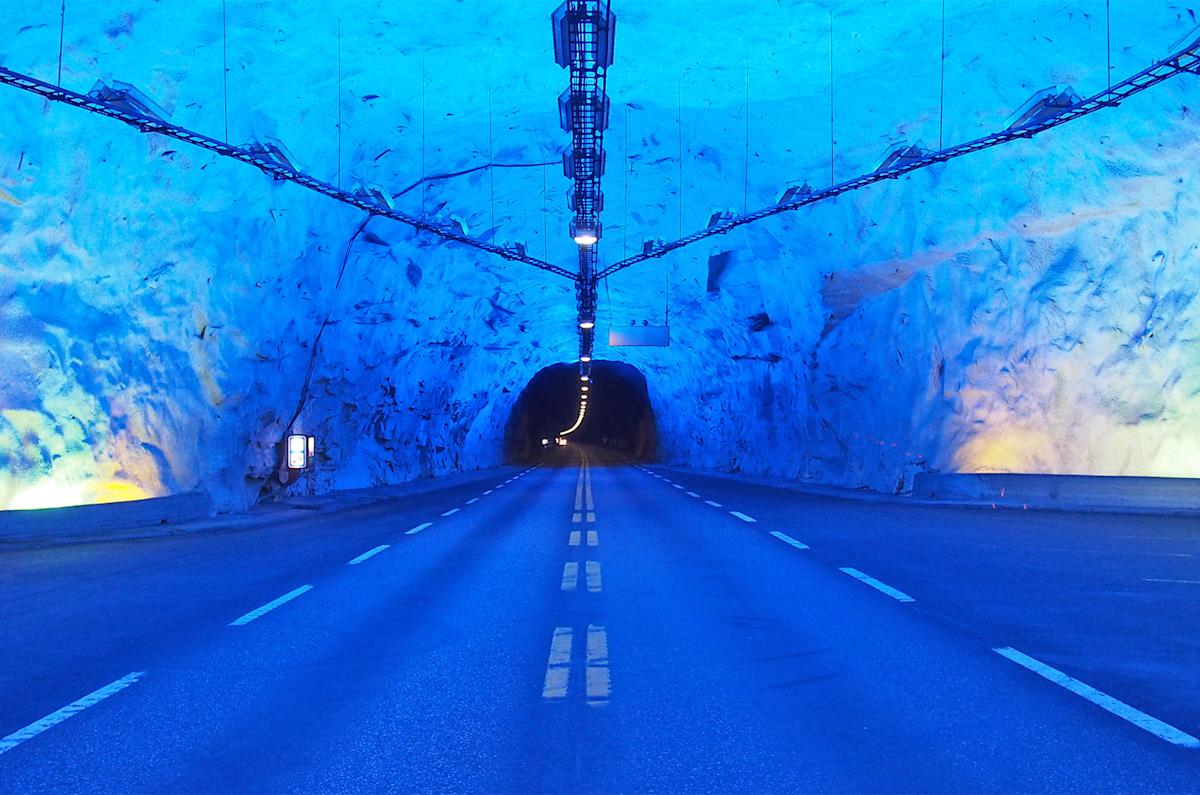
Tunnels are used to transport traffic through some of the most extreme terrains on Earth, helping to reduce travel times and thus make journeys less stressful.
While most tunnels offer short underground rides, some are much longer. Here are the 10 longest road tunnels in the world, which were constructed using cutting-edge technology and keep drivers alert as they traverse their extended underground lengths.
Ryfylke Tunnel, Norway – 8.98 miles (14.46 km)

The Ryfylke Tunnel is currently the longest undersea road tunnel in the world, stretching approximately 8.98 miles between Stavanger and Ryfylke. Norway developed the Ryfylke Tunnel to reduce reliance on ferries. It is now part of the Rogfast project, which aims to connect multiple islands via undersea tunnels, meaning Ryfylke may relinquish its title as this construction work continues.
The Ryfylke Tunnel opened in 2019 and took seven years to build, with tolls charged to help recoup construction costs.
By the time the Ryfylke Tunnel began operations, it had cost NOK 6.4 billion (£460 million) to complete. Electric vehicles receive a 50% discount on tolls.
The Ryfylke Tunnel reaches a maximum depth of 285 meters under the sea and consists of two independent tubes carrying traffic in opposite directions. Each tube has two lanes and the tunnel can carry 10,000 vehicles per day.
Tsigana Tunnel, Türkiye – 8.99 miles (14.48 km)

The Zigana Tunnel is located near the northern coast of Türkiye, passing through rugged mountain rocks and bypassing the Zigana Pass, which is blocked by snow in winter.
Construction of the Zigana Tunnel started in 2016 and will be completed in 2023. It is Türkiye’s longest road tunnel at 8.99 miles long and reduces the trip through the exposed Zigana Pass by 5 miles. It also reduces travel time in the summer by about 20 minutes.
The Zigana Tunnel consists of two separate tunnels to keep traffic flows separate and was built using the New Austrian Tunneling Method. As excavation continues, the system adapts to the rock and uses shotcrete to build the walls.
There are 16 parking spaces and 6 ventilation shafts in each tunnel. It also built 40 connecting tunnels between the pairs of pipes, as well as nine transformer chambers to accommodate power from the Zigana tunnel.
Muzhailing Tunnel, China – 9.46 miles (15.22 km)

The designers and builders of the Muzhailing Tunnel in Gansu Province, China, faced many challenges. First, it is built at a high altitude and in an area with active seismic activity, which means it is prone to earthquakes.
Although the conditions for building one of the world’s longest road tunnels were less than ideal, the tunnel was built using a technology called NPR anchor cables. This anchors the structure into the surrounding rock and allows the tunnel to withstand deformation as the ground moves.
Like most modern road tunnels, the Muzhailing Tunnel consists of two separate tubes, each carrying traffic in opposite directions.
Construction of the tunnel, which began in 2016 and is due to be completed in 2024, is further complicated by the thin air at high altitudes and its impact on workers.
The now-completed Muzhailing Tunnel has been extensively studied by tunneling experts for the way it handles such difficult terrain.
Tiantaishan Tunnel, China – 9.67 miles (15.56)

The Tiantaishan Tunnel cost 2.75 billion yuan (£300 million) to complete, a bargain in the world of road tunnels. Construction of the Tiantaishan Tunnel started in 2016 and will be completed and put into use in 2021, once again setting a record for construction time.
This is all the more impressive when you consider the tunnel’s high altitude and the frigid weather in China’s northwestern Shaanxi province.
Tiantaishan Tunnel, China – 9.67 miles (15.56)

When construction started in November 2016, 2,000 workers were working shifts underground in Qinling. They also lived there during construction.
As part of the construction of the Tiantai Mountain Tunnel, a new smart lighting system was developed to provide more natural light deep in the tunnel. This setup also provides different light patterns and designs on the tunnel walls to prevent drivers from becoming bored while traveling through the 9.67-mile-long tunnel in either three-lane tunnel tube.
Gotthard Road Tunnel, Switzerland – 10.46 miles (16.84 km)

Switzerland’s Gotthard Base Tunnel was once the world’s longest road tunnel, but its ranking has slipped as new projects have surpassed it in length. However, having opened in 1980, the Gotthard has been in operation longer than any other hospital in the top 10.
Construction of the Gotthard Road Tunnel began in 1970 and its maximum transport height is 1,175 meters (3,855 feet), higher than Yr Wyddfa (Snowdon Mountain) in Wales.
Gotthard Road Tunnel, Switzerland – 10.46 miles (16.84 km)

Due to the strictly enforced speed limit of 80 km/h, driving through the Gotthard Road Tunnel takes approximately 13 minutes. There are also tolls to use the tunnel, which can carry up to 24,000 vehicles per day.
The Gotthard Base Tunnel is unusual among modern road tunnels in that it uses a single tube to carry traffic in both directions. In 2016, 57% of Swiss people voted in a referendum to build a second Gotthard road tunnel.
Jinpingshan Tunnel, China – 10.90 miles (17.54 km)

While all other road tunnels in the top 10 are open to the public, the Jinpingshan Tunnel restricts traffic flow. That’s because the tunnel was built to provide access to Jinping Dam, the world’s tallest dam, and between it and another hydroelectric dam.
The Jinpingshan Tunnel passes through an area of southwestern China known for its geological activity. This is partly why access to the tunnel is restricted, but also because of security around the dam’s hydroelectric power station.
Jinpingshan Tunnel, China – 10.90 miles (17.54 km)

The deepest point of the Jinpingshan Tunnel is 2,375 meters below the surface, and more than half of the tunnel’s total length exceeds 1,500 meters.
The Jinpingshan Tunnel took five years to complete and was the longest blind tunnel at that time. This is where both ends of the tunnel start at the same time and meet in the middle. The total cost of the Jinpingshan Tunnel is 1.3 billion yuan (£146 million).
Zhongnanshan Tunnel, China – 11.21 miles (18.04 km)

The Zhongnanshan Tunnel is not far from the Tiantaishan Tunnel, but its total length and subsurface depth exceed its immediate neighbor. The Zhongnanshan Tunnel has a maximum depth of 1,640 meters, making it one of the deepest tunnels in the world.
Still, the tunnel only took five years to complete. The Zhongnanshan Tunnel started construction in 2002 and was the longest tunnel in Asia when it opened to traffic in 2007.
Zhongnanshan Tunnel, China – 11.21 miles (18.04 km)

The Zhongnanshan Tunnel cost approximately 3.2 billion yuan (£350 million) to complete. This makes it one of China’s most expensive road tunnels to date. Three ventilation shafts provide fresh air to each of the two tunnels, and each pipe carries traffic in opposite directions so the streams never pool together.
Along its 11.21-mile length, different colored lights and patterns are projected on top of the tunnel, as well as artificial plants to provide stimulation and prevent fatigue for drivers.
Yamate Tunnel, Japan – 11.3 miles (18.20 km)

The Yamanote Tunnel in Tokyo, Japan is similar to London’s Black Wall Tunnel, but on a grander scale. The Black Wall Tunnel is only three-quarters of a mile long and sits just 1.7 meters above the riverbed, while the Yamanote Tunnel is 11.3 miles long and passes 30 meters below the Japanese capital’s population.
The Yamanote Tunnel still holds the honor of being the longest urban tunnel in the world.
Yamate Tunnel, Japan – 11.3 miles (18.20 km)

The Yamanote Tunnel took 15 years to complete, but was delayed by opposition from residents and environmental concerns. However, the tunnel was approved because it would ease traffic on Yamate Street above the tunnel.
The Yamate Tunnel’s two 11-meter-diameter tubes have emergency telephones every 100 meters along their length. There is also a sophisticated filtration system that removes particulate emissions from the air drawn from the tunnel.
WestConnex, Australia – 13.67 miles (22.0 km)

The WestConnex tunnel is due to be completed in November 2023 and is part of plans to ease congestion in the city of Sydney. By far the largest road infrastructure project ever undertaken in Australia, the 13.67-mile tunnel is part of a longer 20.5-mile traffic-reducing motorway.
It will eventually connect Sydney’s suburbs, airport, North Shore and city centre. Much of the land above the WestConnex tunnel has been converted into parks, playgrounds and open spaces for city residents to relax.
WestConnex, Australia – 13.67 miles (22.0 km)

The WestConnex Tunnel is Australia’s longest underground road and is believed to have cost A$10bn (£5.1bn).
The figure sets a new record for NSW Government transport spending, with projects expected to reach A$45bn (£23.1bn) when fully completed. However, the government also said the tunnel would save A$22bn (£11.3bn) due to reduced journey times and improved reliability.
Rydal Tunnel, Norway – 15.23 miles (24.51 km)

The longest road tunnel in the world is the Rydal Tunnel in Norway. Construction of the 15.23-mile underground project began in 1995 and opened to the public in 2000. The tunnel took around 20 years to agree to build and cost NOK 1.1bn (£85m) to complete, a huge value in the field of road tunneling engineering.
It is much cheaper to build than most tunnels because the nature of the rock means that the tunnel does not need to be lined and does not need to be earthquake-proofed as Norway does not experience any serious earthquakes. The tunnel connects Ledal and Aurland and consists of two tubes, each carrying traffic in one direction for safety reasons.
Rydal Tunnel, Norway – 15.23 miles (24.51 km)

Although the Lérdal Tunnel is the longest road tunnel in the world, it is also one of the most heavily used. It typically carries around 2,050 vehicles a day, mainly due to its remote location, 180 miles northwest of Oslo.
To alleviate the monotony of driving through the world’s longest road tunnel (which is also straight), this Norwegian project is divided into four sections, each separated by a large cavern with parking areas. The cave has blue and yellow lights to give it the feel of a Norwegian sunrise, which is thought to boost the brain when drivers are tired. Police have also installed cameras to combat speeding.
If you liked this story, click the “Follow” button above to see more similar stories from Autocar
Photo License: https://creativecommons.org/licenses/by/4.0/deed.en
]]>