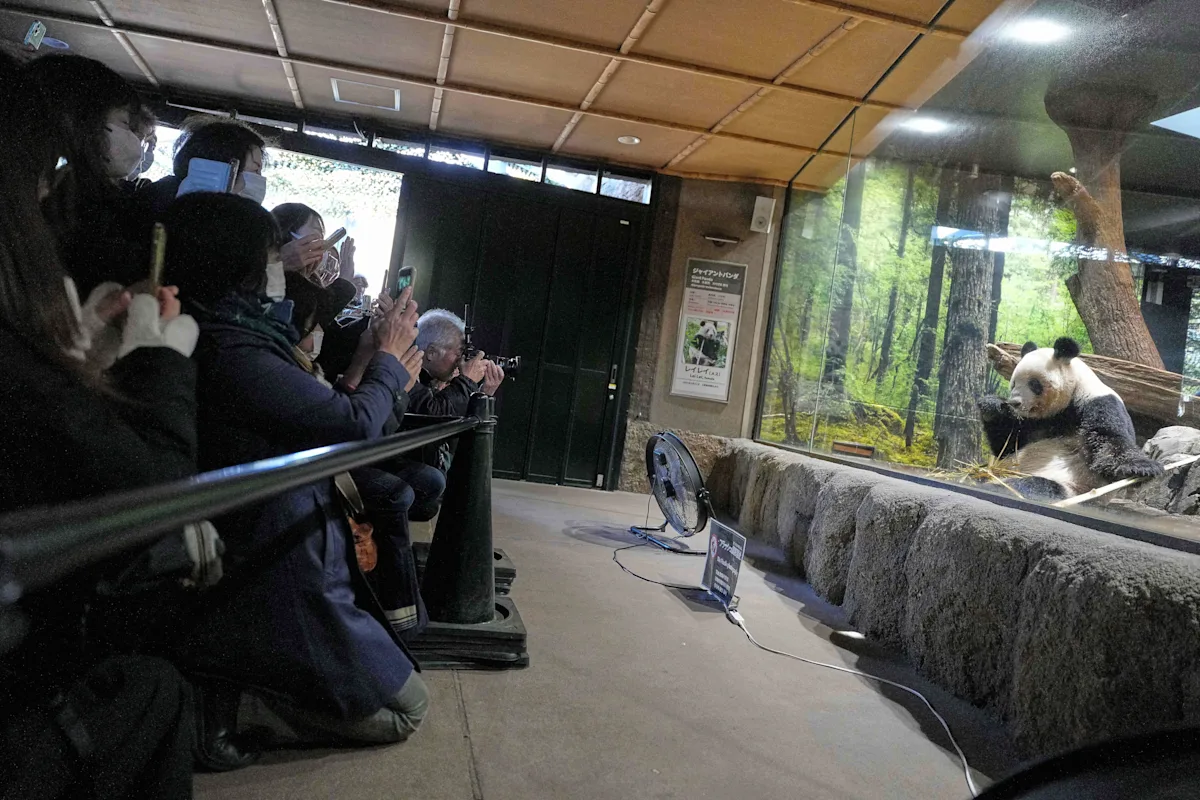
TOKYO (AP) — Thousands of people flocked to Tokyo’s Ueno Zoo to get a last look at the popular pair of giant panda twins due to return to China next month as relations with Beijing soured, fearing if or when they would see their replacements in Japan.
The Tokyo Metropolitan Government announced on Monday that Xiaoxiao and his sister Lei Lei will return to China in late January, and the last day for the public to see them will be January 25.
Their departure will leave Japan without pandas for the first time in more than half a century. With relations between the two countries deteriorating sharply in recent weeks, prospects for replacing them are dim.
The giant panda is native to southwestern China and is the unofficial national mascot. Beijing loans them to other countries as a show of goodwill but retains ownership of them and the cubs they produce.
Yuki Imai, a panda fan from neighboring Kanagawa Prefecture, said she was shocked by the news of the twins’ return and decided to visit. “I thought I’d go see them as soon as I could while I still could.”
Many people queued for more than two hours just to see the twins for a minute. Yamamoto Kazuhiro said he and his wife, Hiroko, came to see the pandas “for the last time” and that the twins may return early due to their unstable relationship.
The four-year-old twins were born at Tokyo’s Ueno Zoo in June 2021 and grew up there, but they are still on loan from China and must be returned by February.
Relations between Japan and China have deteriorated since Japanese Prime Minister Sanae Takaichi said in early November that Japanese troops may intervene if China imposes a naval blockade or other actions against Taiwan. Taiwan is a self-governing island claimed by Beijing.
China has since restricted travel to Japan, and cultural events and exchanges between local governments have been cancelled.
The dispute escalated this month when China conducted drills involving an aircraft carrier near southern Japan, prompting Tokyo to scramble fighter jets. Japan has also protested that its aircraft have been repeatedly targeted by radar, a move believed to be possible preparations for missile launches.
Tadashi Nakatani, a 51-year-old temple calligrapher who frequently visits from his hometown of Kamakura, west of Tokyo, said international relations may affect panda diplomacy but he was hopeful.
“When things calm down and relationships stabilize, I sincerely hope that the pandas will show up again and that one day everyone will be able to see them again.”
In 1972, China sent its first pair of giant pandas to Japan, marking the normalization of diplomatic relations between the two countries. Since then, Japan has never lost a panda.
Thousands of visitors lined up outside the zoo on Tuesday morning. During their one-minute viewing time in the panda area, visitors called the twins’ names and took photos or videos as they gnawed on bamboo poles or strolled.
Starting next week, only up to 4,800 visitors who successfully reserve a one-minute slot online will be able to see the beloved twins, according to the zoo.
Japanese Chief Cabinet Secretary Minoru Kihara said on Monday that giant pandas have long been loved by the Japanese people and he hopes the two countries will continue to maintain friendship through giant panda diplomacy.
“Exchanges through giant pandas have helped improve public sentiment between Japan and China, and we hope this relationship can continue,” Kihara said, noting that some local municipal governments and zoos have expressed a desire to loan out new pandas as soon as possible.
Ueno Zoo Director Suzuki Hitoshi said of the giant panda twins that raising them to stay healthy is a challenge. “But they gave us a lot of joy and surprises. They also brought great joy to our visitors. We have nothing but words of gratitude.”
The zoo plans to promote other animals to make up for the pandas’ absence while it waits for their replacements. “We will temporarily reserve the panda area to accommodate possible new arrivals at any time.”