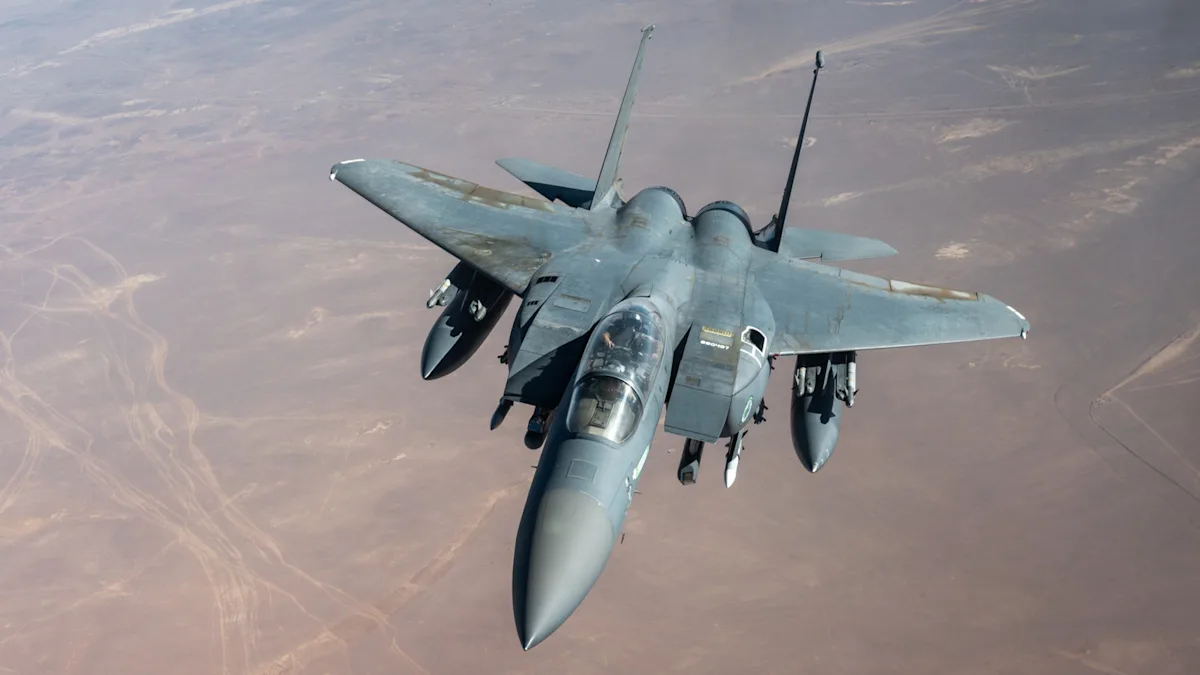
There is no doubt that the McDonnell Douglas F-15 Eagle is one of the most famous and accomplished American jet fighters of all time. Originally developed in the late 1960s and entering service in the early 1970s, the F-15 has now been in service for over 50 years, and despite its age, it remains an important fighter aircraft, not just for the U.S. Air Force but for many militaries around the world.
In service for decades, the F-15 has achieved more than 100 air-to-air victories and has never lost an air-to-air battle. This is an impressive record considering how many conflicts this aircraft was involved in, and while this outstanding record will still stand, it will now have an asterisk next to it. Earlier this week, three U.S. F-15E Strike Eagles were reportedly shot down in a friendly fire incident with a Kuwaiti F/A-18 Hornet.
The incident, which occurred during the chaotic start of the Epic Operation Fury conflict with Iran and is still under investigation, fortunately did not result in any deaths or serious injuries and the crew was able to eject safely. Still, this is one of the strangest and more significant friendly fire incidents the U.S. Air Force has seen in recent years, and it will be studied closely to determine what exactly went wrong.
Read more: 13 countries building their own fighter jets
Hornets beat Hawks

F-15E Strike Eagle and F/A-18 Super Hornet in flight – Ethan Miller/Getty Images
Today, when a U.S. military aircraft goes missing, it’s usually due to some kind of accident or malfunction — including a Navy fighter jet falling off an aircraft carrier. These incidents may also include situations where another U.S. or allied weapon inadvertently shoots down a friendly aircraft. Although rare, friendly fire does occur. For example, in late 2024, a U.S. Navy Super Hornet was accidentally shot down by a friendly guided missile cruiser.
However, “one F/A-18 downed three F-15s” reads more like a fictional battle in the Ace Combat video game, but this time for real. Amateur video initially showed a damaged F-15 fighter jet falling from the sky over Kuwait, followed by footage of the American pilot ejecting safely from the aircraft. Subsequently, the U.S. Central Command confirmed that three U.S. Air Force F-15Es were accidentally shot down by Kuwait air defense forces, and all six crew members on board the three aircraft were safely rescued.
No details have been revealed about how exactly the incident occurred, but the accidental downing did occur under tense wartime conditions when the skies over Kuwait were hit by a massive Iranian drone attack. The details of the story may change once the investigation is complete, but as of now, analysis appears to support reports that all three F-15s were mistakenly shot down by air-to-air fire from an F/A-18.
Chaos and mayhem in Kuwait

F-15s and F-16s over Kuwait during the Gulf War – Mpi/Getty Images
Based on the video footage, analysts noted that the damage to the F-15 did not appear to be severe enough to have come from a large surface-to-air weapon, while the fact that all three crew members were able to eject suggests that the tail was struck by a small air-to-air missile. Regardless, the investigation will certainly focus on how and why the F-15s were targeted in the first place, and whether their identification friend or foe systems were able to distinguish them as friendly aircraft on radar.
The three U.S. aircraft shot down in the incident were F-15E Strike Eagle variants, which differ from standard F-15 fighter jets in several ways that enable them to serve as ground attack aircraft. As of March 3, Central Command confirmed that more than 200 fighter jets such as F-15s and F/A-18s had been used in Operation Epic Fury, and large bombers such as the U.S. Air Force’s B-2 Spirit and B-52 Stratofortress were also deployed against Iranian targets.
While the F-15 Eagle’s perfect air-to-air combat record will remain unchanged regardless of these accidental downings, a small number of F-15s have been shot down by enemy fire in the past, including during the Iraq conflict in the 1990s and 2000s. However, these losses came from ground weapons rather than enemy aircraft.
Want to stay up to date on the latest tech and automotive trends? Sign up for our free newsletter to get the latest headlines, expert guidance and how-to tips, one email at a time. You can also add us as your preferred search source on Google.
Read the original article on SlashGear.