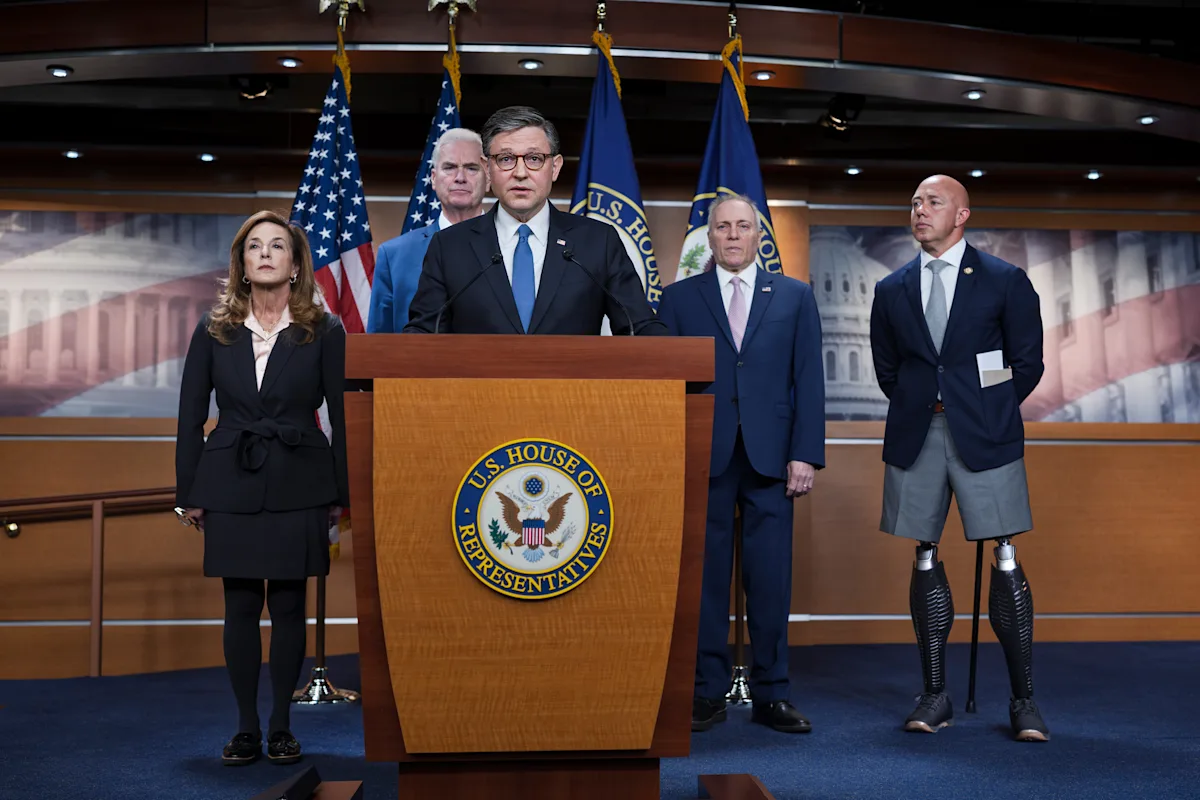
WASHINGTON (AP) — As Congress responds to President Donald Trump’s attacks on Iran, lawmakers who have served on the front lines in Iraq and Afghanistan are adding their voices to a war debate with intense personal significance.
Many admit to mixed feelings, content with retaliation against the Iranian regime’s leadership for decades of targeting U.S. service members but concerned that the next generation of soldiers may soon face the same combat experiences as them.
“Would I be satisfied? You know there’s a Marine Corps side to me: Yes, absolutely,” said Sen. Ruben Gallego, D-Ariz., whose company suffered the worst losses on the U.S. side during the Iraq war. “I know they killed a lot of American soldiers, American Marines. But do I also understand that I have a responsibility to not let my desire for revenge push my country into another war?”
The post-9/11 war experience also influenced the Trump administration’s decision-making, given that senior officials, including Vice President Vance and Defense Secretary Pete Hegers, were deployed to Iraq.
Gallego, like others on Capitol Hill, relies heavily on his first-hand experience fighting in the war after the Sept. 11, 2001, attacks when assessing the conflict with Iran. Wearing bracelets engraved with the names of friends killed in the fighting, lawmakers told stories of attacks by Iran-backed militant groups and reflected on the life-changing injuries they suffered in combat.
Senior lawmakers wary of war
While Congress was largely divided along party lines in the initial vote on Iran, with Republicans backing Trump’s actions and Democrats warning the conflict could expand, veterans of both parties have deep reservations about getting involved.
“As someone who knows a lot of friends and a lot of Gold Star families who didn’t come home, that’s why in the week before the attacks, I was actually one of those people talking about caution and why we need to avoid at all costs getting into another long, drawn-out war in the Middle East,” said Rep. Eli Crane, R-Ariz., a former Navy SEAL who left college to join the military a week after the Sept. 11 attacks.
Klain said his concerns were partially assuaged by briefings from the Trump administration that showed him the president was not planning a protracted war. He voted against a war powers resolution that would have halted attacks on Iran unless Trump received congressional approval.
But Crane said war is never easy. “I have been involved in military operations many times that did not go as planned, so I understand their nature,” he said, adding that he called on the Trump administration to handle conflicts with “humility and caution.”
Gallego and other Democrats worry it’s too late. They expressed condolences for the six members of the U.S. military killed in a drone strike in Kuwait and feared there could soon be more American casualties.
“War is dirty and mistakes happen,” Gallego said. He added that the longer the conflict continues, the greater the chance that members of the U.S. military will be killed. He said he saw friends in Iraq being killed by seemingly random gunfire from enemy combatants.
Still, many Republicans believe attacking Iran is necessary to stop the regime that has helped train and arm militant groups across the Middle East for decades. Republican Rep. Brian Mast, chairman of the House Foreign Affairs Committee, led the House debate against the war powers resolution.
Mast, a former Army bomb disposal expert, now uses a prosthetic leg after suffering catastrophic injuries from an improvised explosive device in Afghanistan. “No one, especially me, but many of my other colleagues, want to see our military get into combat or war,” he said.
He then added, “But Iran’s terror has killed thousands of Americans, and it must stop.”
An attempt to push soldiers to the forefront of the war debate
As the conflict with Iran unfolds and spreads to other parts of the Middle East, Congress faces important questions. The cost of the operation is likely to already be in the billions of dollars, possibly forcing the Trump administration to soon seek billions in funding from Congress. The outbreak of war also disrupted global alliances and the future of U.S. foreign policy.
Overshadowing all this is the possibility of another protracted conflict. Lawmakers said it was their duty to ensure that this did not happen to their fallen comrades.
“To me, it’s about speaking out. It’s about saying that the next generation shouldn’t have to fight in an endless, ill-conceived regime-change war in the Middle East,” said Democratic Rep. Pat Ryan, reaching for a bracelet engraved with the names of his friends who were killed during two tours of duty in Iraq.
Others remember how frustrated they felt with Washington during their service, especially as soldiers tried to fight with insufficient armored vehicles and troops.
“I know what it’s like to be in the last minute of a decision being made in Washington,” Democratic Rep. Jason Crow said. He enlisted in the Army as a private, was promoted to captain, and deployed to Iraq and Afghanistan.
Soldiers on the front lines often suffer, Crow said, “because people are no longer asking the tough questions. People are no longer being held accountable. Congress is no longer voting on this.”
Another veteran, Sen. Tammy Duckworth, D-Ill., said that was one of the reasons she sought a congressional seat in the first place. A Black Hawk helicopter pilot with the Illinois National Guard, Duckworth lost both legs in Iraq after the helicopter he was flying was hit by a rocket-propelled grenade.
“I’m running for Congress so that when the drums of war begin to beat again, I can ensure that our elected officials fully consider the true costs of war,” she said. “Not just dollars and cents, but human lives.”