lost wings yes flightA continuing look back at the aircraft that once captured pilots’ imaginations but quietly disappeared from the airways. These machines—some bold experiments, others everyday workhorses—represent the relentless innovation and craftsmanship that shaped general aviation’s past. Each installment revisits a design that aimed high, flew well, and has made its way into history for one reason or another.
The postwar general aviation boom is rightly regarded as a seminal period in aviation history—a time when enthusiasm for flying was at an all-time high.
Creativity and innovation ushered in a new era, and it was widely accepted that if you can imagine it, you can achieve it. Soldiers returned from overseas, and with them came a whole new economy of pilots trained to fly for people other than Uncle Sam.
As a result, an estimated 30,000 new general aviation aircraft were built in 1946 alone.
Although the economic boom has fueled the general aviation movement in the United States, it is unrealistic for every new model entering the most saturated aircraft market ever to stick the landing.
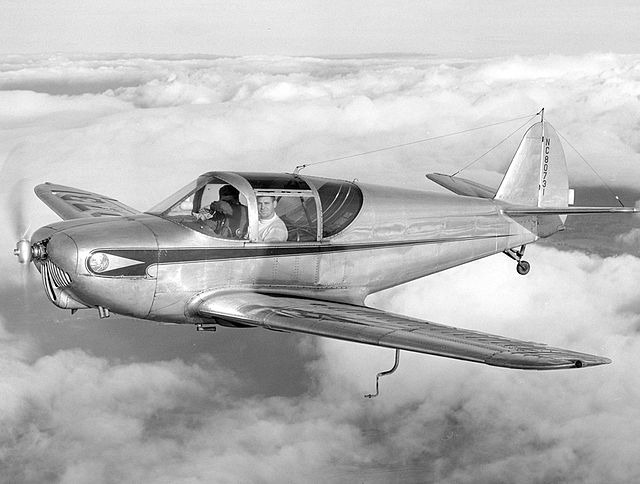
Still fondly remembered for its beautiful looks and high performance, the Globe GC-1 Swift represents the classic story of hype exceeding demand.
Development and History
Originally developed by RS “Pop” Johnson of Fort Worth, Texas, when Johnson built the first Swift as an experimental aircraft, the aircraft contained a fabric fuselage, wings, and tail made of Duraloid, a plastic-bonded plywood structure that was present in other designs at the time.
Johnson had ties to Bennett Aircraft, which went bankrupt after losing a government contract for the Beechcraft AT-10 to provide training aircraft for the U.S. military. In early 1941, the Bennett Aircraft Company reorganized into the Universal Swift Aircraft Company and began advertising the new aircraft’s ability to carry two people up to 600 miles at 130 mph.
Disagreements between Johnson and Globe Swift officials over the future GC-1 design resulted in Johnson leaving the company in July 1941. But because of the excitement surrounding the aircraft, Globe Swift has received orders totaling more than $1 million and has 40 dealers lined up to sell the aircraft.
The Globe GC-1 received type certification in May 1942 and was subsequently shelved as the United States entered World War II. Globe Swift subcontracted with Beech to produce 600 AT-10s for use in the war effort.
As the war was coming to an end in 1944, Globe Swift wanted to revisit the GC-1 and modified the aircraft, which soon resulted in two models: the GC-1A and the GC-1B. The GC-1A was equipped with an 85-horsepower Continental C-85 engine, while the GC-1B model was equipped with a 125-horsepower Continental C-125, which improved the performance of the Swift heavy airframe.
Maximum weight is limited to 1,570 pounds for the GC-A1 and increases to 1,710 pounds for the GC-1B.
Thousands of orders were received for the GC-A1, but only 408 were built before the GC-1B entered production shortly thereafter. During the six months of 1947, a total of 833 aircraft were produced, 503 of which were built by Globe Swift and 329 by the Texas Engineering and Manufacturing Company (TEMCO), which was hired as a subcontractor.
Due to serious accounting errors, the two manufacturers discovered that building the GC-1 would require more time and money than originally anticipated. The aircraft had to be sold at a loss, and the enthusiasm of the initial general aviation boom began to fade. The grounds of both facilities were filled with parked aircraft.
Globe Swift, like its predecessor Bennett Aircraft, has gone out of business. TEMCO took over production of the GC-1 and continued to produce the aircraft using the parts stocks it had acquired until 1951 when parts became scarce and the focus shifted to military production for the Korean War.
A total of 1,500 GC-1A and B aircraft were built during their lifetime.
lasting legacy
With an all-metal frame, a 42-inch-wide, two-seat cockpit and canopy-imitating butterfly doors, the Globe GC-1 Swift punches its weight in the performance category.
Retired airline pilot John Davis put the Swift into a different category in an interview with Aviation Consumer News.
“The Swift is not just another tailwheel aircraft,” Davis said. “This is a high-performance retractable landing gear aircraft. While many other tailwheel aircraft are fixed landing gear with fixed pitch propellers, they are not considered high performance.”
Davis said that for pilots without tailwheel experience, he recommends flying a Citabria or Piper Cub for a while before jumping into a Swift.
“The Swift is not a plane that’s trying to kill you, but it does require skill and respect,” he said. “You can’t stop flying unless you get stuck and shut down.”
Over the years, even if no new models were produced, the aircraft design remained highly regarded, and according to the Smithsonian’s National Air and Space Museum, a small number of Swift-based twin trainers were built for the U.S. and Saudi Arabian militaries.