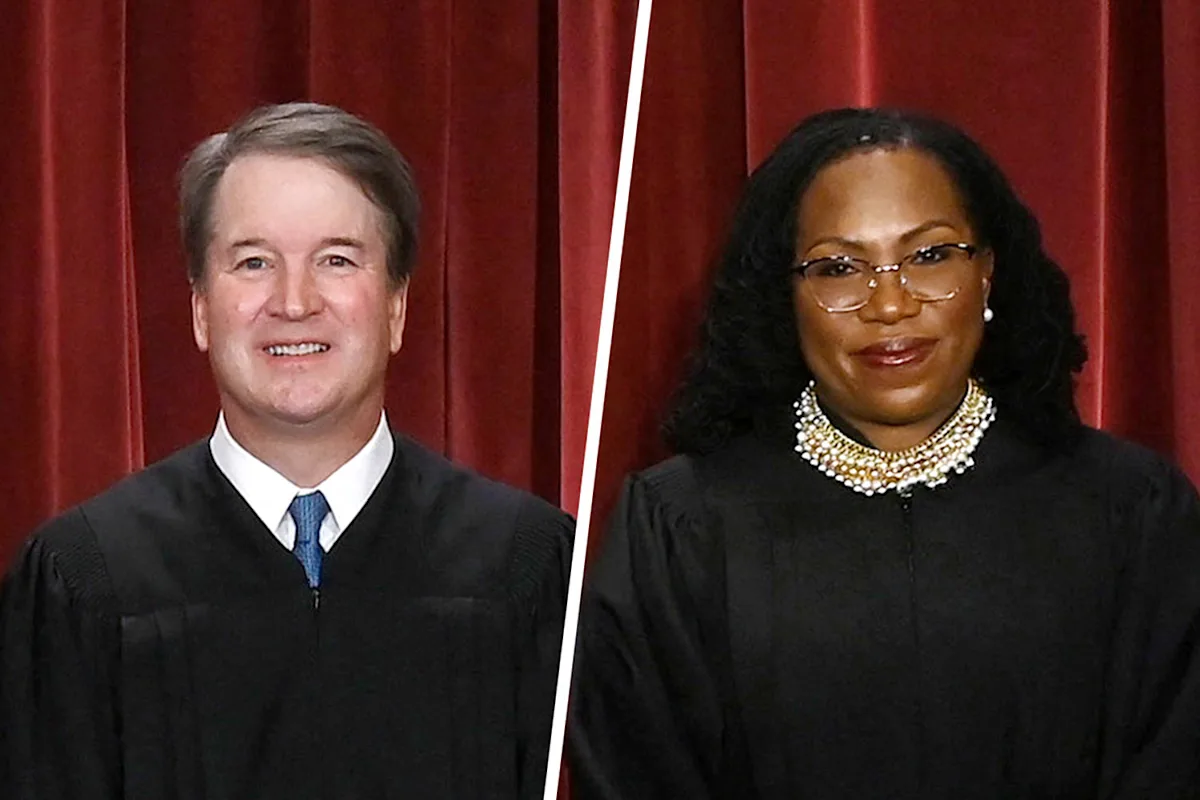
WASHINGTON — Divisions within the Supreme Court over how the high court often rules in favor of the Trump administration during emergencies became public on Monday, with liberal Justice Ketanji Brown Jackson and conservative Justice Brett Kavanaugh at odds.
The Supreme Court’s conservative majority has frequently blocked lower court rulings that have stymied President Donald Trump’s agenda, prompting criticism inside and outside the judiciary.
Jackson, who has often been an outspoken dissenter in these cases, made a rare public appearance with Kavanaugh at an event for attorneys and judges at a federal courthouse in Washington, where she strongly criticized the court’s actions.
She lamented the recent increase in such emergency filings — requests to challenge lower court rulings — and said the number would fall if courts were more stingy in approving applications.
The process is known as the “shadow docket” because the court rarely hears arguments and often issues brief decisions with little explanation. The Supreme Court’s ruling could allow policies to take effect in the early stages of legal challenges, long before lower courts reach any firm conclusions. The case may then return to the Supreme Court in a later proceeding for a final decision on the merits.
Last year, courts allowed Trump to fire thousands of federal workers, assert control of formerly independent federal agencies and implement aspects of his hard-line immigration policies. All of these moves through shadow dockets were blocked by lower courts.
“I just feel like there’s been an increase in the willingness of the courts to get involved … and it’s a really unfortunate problem,” Jackson said. Among other things, it affects how lower court judges handle cases because they already have an inkling of how the Supreme Court might handle them on appeal, creating “a distorted process,” she added.

Jackson and Kavanaugh were introduced at the start of Monday’s event. (Lawrence Hurley/NBC News)
(Lawrence Hurley)
“It doesn’t do the court or the country any good,” Jackson said.
Kavanaugh, who typically sits in the majority on shadow cases, argued for the court — as he has done in the past — saying the court must act in a certain way when the government or other litigants file an emergency motion.
Noting that the increase in government filings is not unique to Trump, Kavanaugh said courts have also approved similar requests from the Biden administration, albeit at a lower rate.
He said the reason successive administrations have filed lawsuits before the Supreme Court is that presidents have relied more on executive orders in recent years because it is difficult to convince Congress to enact legislation and because those actions are often challenged in court.
The justices expressed their disagreements in writing, but it was a rare instance of two justices debating the court’s internal affairs in public.
“None of us like this,” Kavanaugh said of the trend in shadow dockets, noting that the court has chosen to hear oral arguments in some cases and issue longer written rulings in response to some criticism.
He added: “No matter who is president, we have to take the same stance.” Jackson agreed.
The justices were mostly unanimous during the hour-long event in response to questions from Senior U.S. District Judge Paul Friedman in Washington.
They are particularly concerned about increased threats of violence against judges. Judges who rule against Trump have been frequently targeted recently.
“Of course, there are no easy answers,” Jackson said. “This is unfortunate because it is linked to a lack of understanding of judicial independence.”
Kavanaugh praised Chief Justice John Roberts, who he said “chose his sides” to counter criticism.
For example, Roberts issued a statement condemning Trump and his allies for suggesting that judges be impeached for ruling against the administration. Chief Judge James E. Boasberg of Washington, D.C., one of the judges some Republicans want to impeach, was also at Monday’s event.
This article originally appeared on NBCNews.com