As you read this story, you will learn the following:
-
New research into 14,000-year-old soil layers in Alaska has uncovered stone and mammoth ivory tools.
-
The discovery provides the oldest example of a human-made tool ever discovered in North America.
-
The discovery could rewrite our understanding of human dispersal across North America and provide clues to the ancestors of the famous Clovis culture.
Archaeologists have announced the discovery of an extraordinary collection of stone and mammoth ivory tools deep in Alaska’s frozen soil. This remarkable discovery not only contains the oldest ivory-club composite tool ever discovered in North America, but also provides a richer understanding of the story of the dispersal of populations across the continent.
The Holzman site, located in the middle of the Tanana Valley in central Alaska, has provided archaeological and geological value for more than three decades, with researchers regularly traveling to the west shore of Shaw Creek to study the permafrost. Now, in a new study published in Quaternary InternationalA team of researchers from Adelphi University and the University of Alaska Fairbanks revealed that excavations at the site uncovered tool making dating back 14,000 years, making Holzman one of the earliest human settlements in the Americas.
“The site reveals evidence of stone and mammoth ivory tool production, food preparation, and human dispersal 14,000 years ago,” the authors write. The site also provides clues about the ancestors of the Clovis culture, a group of people who made tools on the Great Plains 13,000 years ago.
According to a long-standing theory, the Clovis culture arrived in North America via the Bering Land Bridge. Holzman’s discovery may help confirm this hypothesis, as the location represents a waypoint between Siberia and the Great Plains. “The Holzmann site adds new information to the growing archaeological record of the central Tanana Valley during the Late Ice Age,” the authors write. “Based on current evidence, the confluence of Shaw Creek and the Tanana River was particularly active during the initial arrival of Aboriginal people.”
For the mobile megafauna hunters who crafted the tools left behind at the Holtzman site, Alaska’s Tanana Valley may have been a gateway to explore and colonize new areas of mammoth steppe along the route to the Great Plains. The discovery therefore represents an important step in humanity’s earliest journey into the interior of North America.
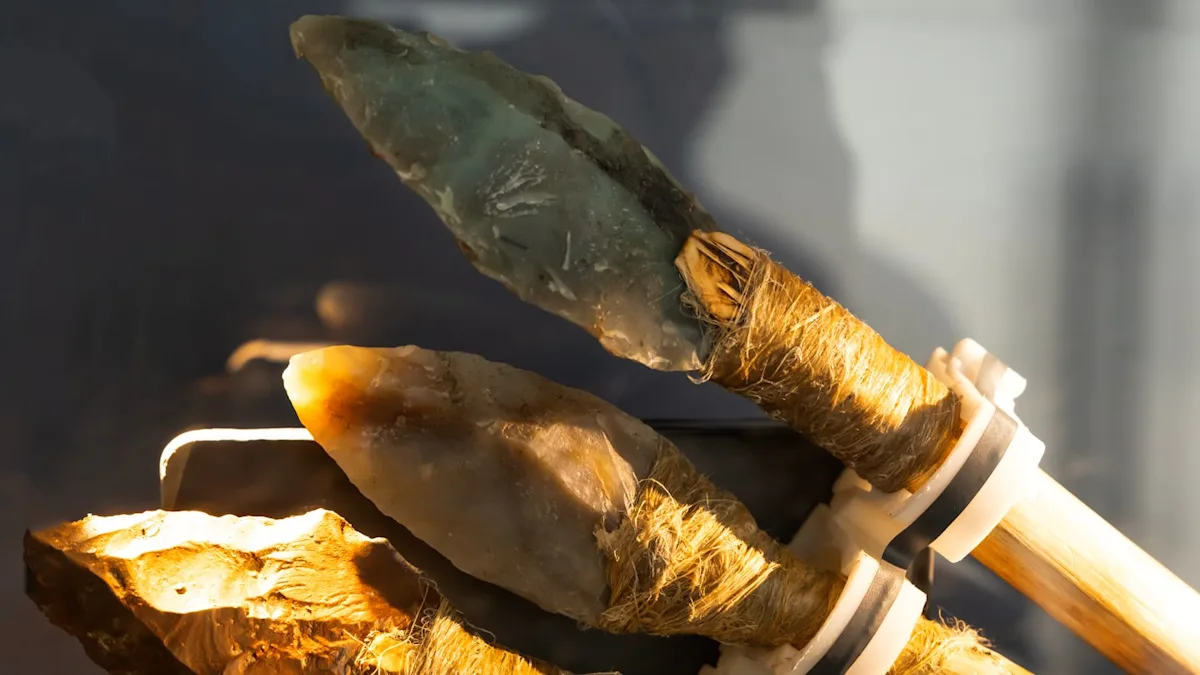
The oldest objects found at the Holzmann site include female mammoth tusks, flake tools, hammerstones, red ochre, and evidence of burning and hammering (formed stones). Slightly younger finds, 13,700 years old, include a quartz workshop (crucial in the formation of mammoth ivory tools) and the earliest ivory stick tools found in the Americas.
“Mammoth tusks also played an important role in early technology,” the authors write. “The ivory tool-making processes and ivory-shaft composite tools discovered at the Holzman site are the earliest known in the Americas, further demonstrating similarities with traditional Clovis technology further south.”
The “large workshop” discovered by Holzmann contained extensive evidence of ivory tools and tool making. “Mammoth tusks and stone tool materials appear to have played an important role in the circulation of resources throughout the eastern Bering Strait and the eventual spread of people southward into the Rocky Mountains and northern High Plains of North America,” the researchers wrote.
The use of mammoth tusks is particularly interesting to researchers, showing in unprecedented detail how ancient cultures interacted with Ice Age megafauna, particularly mammoths.
You may also like