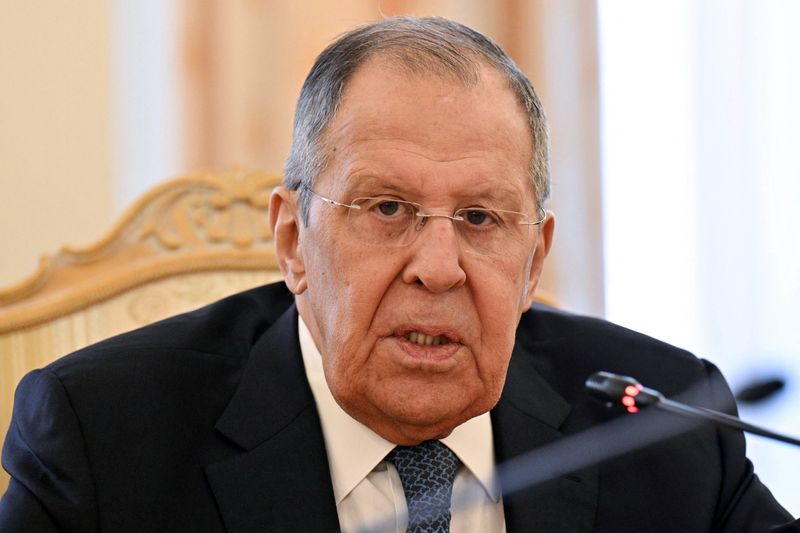
February 18 (Reuters) – Russian Foreign Minister Sergei Lavrov said in an interview made public on Wednesday that any new U.S. strikes against Iran would have serious consequences and called for restraint and a solution that would allow Iran to pursue a peaceful nuclear programme.
Lavrov’s interview with Saudi Arabia’s Al Arabiya TV came a day after U.S. and Iranian negotiators held indirect talks in Geneva to head off a new round of growing crisis between Washington and Tehran.
Lavrov said in the interview: “The consequences are not good. Iran’s nuclear facilities under the control of the International Atomic Energy Agency have been attacked. According to our judgment, there is indeed a risk of a nuclear accident.” The interview was published on the website of the Russian Ministry of Foreign Affairs.
“I’m watching carefully the reaction of the Arab countries in the region, the Gulf monarchies. No one wants tensions to escalate. Everyone understands that this is playing with fire.”
He said rising tensions could undo positive moves in recent years, including improved relations between Iran and neighboring countries, especially Saudi Arabia.
Iran is expected to submit a written proposal on how to resolve the standoff with the United States after talks in Geneva, a senior U.S. official told Reuters on Wednesday.
The official said U.S. national security advisers met at the White House on Wednesday and were told that all U.S. troops deployed to the region should be in place by mid-March.
The United States wants Iran to give up its nuclear program, but Iran firmly refuses and denies that it is trying to develop atomic weapons.
Lavrov said Arab countries were sending a signal to Washington “clearly calling for restraint and seeking an agreement that does not violate Iran’s legitimate rights and… guarantees that Iran has a purely peaceful nuclear enrichment program.”
He said that Russia maintains close and regular contact with Iranian leaders and “we have no reason to doubt Iran’s sincere desire to resolve this issue on the basis of compliance with the Nuclear Non-Proliferation Treaty.”
(Reporting by Reuters; Editing by Christian Schmolinger)