Authors: Sarah Marsh, Humela Pamuk and Andrew Gray
BERLIN/MUNICH (Reuters) – U.S. Secretary of State Marco Rubio said the transatlantic relationship faces a “defining moment” in a rapidly changing world, but he struck a warmer tone ahead of the Munich security conference on Friday after a year of unprecedented upheaval.
At the same gathering of senior security officials last year, Vice President J.D. Vance attacked European allies, setting off a series of confrontations in which the United States appears determined to destroy much of the international order it helped create.
In response, Washington’s partners have been pushing to chart a more independent course while preserving the alliance’s foundations as they face numerous threats, including Russia’s war in Ukraine and massive disruptions to global trade.
“I think we’re at a defining moment right now … the world is changing very quickly right in front of us,” Rubio said before departing for Munich.
“Frankly, the world I grew up in is gone, and we live in a new era of geopolitics that will require all of us to reexamine what it looks like and what our roles are,” he said.
“(The United States) is deeply connected to Europe, and our future has always been and will continue to be that way,” said Rubio, a potential rival of Vance’s 2028 U.S. presidential bid. “So we have to talk about what the future looks like.”
‘Wrecking ball politics’ threatens league
This year’s conference is being held against the backdrop of multiple conflicts including Ukraine, Gaza and Sudan.
Transatlantic relations have long been at the heart of the Munich Security Conference, which began as a Cold War forum for Western defense debate. But the unquestioned assumptions of cooperation that underpinned it have been upended.
The forum’s head, former German diplomat Wolfgang Ischinger, this week spoke of “wrecking ball politics” in which “wrecking destruction – rather than careful reform and policy revision – is the order of the day”.
Underscoring the losses, a YouGov poll of six major European countries on Friday showed that Europe’s favorable view of the United States fell to its lowest level since tracking began in 2016.
YouGov said the latest figures were roughly on par with the perceived threat from China, Iran or North Korea, and in some cases even higher, although behind Russia.
U.S. President Donald Trump has ousted Venezuela’s leader, threatened other Latin American countries with similar military action, imposed tariffs on friends and foes alike and openly talked about annexing Greenland from NATO member Denmark — a move that could effectively end the alliance.
“No one in Europe or the United States can win from any conflict between old allies,” said Danish Prime Minister Mette Frederiksen, who said she would meet Rubio in Munich.
“So we have to do everything we can to keep the Americans close to us, but we live in a new world chaos. That’s why the most important thing for us Europeans is that we arm ourselves as quickly as possible.”
The Trump administration’s harsh new tone, including dire warnings that Europe faces “the destruction of civilization,” has shaken its allies who have pledged to ramp up their own military spending after decades of neglect.
However, Europe’s dependence on U.S. military support will take years to eliminate, leaving Europe vulnerable as the war in Ukraine and the standoff with Russia continue.
Germany’s foreign minister said on Friday that recent comments by U.S. officials had caused anger within NATO.
“The alliance is also under pressure. There is alienation and some of the things we hear from Washington are irritating. We need to discuss this together here,” Johann Wadephul told German broadcaster ARD.
In another telling sign of the shift in rhetoric, Peter Leibinger, president of the German industry association BDI, said in Munich that Europeans must “cooperate with Washington, not cooperate with Washington, and maybe even confront Washington.”
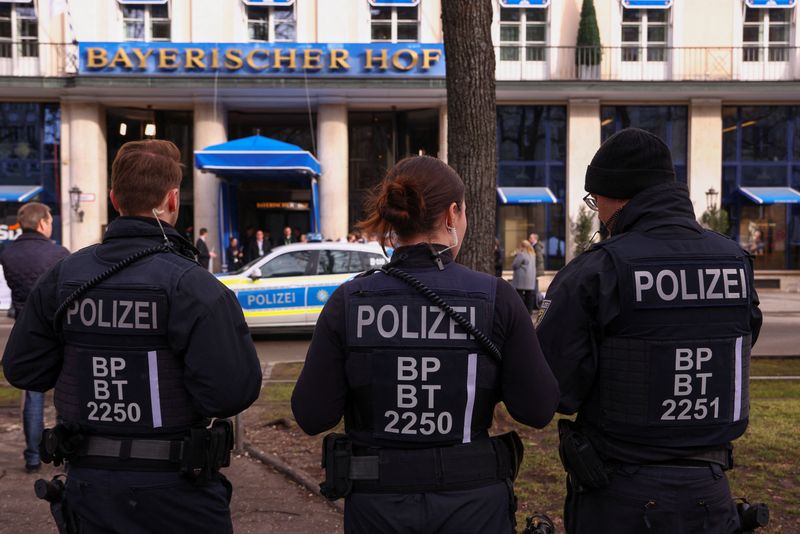
German Chancellor Friedrich Merz will address the conference on Friday afternoon, which is expected to be attended by some 70 heads of state and government and more than 140 ministers under tight security in Munich.
Key attendees include Chinese Foreign Minister Wang Yi, Ukrainian President Volodymyr Zelensky and French President Emmanuel Macron, who warned this week: “We have a China tsunami on trade and every moment instability on the U.S. side.”
(Reporting by Humela Pamuk, Sarah Marsh, Andrew Gray, Mark John, Ludwig Berg, Andreas Linke, Jacob Gronholt-Pederson; Writing by Sarah Marsh and Matthias Williams; Editing by James McKenzie and Toby Chopra)