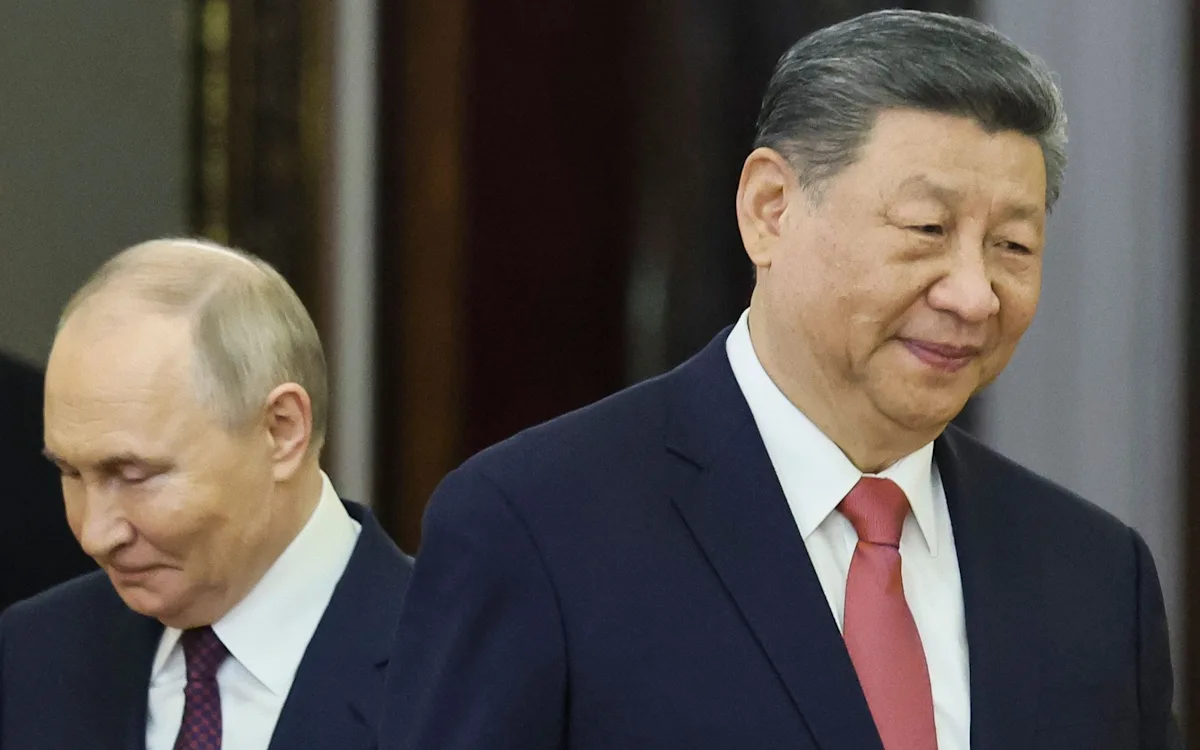
When Vladimir Putin visited Xi Jinping on a four-day visit in September, he called the Chinese president a “dear friend”.
The Russian president, speaking with Xi Jinping at a large orchid exhibition at the Great Hall of the People in Beijing, claimed that relations between the two countries have “reached an unprecedented high level”.
Of course, on the surface, China’s alliance with Russia appears to have only grown stronger since Putin’s 2022 invasion of Ukraine.
Nowhere is this more evident than in trade between the two countries, which has boomed since the West imposed massive sanctions on Putin.
Trade between Russia and China hit a record $245bn (£182bn) last year, driven by Mr Xi becoming Mr Putin’s biggest global buyer of oil and gas. Overall, China has also become Russia’s largest supplier of goods.
However, closer ties with China come at a cost.
In particular, Russian businesses are increasingly frustrated by the flood of cheap Chinese goods.
Vladimir Milov worked in the Russian government from 1997 to 2002 and later became an outspoken critic of Putin. He said the economic union was severely counterproductive for Russia.
“It’s very detrimental,” he said. “China is taking advantage of this because it knows Russia has nowhere to go.”
Such warnings could be a sign that economic ties between the two countries are beginning to strain.
While mutual trade hit a record high in 2024, it has fallen by nearly a tenth so far this year.
Lada sales plummet
One key area of tension is cars.
After Western manufacturers cut ties with Russia in 2022, Chinese rivals stepped in at the right time.
China’s car exports to Russia increased sevenfold in the two years to 2024, triggering growing complaints from domestic manufacturers.
Maxim Sokolov, chief executive of Russian carmaker AvtoVAZ, accused China of “unprecedented dumping” which he said in December had crossed “all imaginable boundaries”.
Sales of his company’s iconic Lada cars have plummeted, forcing the company to cut production by nearly half and move to a four-day work week in late September.

AvtoVAZ Sales of the iconic Lada car have fallen sharply, causing its production to be halved – Andrei Bok/SOPA Images/LightRocket via Getty Images
Kamaz, Russia’s largest truck maker, also shortened the work week in August after demand for its vehicles plunged 60%. At the time it blamed “excessive” imports.
To assuage some of the criticism, the Kremlin responded by significantly raising import fees for vehicles.
Since October 2024, Russia’s “recycling fees” for imported cars have more than doubled.
The fee is purported to cover the cost of future vehicle disposals but mainly functions as a tariff, which as of January this year stood at 667,000 rubles (£6,275) per vehicle.
This has resulted in China’s car exports to Russia being halved in the first six months of 2025.
Second’

Chinese cars were exported to Russia in 1912
‘
In July, Russian regulators also banned the import of trucks from major Chinese brands including Dongfeng, Foton, FAW and Sitrak, which they said posed a “direct threat” to public safety.
“These trade-related tensions will begin to grow as the market for Chinese goods becomes saturated and uncompetitive Russian industry is unable to sell,” said John Kennedy, director of research at the RAND Corporation.
Sanctions bite
There are signs that the Russian steel industry is also being affected.
Andrei Gatun, chief executive of the Chelyabinsk Forging and Stamping Plant, warned last year: “Russian companies competing with Chinese companies are gritting their teeth.”
China has not hesitated to fight back with trade restrictions of its own.
Most notably, Xi Jinping reimposed tariffs on Russian coal in January 2024, two years after the restrictions were first lifted.
This has already affected exports to China, with Milov claiming the tariffs are exacerbating the worst crisis in the Russian coal industry since the collapse of the Soviet Union.
Revenues in the industry are expected to decline by 12% this year alone.
Elsewhere, China has so far refused to lift a long-standing import ban on winter wheat and barley, Russia’s largest agricultural exports. Instead, it buys from Ukraine and Kazakhstan.
Milov said that China’s imports from Russia are very cheap because it is one of the only buyers in Russia and has a monopoly position.
Russia’s largest exports to China are oil and natural gas, which together account for two-thirds of its trade volume.
Rosneft CEO Igor Sechin said that between January 2022 and June 2024, compared with Middle East exports, China’s cost savings in purchasing Russian oil were as high as $18 billion.
“After sanctions are lifted, Russia is what Beijing wants every trading partner to see,” said Gregor Sebastian of Rhodium Consulting’s China corporate advisory team.
“China is importing raw materials for the finished goods it produces and then reselling them back to Russia at higher profit margins. This is a major part of the relationship between the two countries.”
Most importantly, however, Russia wants new technologies and investments from China. But it didn’t get it.
Joint project stalled
Milov said that China’s average annual investment flows into Russia have plummeted to US$400 million from an average of US$1.2 billion in 2011.
In 2022, China excluded Russia from its Belt and Road financing plan, and in July, China’s Ministry of Commerce “strongly recommended” that automakers not invest in Russia.
Many previously announced major projects backed by China have now been canceled or put on hold.
Russia quietly disappeared from a project that was supposed to develop a long-range aircraft jointly with COMAC.
Work has already begun on the project, initially called CR929, which stands for “Chinese Russia”. However, the R has now been abandoned and the aircraft was renamed C929.
Plans by CRRC Changchun Rail Coach Co. to build a high-speed train between Moscow and Kazan in southwestern Russia have also been suspended.
Separately, no progress has been made in the development of the Tianjin refinery, a joint venture approved by Rosneft and China National Petroleum Corporation (CNPC) in 2014.
After Putin and Xi Jinping met in September, Gazprom announced that the two countries had signed an agreement to build a “Power of Siberia 2” natural gas pipeline to China.
While this is undoubtedly a huge win for Russia, China has yet to confirm the project.
This may suggest that, despite the pomp, the two countries’ authoritarian alliance may be weaker than it appears.
“Despite these hugs and kisses at the summit, China and Russia are still far apart,” Milov said.
Try full access to The Telegraph for free now. Unlock their award-winning website and essential news app, plus helpful tools and expert guidance on your money, health and holidays.