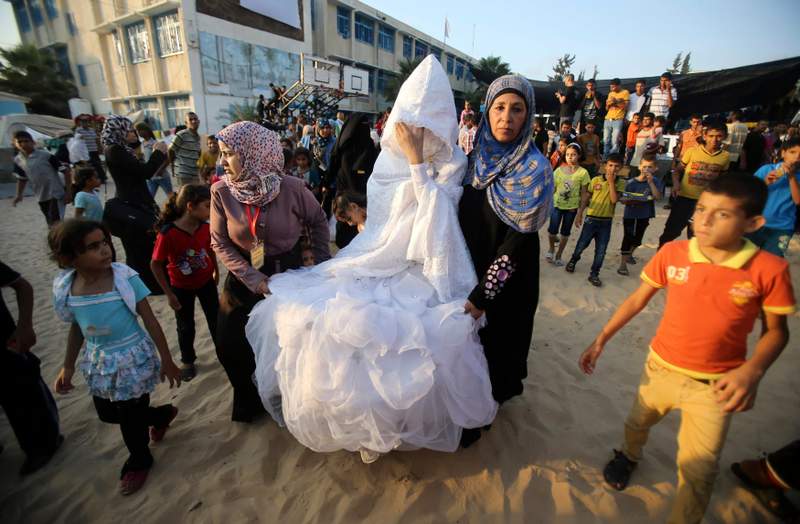
Possible reasons for the increasing number of child brides in the Palestinian territories are displacement, poverty and the breakdown of social, legal, health and protection systems.
According to a report released by the United Nations Population Fund (UNFPA) in early March, the number of child marriages has increased in Gaza, and Palestinian families have reportedly begun to view the marriage of their underage daughters as an economic lifeline.
The publication said the possible reasons for the growing number of child brides in the Palestinian territories are displacement, poverty and the breakdown of social, legal, health and protection systems caused by Hamas’ two-year war against Israel.
The report notes that while child marriage rates have declined steadily over the past decade, from 28% in 2009 to 17.9% in 2022, the war has offset much of that progress.
Although UNFPA found that nearly 10 percent of newly registered pregnancies in December 2025 were due to adolescents, confusion in Gaza’s health and legal systems creates obstacles to assessing current pregnancy rates.
The report released by the agency said that as child marriage increases, so does the incidence of coercion, gender-based violence and severe psychological distress among Gazan girls.

On February 1, 2025, Hamas terrorists gathered at a public event in Khan Younis, Gaza. (Photo credit: MOIZ SALHI/Middle East Pictures/AFP, Getty Images)
Increase in child marriages in Gaza linked to abuse
A January 2025 study by the United Nations Population Fund found that 71% of Gazan girls reported increased pressure to marry. During the short monitoring period alone, emergency courts issued more than 400 marriage licenses to girls aged 14 to 16 years.
“Some families see marriage as a survival strategy in situations of displacement, poverty and insecurity,” explains Seema Alami, an adolescent program officer at the United Nations Agency for Sexual and Reproductive Health.
The United Nations Population Fund stressed that official figures are likely to be underestimates because many unions involving minors are not officially recognized until the girl reaches the legal age of marriage or becomes pregnant, leaving young girls without the legal protection and rights that married women are entitled to.
UNFPA shares the story of Amal, a 14-year-old girl from Khan Younis who was forced to marry her cousin at the behest of her aunt. The United Nations Population Fund outlines the physical trauma associated with child marriage and the subsequent sexual abuse.
She suffered severe bleeding on her wedding night because she was forced to have sex at a young age, while others have shared stories of miscarriage and abuse.
“I told myself that maybe life would be better. Maybe someone would take care of me and I wouldn’t go to bed hungry. But my wedding night was very difficult,” Amal told UNFPA. “Now I’m thinking about becoming a mother, but I keep thinking about how to feed my baby and whether my body will survive pregnancy and delivery.”
“Some evidence suggests that 63 per cent of girls married early have experienced physical, psychological or sexual violence,” Alami said, adding that more than 100 suicides or suicide attempts among survivors of violence have been recorded.
Hiba was only 16 when she was married in Beit Hanoun, but she suffered multiple miscarriages. “I have always resisted the idea of marriage. I wanted to succeed in my beauty salon project and build my future,” she told the UN agency.
“But my dream life disappeared. Within six months I suffered multiple miscarriages. The war took away my home, my job and even my pregnancy,” she added.
Safa, 15, told the United Nations Population Fund that the war had left her displaced and in need of a home, and she agreed to get married. “No house, no celebration, just a tent. I feel older than I am, with responsibilities that are too heavy for me. After we lost everything, now I’m waiting for a baby in a damaged room,” she shared.
