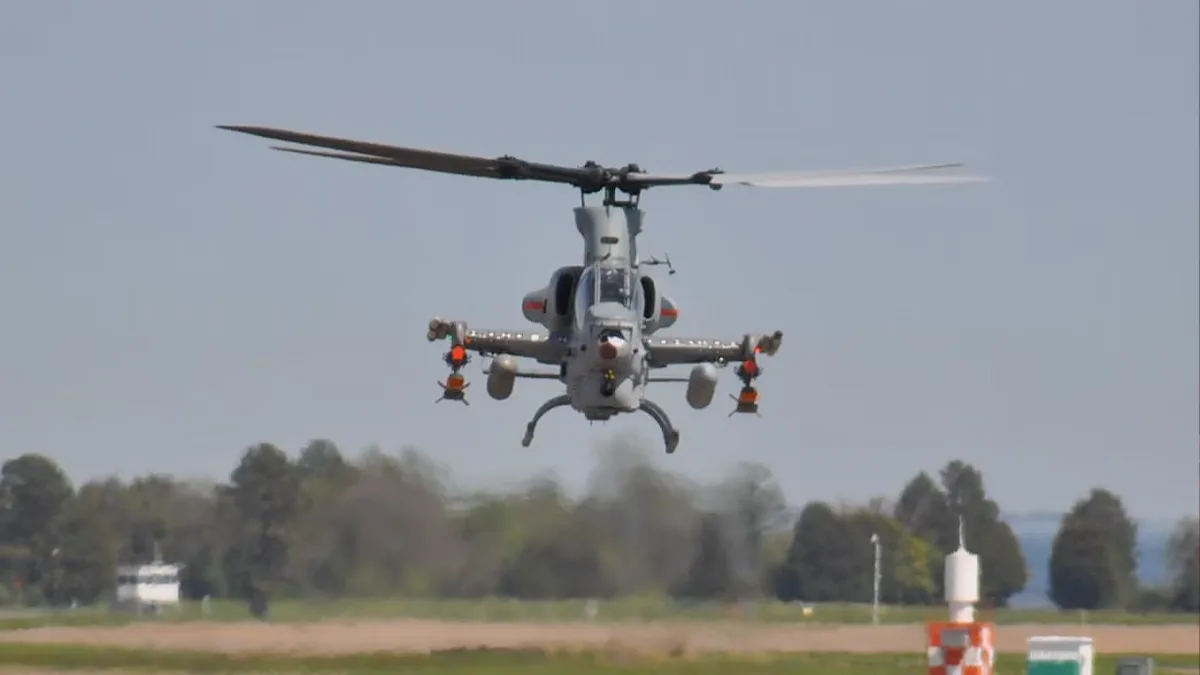
With the war in the Pacific in mind, the Marine Corps is steadily expanding its long-range weapons arsenal. On Jan. 30, the service selected L3Harris’ “launch effect,” called Red Wolf, which can be deployed from an AH-1Z Viper helicopter to hit targets up to 230 miles away.
In other words, Marine Corps attack helicopters can quickly reach objects (using missiles) 3,373 football fields away.
This allows Marines moving forward with Force Design 2030 to conduct over-the-horizon attacks from Vipers and other vertical takeoff platforms. With an estimated cost of $300,000 to $500,000 per piece, it also follows the Pentagon’s trend of seeking cheaper (relatively speaking) but still capable options to deal with serious drone threats, such as the Shahed-136, which evidence suggests costs less than $50,000.
Red wolf and launch effect
Red Wolf may look like many other air-launched cruise missiles, but it’s actually a type of missile called a “launch effect.” It’s a buzzword that covers small drones that do more than just explode on something.
In requirements to potential manufacturers, the Pentagon said it needs to be aircraft-agnostic so it can be used on other platforms; be network-enabled so it can receive targeting and mission updates while in flight; and have long range so it can hit farther targets. They also want to be able to hit land and sea objects, because when your wish list is that long, why not add one more, right?
The requirements also stipulate that they use the weapon’s open systems architecture to allow for different payloads of up to 25 pounds. This is where the priming effect comes into play. Kinetic payloads, such as high explosives, are just one of the missions these vehicles can perform. They are also capable of conducting electronic warfare, acting as decoys, intelligence, surveillance and reconnaissance (ISR), and acting as communications relay stations.

Red Wolf animation. Image from L3Harris.
Marines are preparing for combat in the Pacific, where they will be more dispersed and farther from safe havens than since World War II. China also has an arsenal of long-range weapons and a growing navy, meaning few places in the region are safe if a shooting occurs.
What we’re seeing with the Marine Littoral Regiment is that they have long-range weapons like the Marine Expeditionary Ship Interceptor System (NMESIS), and being able to hit targets from a distance without calling in the Navy or Air Force is a priority.
If your entire plan is built around having your troops deployed individually in distant locations, giving a helicopter the ability to hit targets at extreme ranges is a big boost (for a helicopter). Helicopters can stay closer to more exposed areas in the Indo-Pacific and continue flying through Forward Arming and Refueling Points (FARPs). This is more than just a fun line; it’s a critical capability that allows close air support and medical evacuation missions to reach the troops who need it most.

Red Wolf launched the effects vehicle. Image from L3Harris.
Similar ammunition
Long-range options are often limited due to the helicopter’s flight ceiling, lightness requirements and speed.
In tests, including launches from an AH-1Z Viper, the Red Wolf’s range exceeded 200 nautical miles (or 230 miles). The next weapon with the second longest range is the Spike NLOS. It’s a similar weapon the Army tests on the AH-64 Apache, which has a range of about 17 miles.
More common munitions, such as the AGM-179 JAGM-MR and AGM-114 Hellfire II, have ranges of about 10 miles and 5 miles respectively. At these ranges, even for Spike NLOS, you are within the red ring of death for many air defense systems, including some shoulder-fired MANPADS with ranges up to six miles.
change priorities
The Red Wolves selection is further evidence that big changes are no longer coming, but are now in full swing. The proliferation of small, cheap drones and other weapons means that eliminating these threats depends largely on expensive but surprisingly capable missiles.
During the Red Sea battle from October 19, 2023, to January 19, 2025, the navy launched nearly 400 munitions to protect itself and commercial shipping from Houthi drones and missiles. These include 120 SM-2 missiles, priced at $2.5 million each, 80 SM-6 missiles, priced at $4.3 million each, and a total of 20 Evolved Sea Sparrow Missiles (ESSM) and SM-3 missiles, priced at $1.8 million and $28.7 million each, respectively.
To help alleviate magazine depth and cost issues, the Pentagon is focusing more on weapons like the Red Wolf, which can be used to perform the same missions as high-precision interceptors but don’t cost as much.
In fact, this “do the same thing but pay less” approach has spread to other weapons, such as the Hellfire II, which was modified to counter UAS in the Red Sea and was even spotted on the Ukrainian V2X Tempest off-road vehicle, which the Marine Corps is now purchasing.
On our YouTube channel we explore this in more depth and why it’s not as easy as it sounds. Check it out here.