Author: Parisa Hafezi and Maayan Lubell
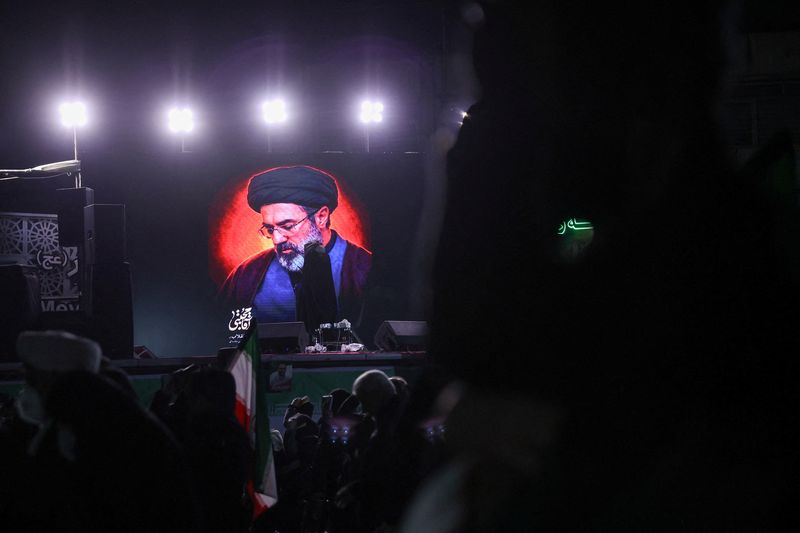
DUBAI/JERUSALEM (Reuters) – Iran appointed Mojtaba Khamenei as supreme leader on Monday to succeed his father Ali Khamenei, signaling that hardliners still have a firm grip on power, a week after the U.S.-Israeli war with Iran sent oil prices soaring and Asian stocks tumbling.
As the war enters its tenth day, new missile and drone attacks from Israel and Iran are reverberating across the Middle East.
Pope Leo warned on Sunday that a “tremendous tragedy” would occur due to the “pervasive atmosphere of hatred and fear” in Iran and the entire region.
Leo said during the Angelus prayer in St. Peter’s Square: “Let us pray sincerely to God that the roar of bombs may cease, that weapons may be silenced, that spaces for dialogue may be opened and that people’s voices may be heard.”
The Israeli military said on Monday it had begun a wave of attacks in central Iran and hit infrastructure belonging to Hezbollah militants in Beirut.
Police sources said Iran and its proxies also appeared to be launching attacks across the region, with rockets and drones targeting U.S. diplomatic facilities near Baghdad International Airport but being intercepted by the C-RAM defense system. Security sources said drones struck a U.S. military base near Erbil airport in Iraqi Kurdistan, while Saudi authorities reported intercepting a drone east of its northern Jawf region.
Thick smoke rose in the direction of Bahrain’s BAPCO refinery after the government said Iranian drone strikes in the area caused casualties and property damage, Reuters witnesses said.
Tehran rebels
Mojtaba, a cleric with influence within Iran’s security forces and a vast business network led by his father, is seen by the Assembly of Experts as the front-runner ahead of Sunday’s vote. The Assembly of Experts, composed of 88 clerics, is responsible for choosing Ali Khamenei’s successor.
“The Assembly of Experts has adopted a decisive vote to appoint Ayatollah Seyyed Mojtaba Hosseini Khamenei as the third leader of the Holy System of the Islamic Republic of Iran,” the Assembly of Experts said in a statement issued after midnight Tehran time.
This position gives Mojtaba the final say on all state affairs in the Islamic Republic.
Mojtaba’s appointment is likely to draw the ire of U.S. President Donald Trump, who said on Sunday that Washington should have a say in the selection. “If he doesn’t get our approval, he’s not going to last long,” he told ABC News.
Ahead of the announcement, Israel threatened to target anyone chosen.
After appointing a new top leader, Trump declined to respond in an interview with The Times of Israel, saying only “we’ll see what happens,” the newspaper reported. Trump also said in the interview that ending the war would be a “mutual” decision with Israeli Prime Minister Benjamin Netanyahu.
Mojtaba’s father, Supreme Leader Ali Khamenei, was killed in the first attack on Iran more than a week ago.
The U.S. military reported that a seventh American has died from injuries sustained in Iran’s first counterattack a week ago, a day after Trump presided over the repatriation of the remains of six more victims.
Two soldiers were killed in southern Lebanon, the Israeli military said on Sunday, the first fatalities among its ranks since hostilities between Israel and Hezbollah resumed last week as Israel stepped up airstrikes in the country.
The military did not immediately provide further details about the circumstances of the incident.
Earlier on Sunday, Israel attacked an apartment in a Ramada hotel complex in central Beirut, killing at least four people in a strike it said targeted Iranian commanders operating in the Lebanese capital.
According to Iran’s ambassador to the United Nations, U.S. and Israeli attacks have killed at least 1,332 Iranian civilians and injured thousands more.
Oil price exceeds $100 per barrel
U.S. crude oil futures rose more than 20% in early trading on Monday, hitting their highest level since July 2022, as major Middle East oil producers cut supply due to the inability to safely ship cargoes to global refineries through the Strait of Hormuz.
Traffic in the strait has been largely shut down after Iran attacked at least five ships and a limited number of transiting tankers, severing a key artery that accounts for about 20% of global oil and liquefied natural gas supplies.
Brent crude oil prices rose 17% to $108.73 a barrel, having soared 28% last week.
The war has forced oil and gas exporters from Qatar to Iraq to halt production, and Kuwait announced production cuts over the weekend. Analysts predict that the United Arab Emirates and Saudi Arabia will soon cut production as oil storage runs out.
According to the British “Financial Times” report, the finance ministers of the Group of Seven countries will discuss on Monday the issue of jointly releasing emergency oil reserves under the coordination of the International Energy Agency.
The Financial Times added that so far three G7 countries, including the United States, have expressed support for the idea.
Japan’s government has instructed its national oil reserves to prepare for a possible release of crude oil, a senior member of Japan’s Diet said on Sunday. About 95% of Japan’s crude oil depends on the Middle East, about 70% of which is transported through the Strait of Hormuz.
Soaring oil prices put pressure on Asian stock markets, with Japan’s Nikkei falling 5.8% and import-reliant South Korea falling 6.5%.
(Reporting by Reuters; Writing by Michael Perry; Editing by Lincoln Feast.)